
Discover how to find niche markets with our actionable guide. We share data-driven strategies for identifying, validating, and dominating your perfect niche.

Tired of trying to be everything to everyone? The secret to breaking through the noise isn't shouting louder; it's finding a small, passionate group of people and becoming their go-to solution. Forget chasing massive, saturated markets. The real opportunity lies in identifying underserved audiences with very specific problems.
This guide is your roadmap. We’ll show you practical, data-backed ways to find these hidden gems and build a business that resonates. When you find a group with a shared passion or a nagging pain point that big companies are ignoring, something magical happens. You get higher engagement, face way less competition, and can build a fiercely loyal community.
Why Going Niche is Your Ultimate Superpower
Let's get one thing straight: in today's world, "small" is the new "big." The most successful ventures aren't the ones trying to appeal to the masses. They're the ones that find a dedicated tribe and serve them exceptionally well. We're going to move past the old, tired advice of just looking for "less competition" and dive into what modern buyers actually want: specialized products, unique experiences, and a real sense of belonging.
Huge, generic markets are constantly splintering into thousands of micro-communities, each with its own language, inside jokes, and unique needs. This is where you come in.

Small Ponds, Big Fish
Consumers are exhausted by generic, one-size-fits-all products. They are actively seeking out brands that "get" them, and they'll pay a premium for it.
This shift creates an incredible opening for anyone willing to listen and serve a specific audience. When you focus on a niche, you can:
Create Real Connections: You're not just a faceless brand. You can speak your audience’s language and become a trusted voice in their world.
Charge What You're Worth: When you solve a very specific and urgent problem, people are willing to pay more. Generic solutions can't compete.
Stop Wasting Marketing Dollars: Instead of trying to reach everyone, you can pinpoint your exact customer. Your marketing becomes laser-focused and far more effective.
Focusing on a narrow segment doesn't limit your potential—it concentrates your power. A niche strategy lets you become a big fish in a small pond, quickly building authority and a brand that people truly connect with. If you're curious about how companies gather this kind of laser-focused information, our guide on what is market intelligence is a great place to start.
Where to Hunt for Untapped Niche Ideas
Forget scrolling through those generic "top 10 niche markets" lists. The truly exciting, profitable ideas aren't found on a blog post—they're hidden in plain sight, buzzing inside passionate online communities. This is your playbook for finding them.
The goal here is to train your brain to spot the problems people are desperate to solve. When you can pinpoint a recurring frustration or a shared "I wish someone would just make a..." moment, you're on the verge of striking gold.
1. Dive into Niche Subreddits
Reddit is a goldmine for unfiltered, raw consumer insights. It’s thousands of tiny, hyper-focused communities (subreddits) dedicated to every hobby, profession, or interest you can imagine. This is where people go to complain, ask for advice, and geek out about their passions.
Your job is to become a fly on the wall. Look for patterns in the conversations.
Are folks in a woodworking subreddit constantly griping about a specific type of clamp?
Are users in a vegan skincare group lamenting that no one makes an affordable, cruelty-free retinol that actually works?
These repeated pain points are giant, flashing signs pointing to a market gap.
This screenshot from the r/specializedtools subreddit is a perfect example. You see people sharing incredibly unique tools, often for super-specific jobs.
By just watching these conversations, you can get a direct line into the tools and solutions that pros and hobbyists are dreaming of.
2. Monitor Specialized Online Forums and Groups
Don't stop at Reddit. There are countless independent forums and Facebook Groups that serve hyper-specific communities. Think about groups dedicated to classic car restoration, urban gardening, or even fans of a niche board game.
Jump into a few groups that align with your own interests and just start listening. Your ears should perk up when you see phrases like:
"Does anyone know how to..."
"I'm looking for a tool that can..."
"My biggest frustration with X is..."
Every one of these is a potential breadcrumb leading you straight to a killer niche idea. For instance, a post in a drone photography group about how hard it is to find a durable, weatherproof backpack for a specific drone model could easily spark an idea for a new e-commerce brand. For more details, check out this resource on how to find profitable niches.
3. Analyze Product Hunt and Kickstarter for What's Next
Platforms like Product Hunt (for software) and Kickstarter (for physical products) are incredible for spotting emerging trends. But here’s the pro move: don't just look at the runaway successes. Dig into the comments and discussions on projects that didn't get funded. Sometimes, the core idea was brilliant, but the execution was off—an open door for you to do it better.
Look for projects with passionate, vocal communities buzzing around them. What features are backers begging for? This feedback is pure market research, handed to you on a silver platter.
4. Scrape B2B Job Boards for Service Gaps
This is a clever one, especially for finding service-based or B2B software niches. Start analyzing job postings. Companies practically scream their biggest operational pain points when they're trying to hire someone.
If you suddenly see a huge spike in job postings for "Salesforce integration specialists" or "HubSpot automation experts," that's a massive signal of strong, growing demand. This could be your chance to launch a niche consulting agency, create an in-demand online course, or build a software tool that makes those tasks a breeze. There are fantastic market research tools for startups that can even help automate this data collection.
Using Data to Find the Gold
An idea is just an idea until the data backs it up. This is the crucial step where you sift through your brainstorms and separate the potential goldmines from the passion projects. Let's walk through how to systematically vet every idea against the metrics that truly matter: audience demand, competition, and its potential to actually make money.
The whole process is pretty straightforward. You start by observing communities, which helps you pinpoint real problems, and from those problems, you generate validated ideas.
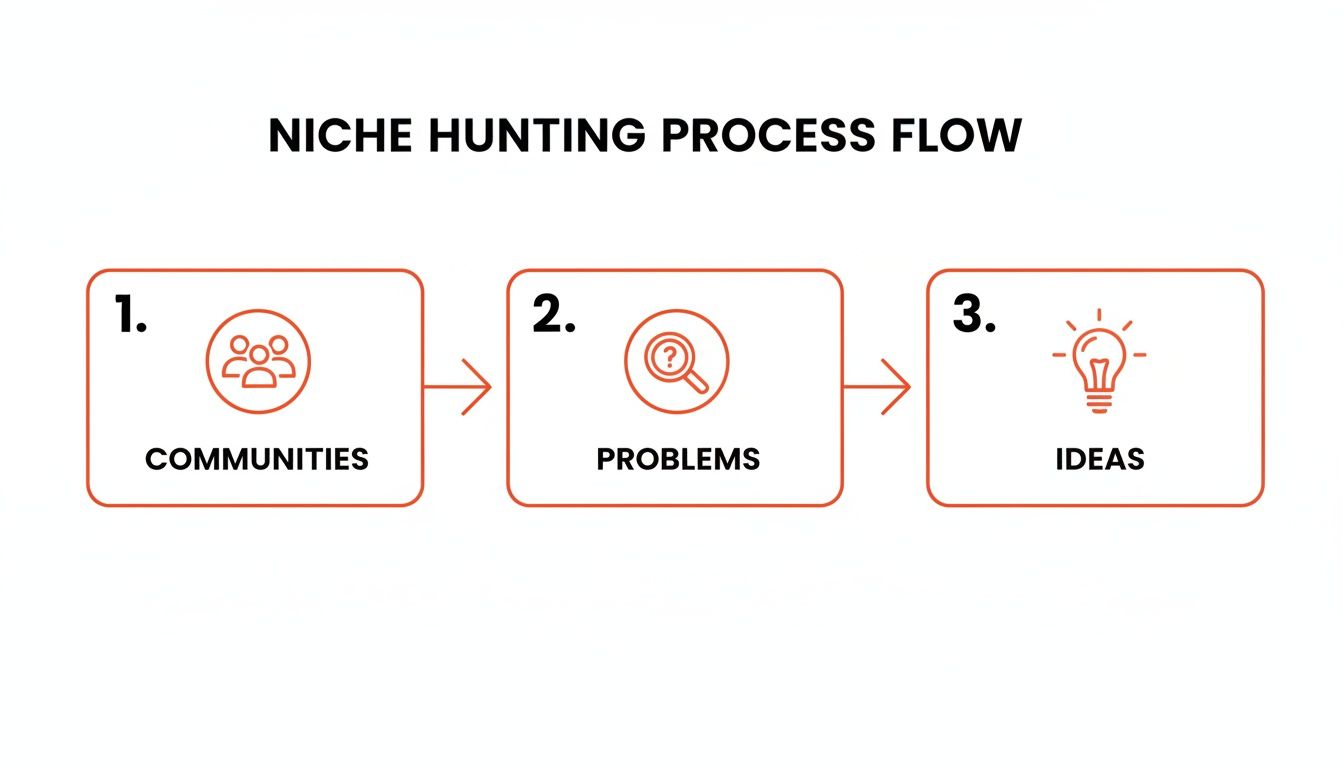
The big takeaway here? The best ideas aren't dreamed up in a vacuum; they come from listening to actual people talk about what's frustrating them.
Gauging Demand with Search and Social Data
First up: are people actually looking for solutions in your potential niche? If no one's searching for it, you're facing a tough, uphill battle trying to create demand from scratch.
Start by digging into keyword research tools. You're hunting for keywords with healthy search volume that aren't completely dominated by huge brands. Get specific and think about long-tail keywords—those longer, more detailed phrases that show someone is much closer to buying. For instance, instead of a broad term like "knives," a much stronger signal is something like "high-carbon steel chef knife for beginners."
A niche with 1,000 monthly searches for a specific, high-intent keyword can be far more valuable than a generic term with 100,000 searches. It's all about finding a hungry, targeted audience, not just a big one.
Analyzing the Competitive Landscape
Alright, you've confirmed people are out there. Now it's time to size up the competition. Don't be scared off by a few competitors—it’s actually a good sign! It proves people are already spending money in this space. Your goal isn't to find an empty field, but to find one where you can carve out your own territory.
Here's a step-by-step approach:
Identify Top Players: Are they massive corporations or small, independent creators? It’s a lot easier to go up against the little guys.
Find Their Weaknesses: Dive into their customer reviews. What are people constantly complaining about? These complaints are basically a roadmap for how you can do it better.
Analyze Their Marketing: Check out their website, social media, and content. Can you bring a fresher, more authentic voice to the table?
A much faster way to do this is by scraping data from marketplaces and directories. For example, you could use an AI-powered tool to quickly pull data from Amazon search results. By gathering intel on the number of sellers, average review scores, and pricing, you can see in an instant just how saturated the market is.
The same logic applies to B2B. Analyzing software directories like G2 or Capterra can reveal huge opportunities. For a deeper look at this process, check out our guide on how to do market research for small business.
Identifying Monetization Potential
Last but not least, can you actually make money here? It all comes down to "commercial intent." Are the people in this niche just browsing for free information, or are they actively looking to open their wallets?
Look for signs of commercial activity. Are there affiliate blogs, sponsored posts, or e-commerce stores already making money from this audience? The existence of these proves a market for paid solutions is already there.
Here's a simple framework to score and compare ideas once you've gathered the data. It keeps things objective and helps you focus on the biggest opportunities.
Niche Opportunity Scoring Matrix
Niche Idea | Audience Signal (Search/Forum Volume) | Competition Level (Number of Incumbents) | Monetization Potential (High/Medium/Low) | Overall Score |
|---|---|---|---|---|
e.g., Sustainable Pet Toys | 15k/mo | 5 major, 20 small | High | e.g., 8/10 |
e.g., AI Tools for Solo Lawyers | 5k/mo | 2 major, 5 small | High | e.g., 9/10 |
e.g., Keto Meal Prep Delivery | 50k/mo | 10 major, 100+ small | Medium | e.g., 6/10 |
By putting your ideas through this data-driven wringer, you’re building a shield against wasted time and money. Systematically analyzing demand, competition, and commercial potential is how you filter your list down to the true winners worth pursuing.
Don't Build a Thing Until You've Done This
Alright, you've waded through the data, sized up the competition, and now you’re sitting on a niche idea that feels like a potential goldmine. The urge to just start building is immense, but pump the brakes. The pros know that validation is the most crucial, and most overlooked, step. This is where you find out if people will actually pay for your idea before you sink your life savings into it.
This stage is all about running small, cheap experiments to answer one single question: will they buy it? Before you spend a dollar on development or inventory, you absolutely have to validate a business idea to prove there's real demand.
Your First Litmus Test: The Simple Landing Page
Your most powerful weapon in this phase is a dead-simple, one-page website. The goal here isn't to make a sale—not yet. It's to sell the concept and see who bites. Think of it as your minimum viable test to check if your message hits home with your ideal customer.
Keep this page brutally simple and focused on one single action. No fluff. Just these core components:
A Killer Headline: Nail the problem you solve and for whom. Something like, "The Last Backpack Drone Photographers Will Ever Need."
A Punchy Value Prop: A few bullet points explaining the benefits. How are you making their life better, easier, or more awesome?
A Great Visual: You don't need the final product. A mockup, a slick render, or even a well-chosen stock photo will do the trick.
One Clear Call to Action (CTA): This is everything. Ask them to sign up to "Be the first to know when we launch" or "Get the exclusive early-bird discount."
Every single email signup you get is a vote of confidence. It’s a real person raising their hand and saying, "Yes, you've found a problem I have, and I want you to solve it."
Pour a Little Gas on the Fire with Micro-Ads
Got your landing page live? Great. Now it’s time to send some traffic its way. You don’t need a massive budget; a small, laser-focused ad campaign on a platform like Facebook, Instagram, or even a niche subreddit is perfect. Seriously, $50 to $100 is often all it takes to see if you have a winner.
The magic is in the targeting. Use all those audience insights you gathered earlier. If your niche is "eco-friendly toys for anxious dogs," you can target people who follow sustainable brands and pages about dog anxiety.
Keep an eye on these numbers:
Click-Through Rate (CTR): Are people even stopping to click your ad? This tells you if your hook is working.
Cost Per Click (CPC): How much does each visit to your landing page cost?
Landing Page Conversion Rate: This is the big one. What percentage of visitors actually signs up?
For a pre-launch page, anything around a 5% conversion rate (or higher!) is a fantastic sign that you’re onto something real.
Validation isn't about asking your friends if they think it's a good idea. It's about creating a scenario where total strangers prove their interest with a small action, like giving you their email.
The Ultimate Tell: The Smoke Test
Ready to play for keeps? The "smoke test" is the final boss of pre-product validation. It involves setting up what looks like a real pre-order page for a product that doesn’t actually exist yet. It feels a little gutsy, but it’s the purest way to measure true buying intent.
Design your page to look like a legitimate product page. Add pricing, spell out the features, and include a big, beautiful "Pre-Order Now" button.
When a user clicks that button, instead of a checkout, they land on a page that says something like, "We're not quite ready for primetime! Enter your email to be the first in line when we launch and snag a 20% discount."
This test cuts through all the noise. You’re directly measuring how many people were willing to pull out their credit cards. It tells you your niche market isn't just interested—it's ready to spend money.
Connecting With The Modern Niche Consumer
Let's get one thing straight: a niche isn't just a product category. It's a culture. Finding your audience is the starting line, but the real victory lap comes when you connect with them on a level that most brands can't—or won't—bother to reach.
Modern consumers, especially the passionate folks who make up niche communities, are sharp. They can spot a phony a mile away. They're not just buying a thing; they're buying into an identity, a shared set of values, and a story they want to be a part of.

Speak Their Language—For Real
If you want to truly own a niche, you have to become a part of the club, not just some outsider trying to sell stuff to it. This means you need to dive headfirst into their world and learn to speak the local dialect.
Start by hanging out where they do. Lurk in their favorite subreddits or Discord servers. What's the slang? What are the inside jokes and memes that keep popping up? When you get this, your marketing stops feeling like an ad and starts feeling like a conversation with someone who gets it.
Figure Out What Makes Them Tick
Once you've got the lingo down, it's time to go deeper. You need to understand the core motivations that hold this community together. Today’s niche enthusiasts are incredibly vocal about what they want: authenticity, sustainability, and hyper-personalization. These aren't just fluffy buzzwords; they're the non-negotiable values that dictate where they spend their money.
We're seeing a massive swing toward products people can make their own, both in how they work and how they look. There's also a huge, measurable demand for sustainable goods and a growing backlash against soulless, AI-generated content. People crave the human touch. For more on this, check out these insights on how niche markets achieve dominance on accio.com.
Here's how you can start today:
Become an Influencer Detective: What content are the big names in your niche creating? Pay attention to the posts that blow up with comments and shares.
Mine Customer Reviews for Gold: Go read the reviews for your competitors' products. Ignore the star ratings and look for the emotional language.
Get in the Trenches: Don't just observe from afar—participate! Jump into conversations, ask smart questions, and offer advice without a sales pitch.
When you focus on forging these genuine connections, you stop being just another product on the shelf. You become the only choice for a fiercely dedicated audience.
Got Questions About Niche Markets? Let's Get Them Answered.
Alright, so you’ve been doing the work. You’ve brainstormed and dug into the data, but maybe there are a few lingering questions making you hesitate. Let’s tackle the most common sticking points so you can push forward with clarity and confidence.
"Is This Niche Too Small to Actually Make Money?"
This is the big one. The fear of pouring your heart into a market so tiny it can't support a real business is very real. But profitability is driven by spending power and problem urgency, not just the sheer number of people.
A small, fired-up audience with a burning problem is worth its weight in gold. It's infinitely better than a massive, lukewarm crowd. The trick is spotting the difference between a "small" niche and a "non-commercial" one.
Look for these commercial signals:
People Are Already Buying Something: Do solutions already exist? Are people complaining about them but still paying for them? This is a massive green flag.
They Spend Money on Related Passions: Let's say your niche is "customizable hiking gear for dog owners." Are these people already dropping serious cash on high-end dog food, vet bills, and outdoor equipment? This shows they have disposable income dedicated to this passion.
You're Solving a High-Value Problem: Does your idea save people time, help them make more money, or dramatically level up a hobby they love? High-stakes problems command high-value prices.
A business with 1,000 true fans who will buy everything you launch is a dream. A market of one million people who ignore your solution is just a vanity metric.
"Am I Chasing a Passing Fad or a Sustainable Niche?"
Jumping on a hot trend feels exhilarating, but it can be a brutally fast path to a dead-end business. A trend is a flash in the pan—think fidget spinners. A sustainable niche is built on a foundation of long-term interest, a core part of someone's identity, or a problem that isn't going away.
To see the difference, you have to dig into the why behind the interest. For example, collaboration software for remote teams is a niche born from a permanent change in how we work. Products for zero-waste living tap into a durable lifestyle choice and a core belief system. Both are built to last.
A fantastic, practical way to check this is to look at Google Trends data over the last five years. A sustainable niche will show either stable, consistent interest or a gradual, steady climb. A trend will look like a rocket launch followed by a crash landing.
"Can I Really Use AI to Find Niches?"
Absolutely. In fact, you'd be crazy not to. AI tools are phenomenal research assistants that can put your discovery process on hyperdrive. They aren’t magic crystal balls that will spit out a perfect business idea.
Think of AI as your own personal, tireless data intern. It excels at two main things: lightning-fast data collection and spotting patterns a human might miss.
An AI-powered tool, for instance, can scrape and perfectly structure conversations from hundreds of forums or thousands of product reviews in minutes. That’s a job that would take you weeks to do manually. From there, you can ask the AI to summarize the most common pain points and analyze customer sentiment.
But the final strategic call is all you. The human intuition and gut feeling for the emotional context behind the data? That's your job. Let AI do the heavy lifting of data analysis. That frees you up to focus on what truly matters: deeply understanding your future customers and building the one thing they've been waiting for.
Summary
Finding a profitable niche market isn't about luck; it's a process of listening, validating, and connecting. Start by observing passionate communities on Reddit and forums to identify unsolved problems. Use data to analyze demand and competition before validating your best ideas with simple landing pages and micro-ad campaigns. By becoming a true member of the community and speaking their language, you can build a loyal audience and a thriving business.
Try this workflow today. Explore our prebuilt templates and start for free today.
