
how to do market research for small business: Learn practical methods, tools, and steps to uncover customer needs and outpace competitors.
Doing market research for your small business can sound complex, but it's really not. The whole process boils down to five simple steps: define your goal, pick your methods, gather data, analyze your findings, and build an action plan. This isn't about guesswork; it's about shifting from thinking you know what customers want to knowing what they need. That knowledge is your secret weapon.
Why Smart Market Research Is Your Best Move
Jumping into market research is one of the best things you can do for your business. This guide cuts through the jargon to show you how modern tools can put powerful insights right at your fingertips. And no, you don't need a massive budget. We're focusing on practical, high-impact strategies you can start using today.
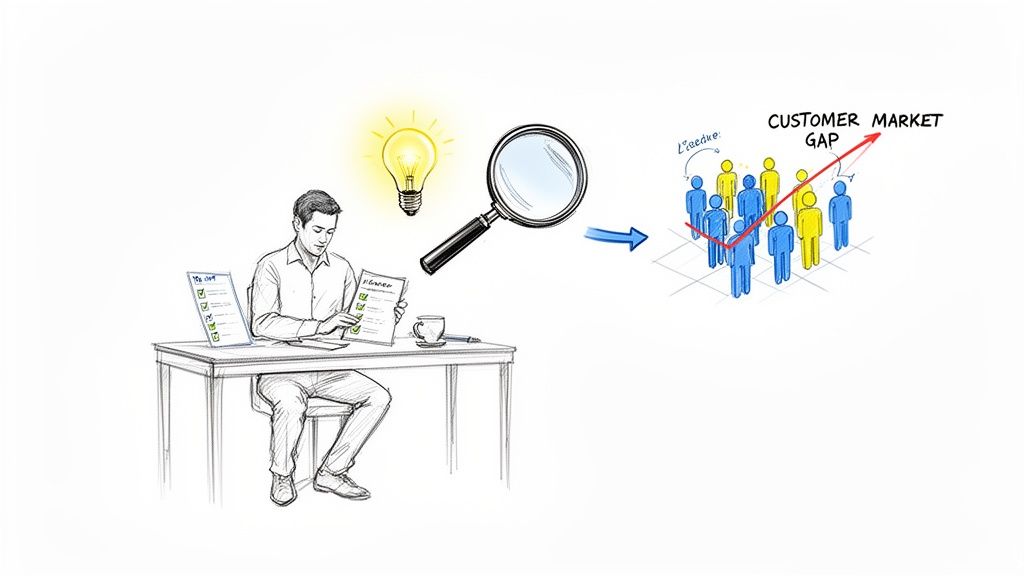
Market Research Is a Game-Changer
Making decisions based on data isn't a nice-to-have anymore—it's essential for survival. With 73% of small businesses now operating online, the competition is fierce.
This digital rush has created a fascinating problem: a whopping 62% of consumers say they have trouble choosing between similar small business products. That's not a threat; it's a huge opportunity for anyone smart enough to identify and fill a specific market gap.
Good research gives you a clear roadmap. It helps you:
Understand your customers and what they really want.
Find profitable gaps in the market before competitors do.
Create a growth plan built on hard evidence, not a gut feeling.
Nail your messaging so it hits home every single time.
Turn Raw Data Into Your Competitive Edge
My goal is to show you exactly how to do market research for a small business without the usual complexity. We'll cover the essentials—from setting sharp objectives and choosing the right methods to turning messy data into a crystal-clear action plan.
You'll get the hang of different research approaches and, more importantly, how to mix them for the biggest impact. If you want to see how this fits into the bigger picture, check out our guide on what is market intelligence.
The point of market research isn’t just to collect charts. It’s about finding the story hidden inside the data. It's about uncovering the 'why' behind what people do, so you can build a business they can't live without.
Ultimately, your success hinges on listening to the market and acting on what it tells you. To make sure your efforts pay off, it’s vital to learn how to conduct market research without a huge budget. This guide will give you the tools and confidence to do just that.
Modern Market Research Methods for Small Businesses
To get started, you need to choose the right tools for the job. Here’s a quick breakdown of the most common methods, tailored for small teams who need to be scrappy and smart.
Research Method | Best For | Typical Cost | Key Advantage |
|---|---|---|---|
Surveys | Getting quantitative data from a large audience quickly. | Low (Free to $$) | Scalable and great for validating ideas with numbers. |
Interviews | Deeply understanding customer motivations, pains, and 'why.' | Low to Medium | Uncovers rich, qualitative insights you can't get from a survey. |
Focus Groups | Gauging group dynamics and initial reactions to new concepts. | Medium to High | Generates dynamic discussions and reveals shared opinions. |
Secondary Research | Finding industry trends, competitor data, and market size. | Low (Often Free) | Fast and cost-effective; builds a strong foundation. |
Web Scraping | Collecting pricing, reviews, and feature data from competitors. | Low to Medium | Provides real-time, structured data from public sources. |
Each of these methods has its place. The real magic happens when you combine them—using secondary research to form a hypothesis, then validating it with a survey and digging deeper with a few customer interviews.
Step 1: Nail Down Your Research Goals
Let's be honest: you can't hit a target you can't see. Before you do anything else, you need to know exactly what you're trying to figure out. Without a clear mission, you'll just end up with a mountain of interesting-but-useless information.
Think of your research goals as the destination you plug into your GPS. They keep you on track and make sure every bit of effort pushes you toward an insight that can actually grow your business.
Focus on One or Two Killer Questions
It’s easy to get ambitious and try to solve every business mystery at once. Don't fall into that trap. It's the fastest way to get overwhelmed and achieve nothing.
Instead, zero in on one or two core questions that will make the biggest difference to your business right now.
Maybe you're wrestling with one of these:
Got a new idea? "Is there a real market for a subscription box for dog toys in Austin, Texas?"
Seeing sales dip? "Why did our Etsy sales for handmade candles suddenly drop by 15% last quarter?"
Thinking about expanding? "Could our graphic design services for local restaurants work for B2B tech companies, too?"
Trying to improve a product? "What are the top three features our current users are begging for in our project management app?"
When you pick a single, powerful question, your research becomes a targeted mission. You're not just collecting data; you're hunting for a specific answer that will tell you what to do next.
Make Your Goals SMART
Want to make sure your research goals are rock-solid? The SMART framework is a classic for a reason—it turns fuzzy ideas into a concrete plan.
Specific: Get super clear. Instead of "learn about customers," try "identify the top three pain points for freelance copywriters managing client feedback."
Measurable: How will you know you've succeeded? Instead of "talk to potential customers," aim to "get feedback from at least 50 potential customers via our survey."
Achievable: Be realistic. Do you have the time, money, and tools to actually get this done?
Relevant: Does this question really matter to your business goals? The answer should point you toward a clear decision.
Time-bound: Give yourself a deadline. "We’ll finish our initial customer interviews in the next three weeks."
This isn't just busywork. It forces you to think through the entire project before you start.
The real goal isn’t just to learn something cool. It's to find an insight so powerful that your next move becomes completely obvious. Great objectives draw a straight line from a tough question to a profitable action.
Define Your Research Scope
Now that you have your core question, it's time to draw the map. Who, exactly, are you studying? What part of the world—or the internet—are you focusing on?
This is all about setting boundaries. Are you looking at your local city, a specific online forum, a niche on Instagram, or an entire industry?
For instance, if your goal is to figure out the demand for vegan baked goods, your scope is probably hyper-local. You’d look at demographics, other bakeries, and eating habits within a five-mile radius of your storefront. This keeps you from getting lost in national trends that don't apply to you and focuses your energy where it counts.
Step 2: Choose Your Research Methods and Tools
You’ve got your goals locked in. Now for the fun part: picking the right strategies to get the answers you need. Think of yourself as a detective assembling a toolkit. Each tool has a specific job, and the magic happens when you combine them.
For a small business, the smartest approach is almost always a mix of talking directly to people (primary research) and digging into information that’s already out there (secondary research). This combo gives you fresh insights from the source while painting a broad picture of the market. It's all about being resourceful.
Start by Listening to Your Audience
Primary research is your direct line to your audience. This is where you gather brand-new data, straight from potential or current customers. It's a goldmine for uncovering the feelings, motivations, and frustrations that raw numbers can't show you.
The most powerful methods are often the simplest:
Customer Surveys: These are fantastic for getting quick, measurable answers from a decent-sized group. Tools like Google Forms make it incredibly easy to ask about preferences, satisfaction, and buying habits without spending a dime. Just keep them short and mobile-friendly to get the best response rates.
One-on-One Interviews: This is where the real "aha!" moments happen. A single 30-minute chat with a potential customer can reveal more than a 100-response survey ever could. You get to dig deep into the "why" behind their answers and hear their problems in their own words.
Social Media Polls: A simple poll on Instagram or LinkedIn can give you instant feedback on an idea. It’s a low-effort way to test messaging, gauge interest in a new feature, or see which product design people prefer.
The key here is to go in with genuine curiosity. You’re not there to sell; you’re there to listen and learn.
The most powerful insights often come from the questions you didn't even know you should be asking. Let your customers talk, and they'll tell you exactly what problems they need you to solve.
Uncover Hidden Gems with Secondary Research
Secondary research is your secret weapon for speed and scale. It's all about analyzing data that someone else has already collected. This is how you understand broader industry trends, size up your competition, and find solid data to inform your primary research.
This is where you can punch way above your weight. The problem today isn't a lack of information; it’s drowning in it. This is precisely where automation becomes a game-changer. An AI-powered browser agent can do the heavy lifting for you, systematically pulling public data from any website without you needing to write a single line of code.
Let’s say you want to understand the competitive landscape for handmade leather bags on Etsy. Instead of manually clicking through hundreds of listings, you could tell an agent to automatically collect:
Pricing data from the top 50 sellers.
Product features and materials listed in their descriptions.
Customer reviews and star ratings for each item.
Shipping times and costs.
This isn’t just about saving time—it’s about getting clean, structured data you can actually analyze. You could quickly map out average prices, identify the most-praised features, and spot gaps in the market, like a lack of personalized options.
This level of detail is critical. After all, market saturation is a top challenge for 53% of small business owners, and a whopping 62% of consumers find it hard to tell similar products apart. In this environment, knowing your competitors inside and out isn't optional. You can dig into more stats about how small businesses are adapting at Paychex.com.
Your Go-To Tool Stack
Putting together the right set of tools doesn't have to be complicated or expensive. Here’s a practical stack that can cover all your bases.
Market Research Tool Stack for Small Businesses
Tool Category | Example Tools | Primary Use Case |
|---|---|---|
Surveys & Forms | Google Forms, SurveyMonkey, Typeform | Creating and distributing questionnaires to gather quantitative feedback from a large audience quickly. |
User Interviews | Conducting and scheduling deep-dive qualitative interviews to understand customer motivations and pain points. | |
Web Data Collection | Automating the collection of public data from websites for competitor analysis, pricing intelligence, and trend spotting. | |
Analytics & Trends | Identifying search trends, popular keywords, and the questions your target audience is asking online. | |
Data Analysis | Organizing, cleaning, and analyzing the raw data you've collected to find patterns and insights. |
This stack provides a solid foundation. Automating your secondary research frees you up to focus on the human side of things—like having insightful one-on-one interviews. To see more options, check out our guide on the top market research tools for startups.
By combining smart automation with genuine customer conversations, you create a powerful research strategy that drives real results.
Step 3: Collect and Organize Your Data
This is where the magic happens. We've laid the groundwork, and now it's time to go out and gather the raw intel that will shape your business. With a solid system, it's totally manageable.
For your primary research—the direct conversations and surveys—the focus is on quality. For your secondary research—the deep dive on competitors—the secret weapon is automation. Let's break down how to nail both.
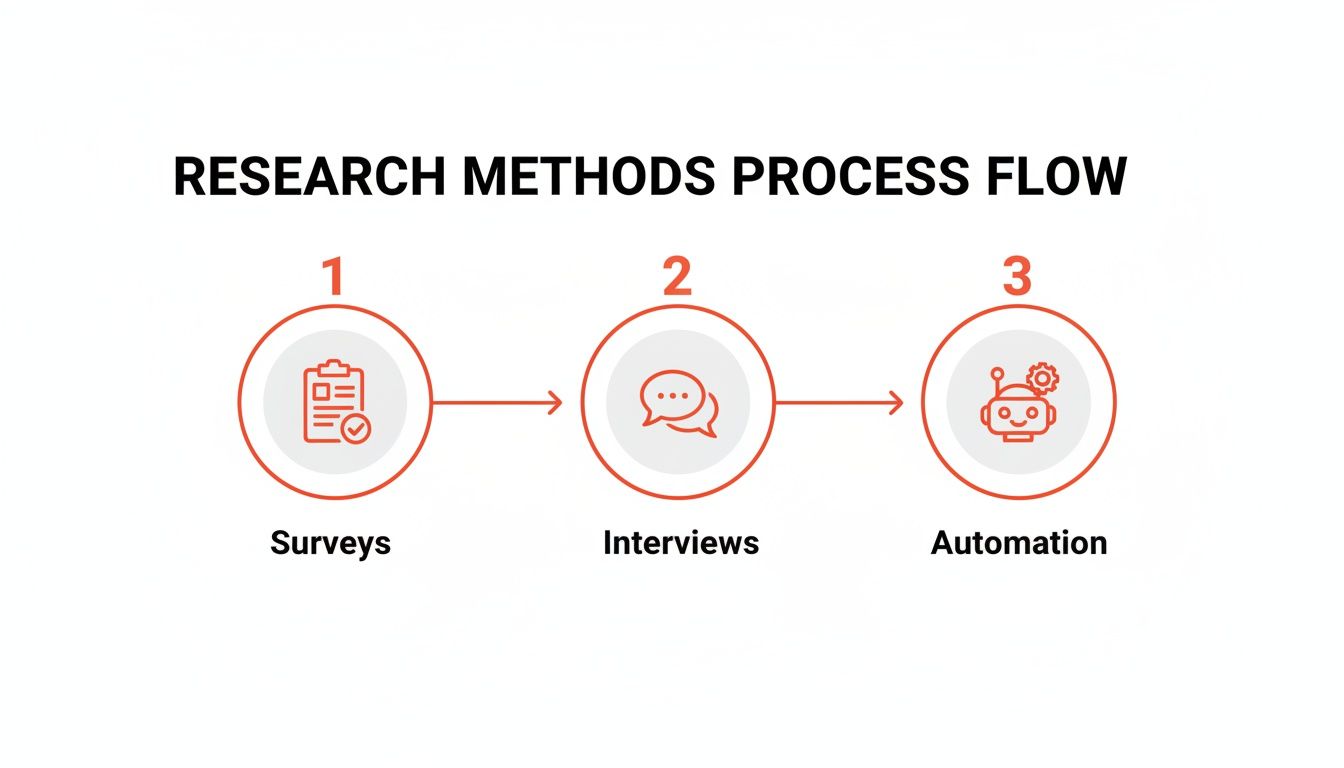
You’re building a complete view by combining broad survey data, deep interview insights, and large-scale automated data collection. It’s a powerful combination.
Nail Your Primary Data Collection
When you’re talking directly to your audience, every interaction is gold. Whether it's a quick survey or a long chat, how you ask is just as important as what you ask.
For a professional approach, check out this guide on data collection methodology.
Here are a few tips to get you started:
Keep Surveys Short & Sweet: Nobody enjoys a 50-question survey. Be ruthless and focus only on your most critical questions. You'll get more responses and show you respect people's time.
Ask Open-Ended Questions in Interviews: Don’t box people in with yes/no questions. Use prompts like, "Walk me through what happened when..." or "How did you feel about that?" This encourages them to tell you a story, and the best insights are always in the stories.
Record and Transcribe Everything: Your memory is not as good as you think. Always ask for permission to record interviews. This frees you up to be present in the conversation, and transcription services make it easy to analyze the text later.
Following these practices ensures the information you collect is rich, reliable, and genuinely useful.
Put Your Secondary Research on Autopilot
Now for the fun part: automation. Manually digging through competitor websites for pricing, product specs, or customer reviews is an absolute time-sink. An AI-powered browser agent can do it all for you, systematically pulling thousands of data points and dropping them into a perfectly organized spreadsheet while you sleep.
Pro Tip: Automation isn't just about saving hours. It’s about getting access to a scale of data that's humanly impossible to gather. This is how you spot the tiny trends and hidden opportunities that your competitors completely miss.
Setting up an automation workflow is shockingly easy. With a tool like Clura, you literally just show the agent what you want—like product names, prices, and review scores on a webpage—and it'll go and do the same thing across thousands of pages. No coding required.
The final step is to give your data a quick clean. Raw data is always a bit messy. Take a moment to standardize everything, like making sure all prices are in the same currency or getting rid of blank rows. This little bit of housekeeping ensures your analysis is built on a solid foundation.
Step 4: Turn Your Research into Insights
Alright, you've put in the work and now you're staring at a pile of spreadsheets, transcripts, and notes.
Let's be clear: raw data is just noise. The magic happens when you connect the dots and find the story hidden inside. This is where you transform information into game-changing intelligence for your business. Your goal isn't just to report numbers—it's to dig in and find the "why" behind them so you can build a concrete plan for growth.
Let's break down a few simple techniques that work wonders.
Start with a SWOT Analysis
Before getting lost in spreadsheets, step back and look at the big picture. A SWOT analysis (Strengths, Weaknesses, Opportunities, Threats) is a simple framework that helps you organize your thoughts based on what your research told you.
It's all about looking at your business from four critical angles:
Strengths (Internal): What are you knocking out of the park? Maybe your interviews revealed that customers rave about your personalized support.
Weaknesses (Internal): Where are the cracks? Your survey data might have flagged a clunky checkout process that’s causing people to abandon their carts.
Opportunities (External): What market gaps did you uncover? Perhaps your competitor analysis showed that nobody in your niche offers eco-friendly packaging.
Threats (External): What's on the horizon? Scraped pricing data might reveal a new, low-cost competitor who is quickly gaining market share.
This exercise gives you an instant, high-level snapshot. It helps you see where you stand and immediately points you toward the most important areas to focus on.
Benchmark with a Competitive Matrix
One of the most powerful outcomes of your research is a clear picture of the competitive landscape. A competitive matrix is a simple chart that lets you visually stack yourself up against rivals on the things that actually matter to your customers.
First, list your top 3-5 competitors in columns. Then, down the side in rows, list the key features or attributes you gathered data on.
Example Competitive Matrix for a Local Coffee Shop
Feature/Attribute | Your Coffee Shop | Competitor A (Big Chain) | Competitor B (Local Rival) |
|---|---|---|---|
Price (Latte) | $4.50 | $5.25 | $4.25 |
Ambiance | Cozy, Community Feel | Fast-Paced, Modern | Artsy, Quiet |
Customer Service | Highly Personalized | Efficient, Standardized | Friendly but Slow |
Online Reviews | 4.8/5 | 3.9/5 | 4.6/5 |
Unique Offering | In-house Roasted Beans | Mobile Order & Pay | Vegan Pastry Selection |
When you see it all laid out like this, it becomes incredibly obvious where you're winning and where you have work to do. You might instantly realize that your personalized service is a massive advantage you should be shouting about in your marketing. For a ready-made structure, grab a free competitor analysis template.
Identify Customer Segments and Sentiment
Great research goes beyond what people buy. It tells you who is buying and how they feel about it. This is your chance to use all that survey data and those scraped customer reviews to find powerful patterns.
Start by looking for natural groupings, or customer segments. Do you notice a cluster of budget-conscious shoppers who pounce on every sale? Or a smaller group of power users begging for more advanced features? Identifying these segments lets you tailor your message directly to the people who care most.
Next, dive into the sentiment. When you scrape hundreds of reviews, you can quickly get a feel for the language people are using.
Don't just look at the star ratings! The real gold is in the recurring keywords. Are customers constantly mentioning "fast shipping" in glowing reviews? Or does "confusing instructions" keep popping up in the negative ones? This is how you find out what truly drives satisfaction—or frustration.
By analyzing both segments and sentiment, you can finally answer those million-dollar questions:
Which customer group is our most profitable?
What are the top three complaints from our least satisfied customers?
What specific words do our biggest fans use when they recommend us?
This is how you go from guessing what customers want to knowing what to build, fix, or promote next.
Step 5: Create Your Winning Action Plan
This is the moment we've been working towards! You’ve done the heavy lifting and are now sitting on a goldmine of insights. But an insight without action is just expensive trivia. It's time to turn what you've learned into a plan that actually grows your business.
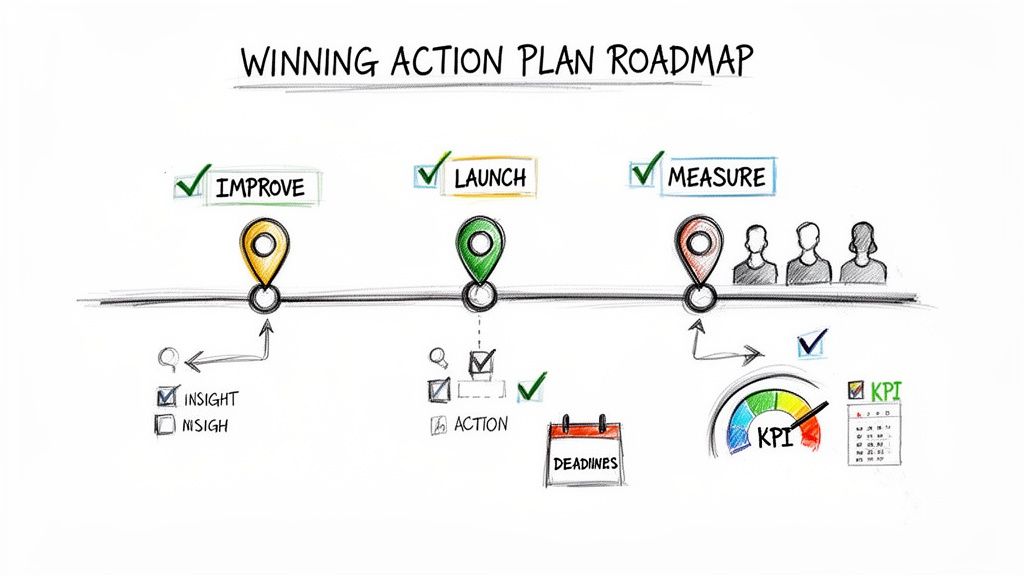
We’re not talking about a dusty, 50-page strategy document. We’re building a living roadmap that connects every piece of research directly to real-world results. This is how you make your market research pay off.
From Insight to Initiative
The magic happens when you draw a straight line from a research discovery to a specific business initiative. Every action in your plan should be a direct answer to something you uncovered.
Let's say your competitor analysis showed your biggest rival gets five-star reviews for their "super-fast shipping," while your customer feedback is full of comments about delays. Boom. That’s your insight.
The initiative isn't a vague goal like "improve shipping." It's a concrete, actionable project. Here’s how you break it down:
The Insight: Our competitor's 2-day shipping is a major selling point. Our average delivery is 5-7 days, and customers are noticing.
The Goal: Slash our average shipping time to 3 days or less by the end of this quarter.
The Actions:
Get quotes from three new fulfillment partners.
Renegotiate rates with our current carrier.
Update all product pages with our new, faster shipping times.
Who Owns It: Sarah is on point for fulfillment quotes. Mike will tackle the carrier negotiation.
How We’ll Measure Success: Track average delivery time and monitor customer reviews, aiming for a 20% increase in positive shipping comments.
See the difference? We went from a problem to a plan. Everything is clear, measurable, and has someone's name next to it.
A Simple Framework for Your Action Plan
Don't get bogged down in complicated project management software. A simple spreadsheet is all it takes to get started. The key is to keep it clear, visible, and part of your team's regular conversation.
The best action plan is a living document, not a forgotten file. It should be the first thing your team looks at every week to track progress and stay aligned.
Here's a simple structure you can use:
Key Insight: What’s the big "aha!" moment from your research?
Business Goal: How does this support a larger company objective, like increasing customer retention?
Specific Initiative: What's the name of the project? (e.g., "Project Onboarding Overhaul.")
Action Steps: List the nitty-gritty tasks that need to get done.
Owner: Who is driving each task forward?
Timeline: When is this due?
Success Metric (KPI): How will you know you won? (e.g., "Reduce customer churn by 10% in Q3.")
When you break it down like this, big goals feel less intimidating and progress feels inevitable. This is how you close the loop on market research and start building a smarter, more customer-obsessed business.
Your Market Research FAQs
Still have a few questions? Let's tackle some of the most common ones we hear from founders.
What's a Realistic Market Research Budget for a Small Business?
You don't have a corporate-level budget, and that's completely fine. A smart rule of thumb is to set aside 1-2% of your projected annual revenue. But if you're just starting out, focus on sweat equity instead of cash.
Get scrappy with these low-cost methods:
DIY Surveys: Tools like Google Forms are completely free and powerful.
Customer Interviews: Your biggest investment here is your time, and the insights are pure gold.
Automated Web Scraping: Many tools offer a solid free plan. You can pull a mountain of competitor data while you sleep.
It's all about being resourceful. A clever plan on a shoestring budget beats an expensive, bloated one every single time.
How Often Should I Be Doing This?
Think of market research less like a one-off project and more like a continuous conversation. The market doesn't stand still, and neither should you.
It's like a regular health check-up for your business. You don't see a doctor once and call it good, right? You go periodically to catch small issues before they become big problems.
Here’s a rhythm that works for most small businesses:
The Deep Dive: Plan a major research project once a year, or before any big move like launching a new product.
The Quick Pulse Check: Every quarter, take a snapshot of what's happening. How has competitor pricing changed? What's the sentiment from your customers?
Always-On Listening: Make this a daily habit. Monitor social media chatter, online reviews, and customer emails.
What's the #1 Mistake Small Businesses Make With Research?
Easy. They don't do it.
The most common trap is thinking your gut instinct is enough. Passion is essential, but assumptions are risky. Data is your safety net.
Another huge pitfall is asking leading questions. We all have a tendency to phrase questions in a way that confirms what we already believe. Fight that urge! Go into your research with an open mind, ready to be surprised—or even proven wrong. That's where the real growth happens.
Ready to put your competitor and market analysis on autopilot? Clura is designed to pull clean, structured data from any website with a single click—no code, no fuss. Give it a try for free and see the magic for yourself.
