Discover the top 12 market research tools for startups. Compare features, pricing, and workflows for competitor analysis, customer discovery, and more.
For any startup, market research isn't just a box to check—it’s the foundation of your growth strategy. It’s how you uncover who your customers are, what they need, and how competitors are trying to win them over. But without a massive budget, finding the right data can feel overwhelming. How do you get the insights you need to validate your idea and scale with confidence?
The answer is a smart, agile, and affordable tech stack. Guesswork leads to wasted time and money, two things no startup can afford to lose. This guide cuts through the clutter to bring you a practical list of the best market research tools for startups.
Inside, you'll find a breakdown of 12 essential platforms, from competitor analysis and customer feedback to data enrichment. For comprehensive data collection, startups can delve into dedicated market research survey software designed to streamline the process. Our goal is to help you stop guessing and start making data-driven decisions that move your business forward. Let’s find the right tools for you.
1. Clura
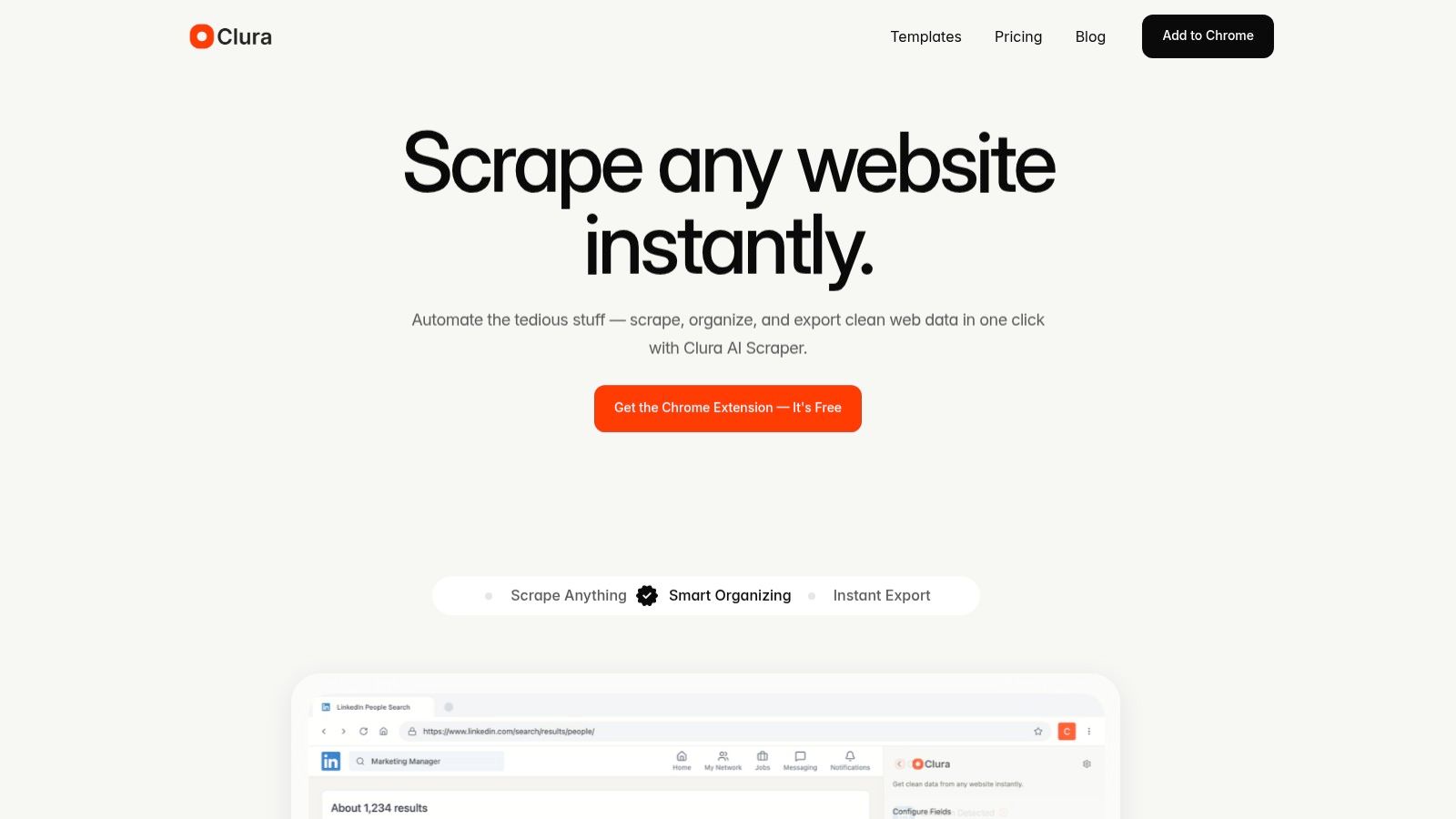
Clura is a no-code AI scraping assistant that works from your browser as a simple Chrome extension. It transforms the manual process of collecting web data into an automated, one-click workflow. For startups needing to gather market intelligence quickly without a data team, Clura is an efficient and versatile solution. It streamlines competitor analysis, lead generation, and price monitoring, making it one of the most practical market research tools for startups.
The platform uses pre-built templates and AI agents to instantly recognize and extract structured data from popular websites like LinkedIn, X (formerly Twitter), Crunchbase, app stores, and e-commerce sites. You can pull clean, organized datasets without writing a single line of code.
Why It’s a Top Choice for Startups
What makes Clura a game-changer is its focus on immediate, actionable output. Instead of wrestling with complex configurations, you launch an agent, and Clura scrapes, organizes, and exports the data into a clean CSV file. Its strength lies in automating repetitive tasks. You can schedule agents to run on a recurring basis—perfect for tracking competitor prices, monitoring brand mentions, or building fresh lead lists automatically.
The user experience is clean and intuitive, earning it high praise for its reliability and speed. The promise to "get 6 hours back every week" resonates with lean startup teams where every minute counts.
Best For: Sales, marketing, and e-commerce startups needing fast data for lead generation, competitive intelligence, and pricing analysis without technical overhead.
Key Strength: Its AI-powered, no-code browser extension makes sophisticated data scraping accessible to anyone, delivering immediate results.
Pricing: Starts with a generous free plan (300 rows/month). Paid plans begin around $15/month for 1,000 rows.
Website: https://www.clura.ai
2. SurveyMonkey (Momentive)
SurveyMonkey is a top choice for creating accessible surveys, making it a go-to platform for startups needing quick, quantifiable customer feedback. Its intuitive, template-driven approach means you can go from an idea to a live survey in minutes. This makes it one of the most efficient market research tools for startups validating a product or testing new messaging.
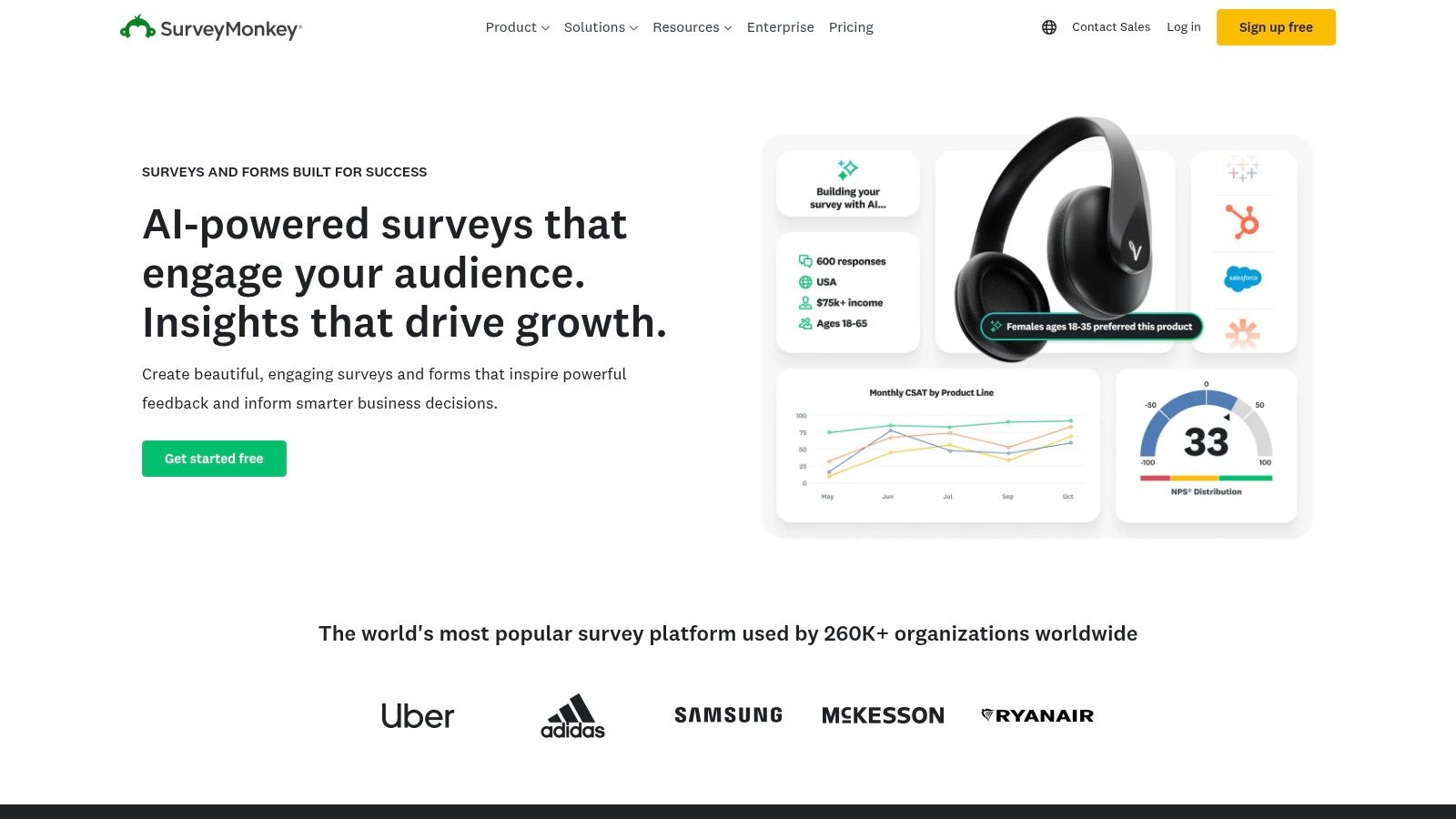
What sets SurveyMonkey apart is its scalability. A solo founder can use the free plan for basic validation, while a growing team can upgrade to access powerful features like team collaboration, advanced logic, and integrations with tools like HubSpot and Slack. For startups needing to reach beyond their existing audience, the SurveyMonkey Audience panel provides direct access to millions of respondents for targeted research. To make the most of this powerful platform, explore resources on proven SurveyMonkey surveys that can help drive better results.
Key Details & Pricing
Feature | Details |
|---|---|
Best For | Startups needing fast, scalable surveys for product validation, customer feedback, and concept testing. |
Strengths | Ease of Use: Unbeatable for quick setup with a massive template library. Scalability: Plans grow with you, from free individual use to robust team plans. Integrations: Over 200 integrations connect survey data to your existing stack. |
Weaknesses | Cost for Advanced Features: In-depth analysis and panel access can get expensive. Plan Limitations: Response limits and data export options are restricted on lower-tier plans. |
Pricing | Starts with a free plan. Paid plans like Team Advantage begin at $25/user/month (billed annually). |
Website |
3. Qualtrics
For startups needing to conduct rigorous, academic-level research, Qualtrics is a heavyweight champion. It's an enterprise-grade experience management platform that helps you design sophisticated surveys with advanced logic, branching, and a wide array of question types. This makes it an exceptional tool for complex market research, such as pricing sensitivity studies and detailed customer segmentation.
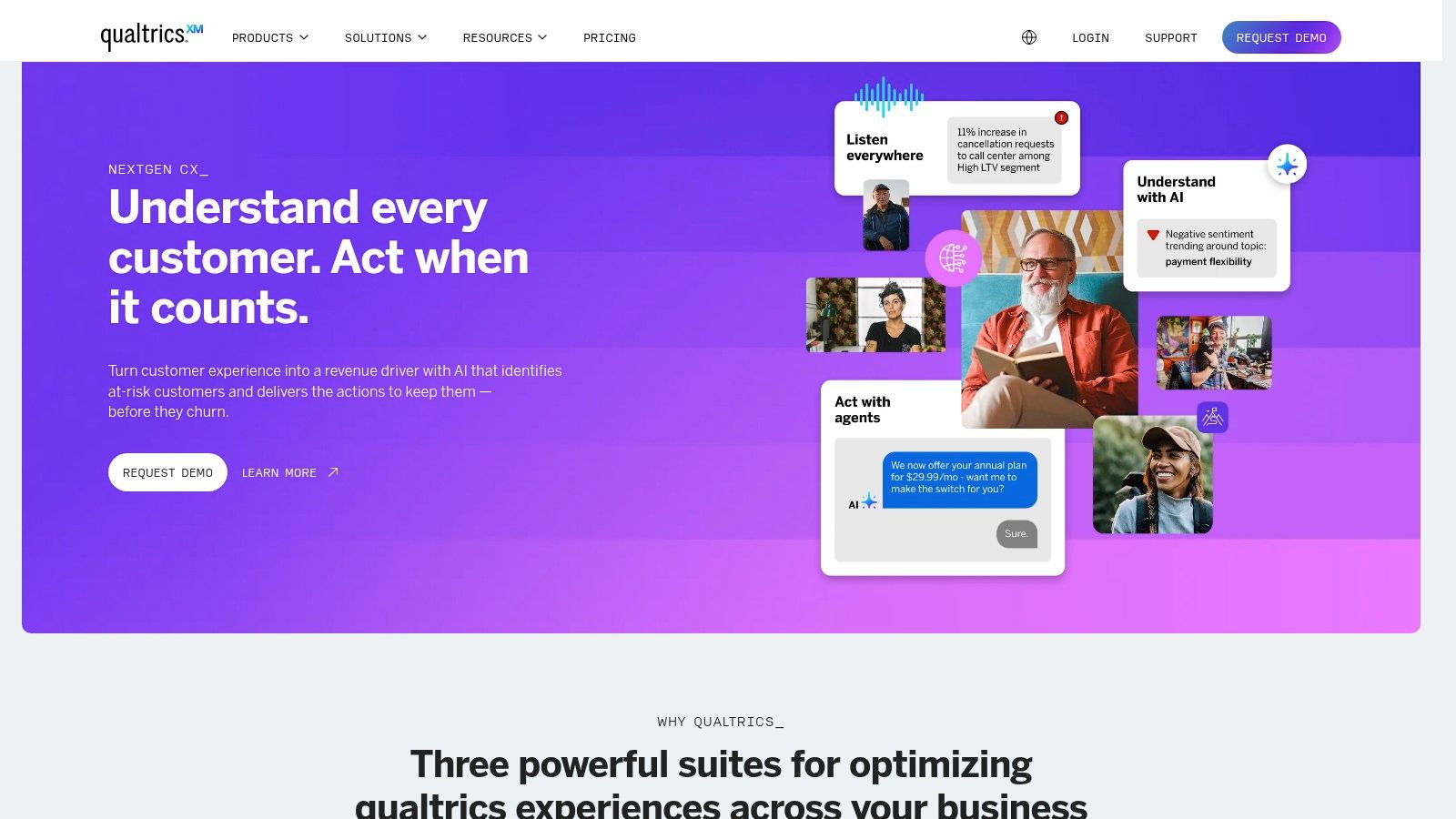
Qualtrics handles the entire research lifecycle, from survey design and distribution to statistical analysis and reporting, all in one platform. While it might seem intimidating, its extensive knowledge base provides fantastic support for getting up to speed. For startups with a dedicated research function, Qualtrics offers a level of depth that simpler tools can't match, making it one of the most powerful market research tools for startups committed to data-driven decisions.
Key Details & Pricing
Feature | Details |
|---|---|
Best For | Data-driven startups conducting complex research like pricing studies, segmentation, and concept testing. |
Strengths | Advanced Methodologies: Unparalleled support for complex survey logic. Robust Analysis: Built-in statistical analysis and reporting. Scalability: Enterprise-ready for growing teams. |
Weaknesses | Cost: Custom enterprise pricing can be prohibitive for bootstrapped startups. Complexity: Steeper learning curve compared to simpler survey tools. Free Plan Limits: The free account is quite restricted. |
Pricing | A free account is available with limitations. CoreXM platform pricing is available by quote. |
Website |
4. Semrush
Semrush is an all-in-one digital marketing suite that doubles as a powerful competitive intelligence tool. For startups, it unlocks a comprehensive view of the online landscape, allowing you to benchmark against competitors, identify promising keywords, and size up digital demand in your target market. It transforms complex SEO and paid search data into actionable insights.
What makes Semrush essential is its ability to reveal your rivals' digital strategies. You can see which keywords drive their traffic, where their backlinks come from, and how their market share is trending. This data is invaluable for finding gaps in the market before you invest heavily in marketing. For a deeper dive, you can explore more resources on the best competitor analysis tools to fully leverage platforms like this one.
Key Details & Pricing
Feature | Details |
|---|---|
Best For | Startups conducting competitor analysis, sizing up online market demand, and defining their initial SEO and content strategy. |
Strengths | Comprehensive Data: Offers a 360-degree view of competitor activity across SEO, PPC, and content marketing. Strong Reporting: Excellent export and visualization tools. |
Weaknesses | Steep Learning Curve: The sheer volume of features can be overwhelming for beginners. High Cost: Advanced modules and additional users can quickly become expensive. |
Pricing | Pro plan starts at $129.95/month. Guru plan at $249.95/month adds historical data. |
Website |
5. Similarweb
Similarweb is a powerhouse for digital market intelligence, giving startups a high-level view of any website's traffic, audience demographics, and acquisition channels. It's one of the essential market research tools for startups looking to benchmark performance or analyze competitor strategies. For founders, it's like having a periscope to see what's working for others in their space.
The platform's strength lies in its ability to provide quick, actionable data. You can instantly see where a competitor's traffic comes from, which keywords they rank for, and which social channels drive the most engagement. This helps startups identify new growth opportunities and avoid costly marketing mistakes. You can even automate data collection from the platform; learn how to build a Similarweb site metrics scraper to keep your competitive analysis fresh.
Key Details & Pricing
Feature | Details |
|---|---|
Best For | Startups focused on competitive benchmarking, identifying traffic sources, and understanding market share dynamics. |
Strengths | Competitive Insights: Unparalleled data on competitor website traffic and marketing channels. Market Sizing: Provides excellent proxies for estimating your addressable market. Freemium Access: Free tools offer significant value. |
Weaknesses | Costly Advanced Data: Full access to its most powerful features is expensive. Data as an Estimate: Traffic figures are modeled estimations, not direct analytics. |
Pricing | Offers free tools and limited data access. Paid plans for advanced intelligence are available upon request. |
Website |
6. Statista
Statista is a powerhouse for secondary market research, offering a massive library of statistics, reports, and industry outlooks. For startups, this platform is the ultimate shortcut to understanding market size, identifying trends, and finding baseline figures for a business case or investor pitch. Instead of spending days searching for credible data, you can find presentation-ready charts in minutes.
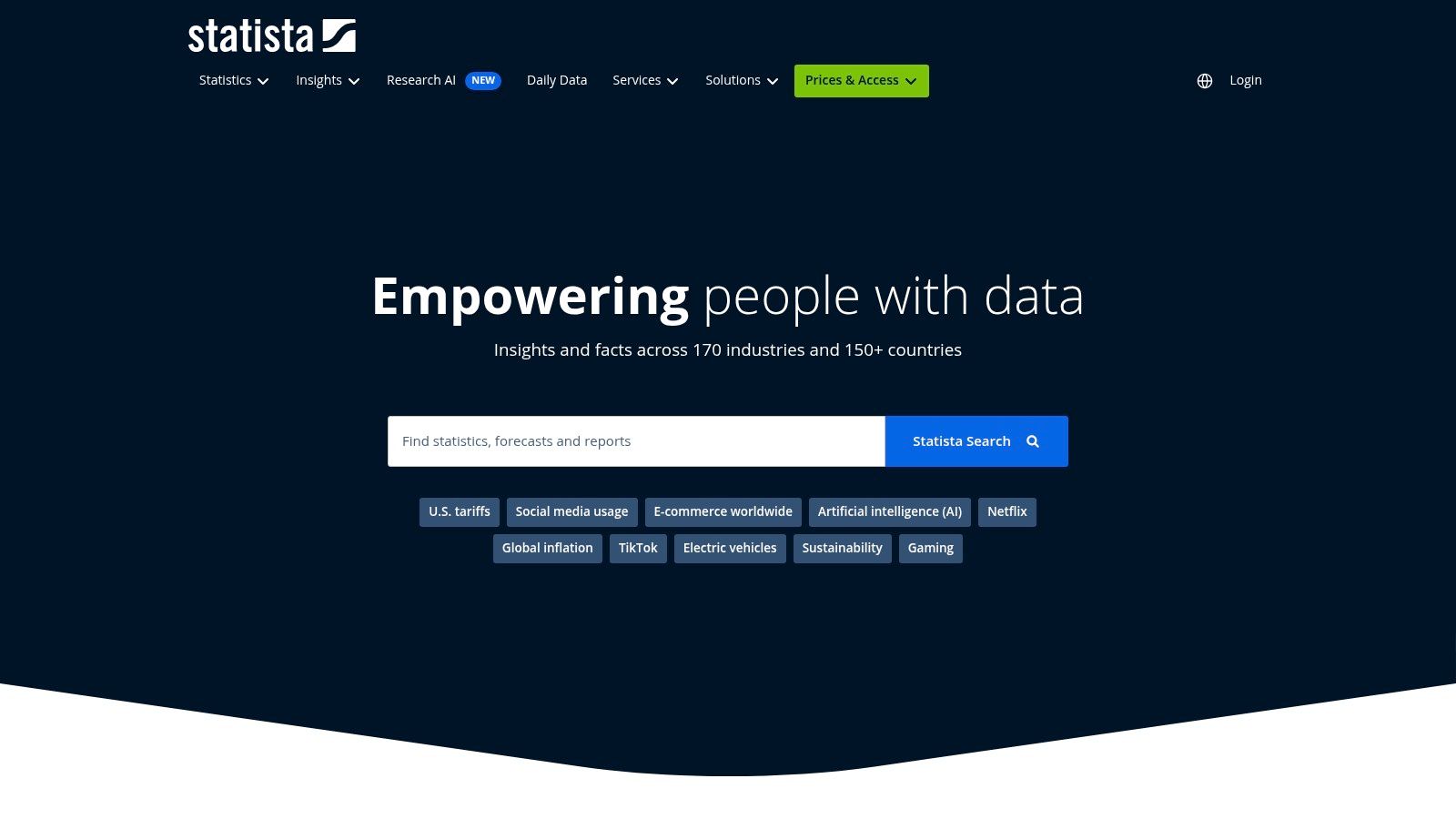
What makes Statista indispensable is how it transforms raw data into actionable assets. The platform allows one-click exports to PowerPoint, Excel, and PDF formats, making it easy to drop compelling data visualizations into your pitch decks or reports. This focus on accessibility saves founders invaluable time, allowing them to focus on strategy instead of data hunting. It is one of the most efficient market research tools for startups needing to establish credibility with solid, third-party data.
Key Details & Pricing
Feature | Details |
|---|---|
Best For | Founders and marketers needing credible secondary data for market sizing, trend analysis, and building investor-ready pitch decks. |
Strengths | Data Credibility: Access to millions of statistics from thousands of vetted sources. Export Functionality: Clean exports to PPT, XLS, and PDF save hours of formatting. Time Savings: Drastically reduces the time needed for secondary research. |
Weaknesses | Niche Data Gaps: Highly specific or emerging industries may have limited data available. Subscription Cost: Full access requires a significant investment. |
Pricing | Starts with a free account for basic access. The Starter plan is $149/month (billed annually). |
Website |
7. Crunchbase
Crunchbase is the ultimate database for the startup ecosystem, providing vast information on companies, investors, and funding rounds. For founders, it's an indispensable tool for competitive intelligence, allowing you to map out your market, identify who is funding your competitors, and discover emerging players. Its powerful search and alert system acts as an early warning system for market shifts.
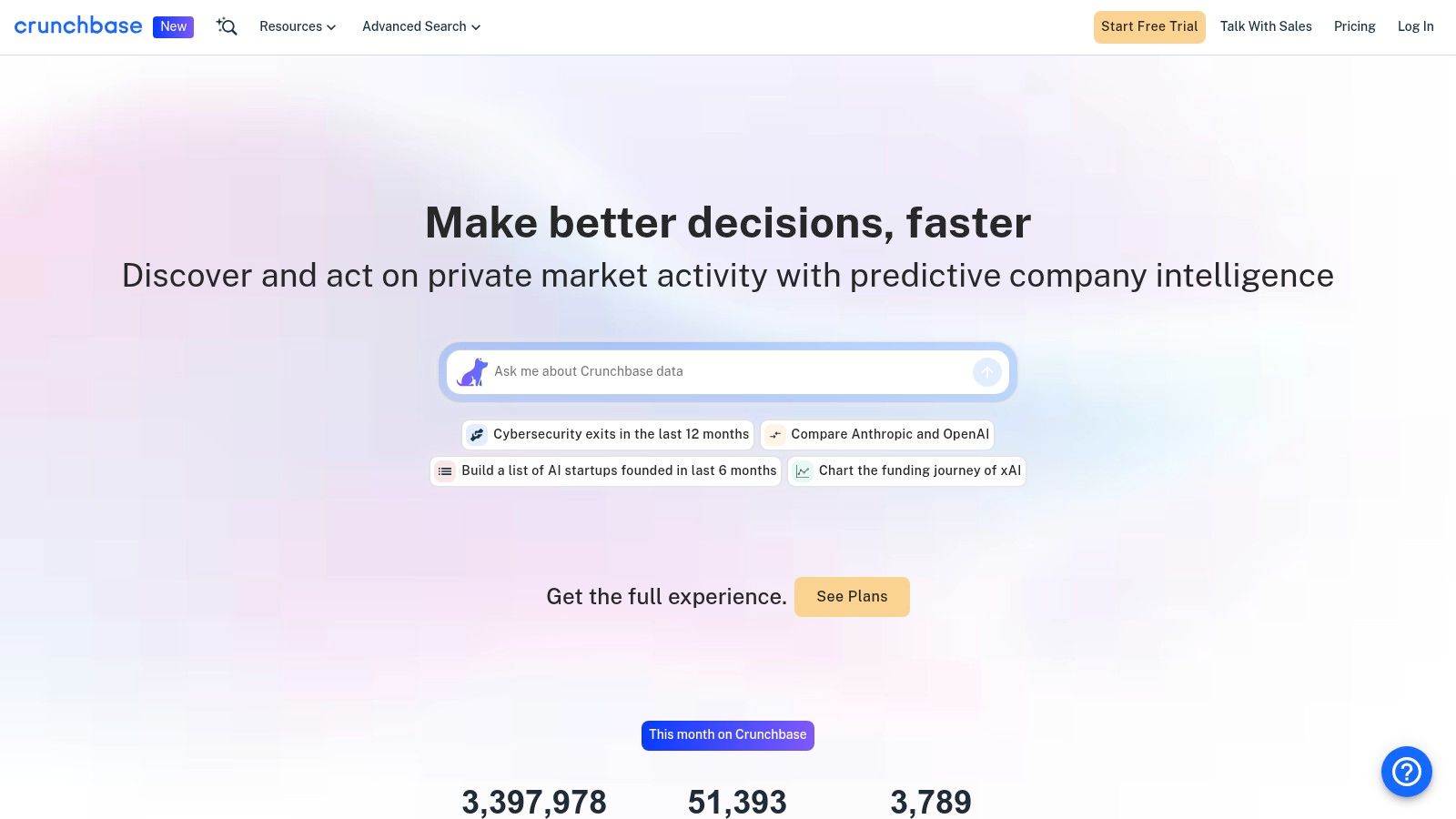
What makes Crunchbase so powerful is its focus on signals that matter: funding announcements, leadership changes, and market momentum. Startups can use it not just for research but for strategic action, from building lists of potential investors to identifying partnership opportunities. You can further leverage its data by automating data extraction. To get started, you can explore pre-built solutions for a Crunchbase companies scraper to build targeted datasets for deeper analysis.
Key Details & Pricing
Feature | Details |
|---|---|
Best For | Competitive analysis, investor prospecting, and tracking market and funding trends in the startup world. |
Strengths | Comprehensive Data: Unmatched database of funding rounds, investors, and company profiles. Powerful Alerts: Stay updated on competitor funding and industry news. Ease of Use: Intuitive interface for searching and filtering. |
Weaknesses | Data Gaps: Private company data can sometimes be incomplete or outdated. Higher Costs: Advanced API access and business tiers can be costly. |
Pricing | Offers a free basic plan. The Starter plan is $29/user/month (billed annually), with Pro at $49/user/month. |
Website |
8. NIQ (NielsenIQ)
When it comes to understanding consumer behavior and retail trends, NIQ (formerly NielsenIQ) is the gold standard. This platform provides enterprise-grade data from retail scanners and consumer panels, giving startups a view into market size, brand share, and pricing dynamics. For a new brand entering a competitive retail landscape, NIQ’s data is a powerful tool for building a data-backed business case.
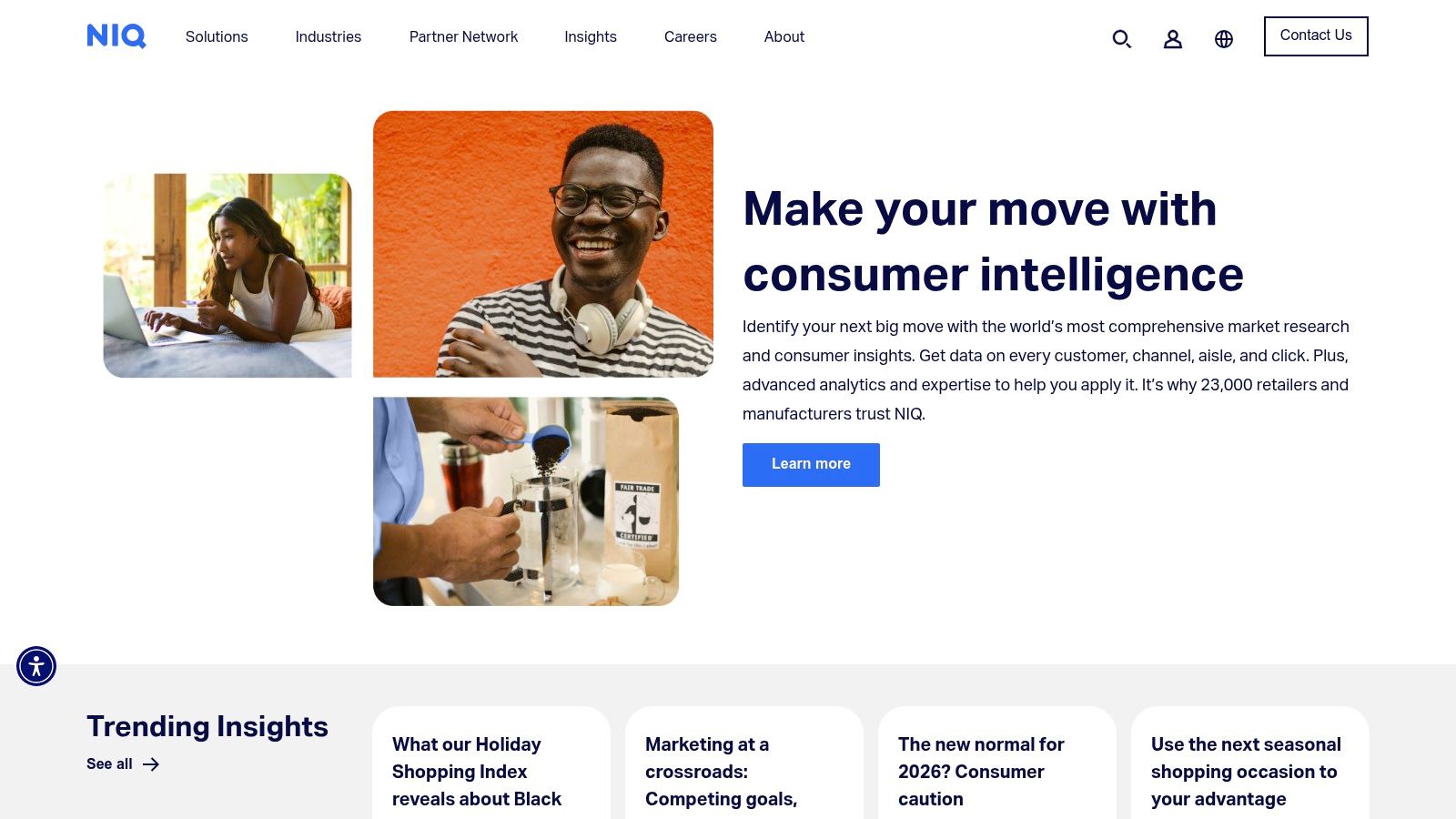
What makes NIQ indispensable is the depth and authority of its data. While most startups won't subscribe to its full suite of services, they can access valuable insights through specialized reports. This allows a lean startup to tap into the same high-quality intelligence that major brands rely on to make billion-dollar decisions. Leveraging NIQ is a crucial step for any startup serious about competing on the physical or digital shelf.
Key Details & Pricing
Feature | Details |
|---|---|
Best For | CPG and retail startups needing authoritative data for market sizing, competitor benchmarking, and pricing strategy. |
Strengths | Data Authority: Provides industry-standard retail and shopper data. Deep Analytics: Unmatched capabilities for price and promotion modeling. Report Accessibility: Specialized reports can be purchased for targeted insights. |
Weaknesses | Enterprise Focus: Most solutions are quote-based and can be very expensive. Niche Relevance: Primarily valuable for CPG and retail startups. |
Pricing | Pricing is enterprise-oriented and available by quote. Specialized reports are available for purchase online. |
Website |
9. UserTesting
UserTesting is a powerhouse for startups seeking qualitative human insights at speed. While surveys tell you what users are doing, UserTesting tells you why by letting you watch real people interact with your website, app, or prototype. This on-demand platform makes it easy to get fast, video-based feedback on everything from initial concepts and messaging to user experience flows.
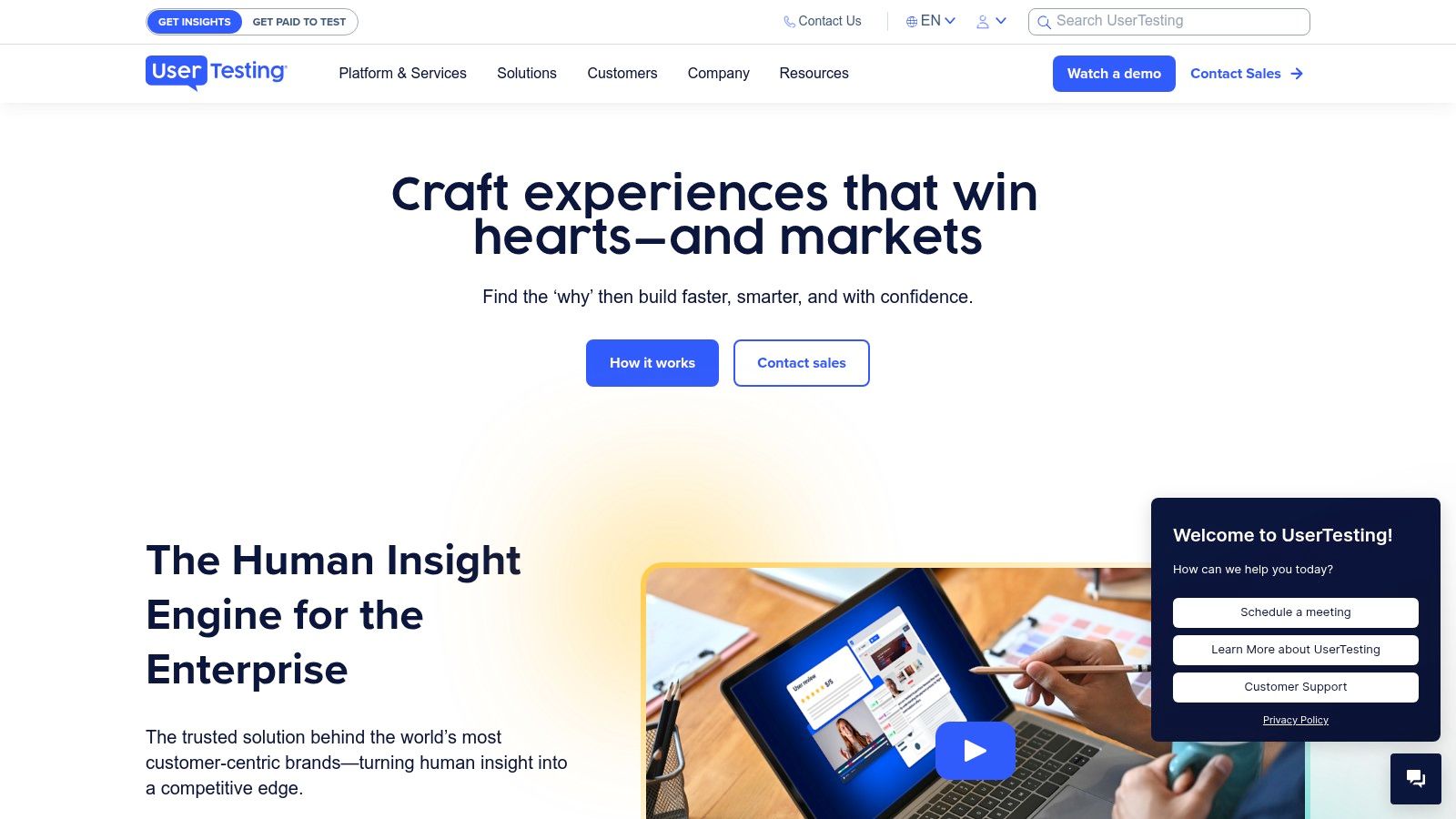
What makes UserTesting a game-changer is its ability to deliver rapid, qualitative validation. Instead of spending weeks recruiting and scheduling interviews, you can launch a test and receive video feedback from your target audience in hours. The platform's global panel and AI-assisted insights help you quickly pinpoint critical issues. For lean teams, this speed is a crucial advantage, making it one of the essential market research tools for startups focused on building user-centric products.
Key Details & Pricing
Feature | Details |
|---|---|
Best For | Startups needing rapid qualitative feedback on UX, prototypes, messaging, and ad campaigns. |
Strengths | Incredible Speed: Get video feedback from a global panel in hours. Qualitative Depth: Watch and hear users, providing context that surveys miss. AI-Assisted Insights: Automatically generates transcripts and highlights key moments. |
Weaknesses | High Cost: Custom pricing is geared toward enterprises and can be expensive for early-stage startups. Requires Volume: The platform provides the best value when used consistently. |
Pricing | Pricing is available by quote. Plans are tailored and often start with a set number of "test credits." |
Website |
10. UserInterviews
Finding the right people for your research is often the biggest bottleneck for startups. UserInterviews removes this barrier, offering a powerful platform to recruit and manage participants for qualitative feedback. It's an indispensable tool when you need to have real conversations with vetted consumers or B2B professionals.
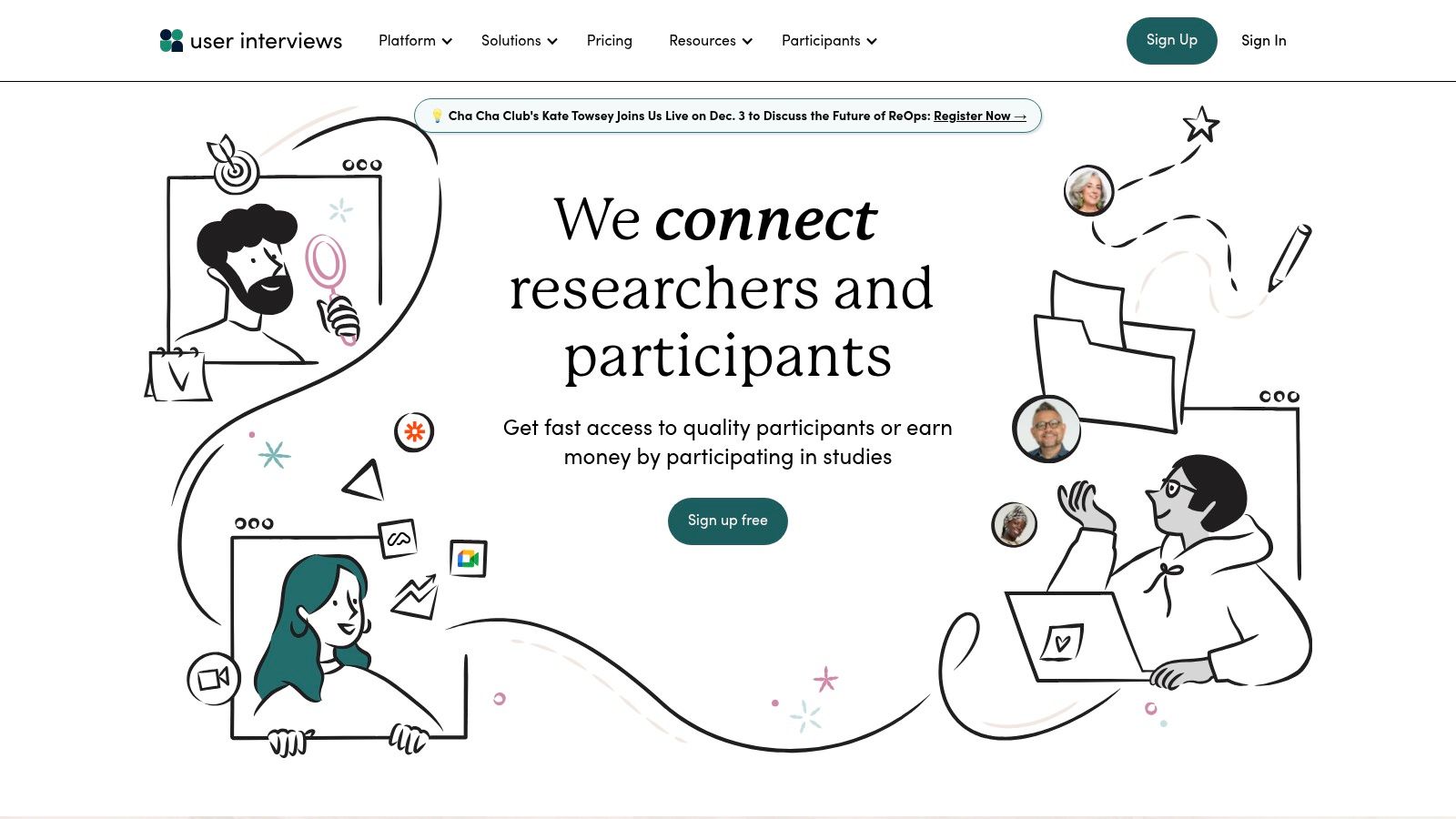
What makes UserInterviews a startup favorite is its blend of speed and precision. You can access a pool of over six million participants, filtering them with detailed criteria to find your ideal user persona. The platform automates the logistics of scheduling interviews, sending reminders, and distributing incentives, freeing up your team to focus on gathering insights. This makes it one of the most efficient market research tools for startups conducting customer discovery or usability testing.
Key Details & Pricing
Feature | Details |
|---|---|
Best For | Startups needing to quickly source and manage participants for qualitative research like user interviews and usability tests. |
Strengths | Targeted Recruiting: Robust B2B and consumer filtering to find niche audiences. Logistics Automation: Handles scheduling, reminders, and incentive payments. Flexible Pricing: Pay-as-you-go options are perfect for startups. |
Weaknesses | Added Costs: Participant incentives are a separate, additional cost. Price Increases: Recruiting highly specific B2B professionals can raise the per-session price. |
Pricing | Offers a free plan for your first three participants. Pay As You Go starts at $45 per session for consumer profiles. |
Website |
11. U.S. Census Bureau (data.census.gov)
For any startup targeting the US market, the U.S. Census Bureau is an indispensable and free resource. It provides the foundational demographic and economic data needed for serious market sizing. This is where you go to calculate your Total Addressable Market (TAM) with official, reliable statistics, understanding population counts, income levels, and business establishments with geographic detail.
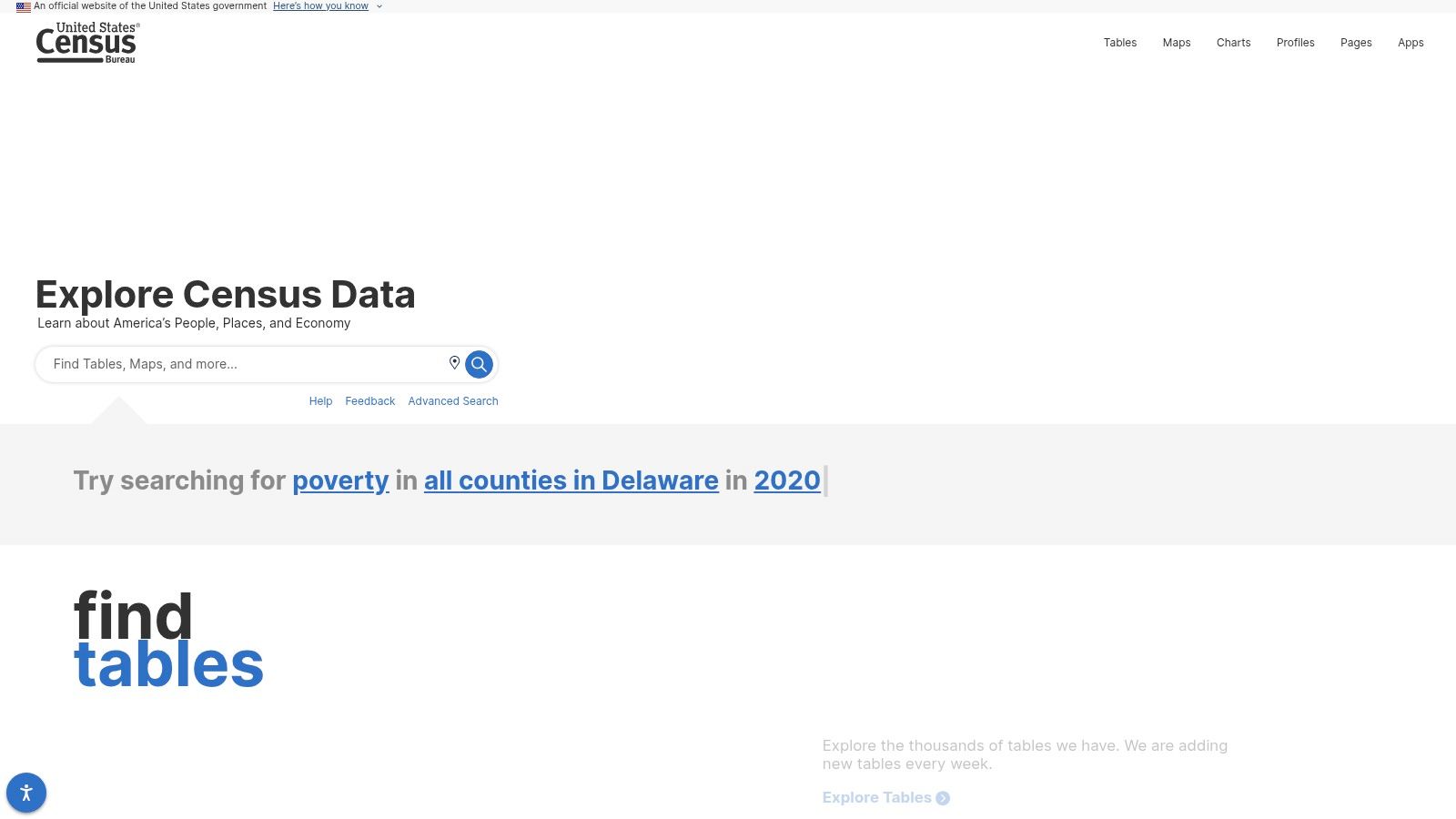
What makes the Census Bureau one of the most powerful free market research tools is its depth. You can drill down from national data to specific states, counties, and even census tracts to inform hyper-local strategies. While the data.census.gov interface has a learning curve, the insights it unlocks for customer profiling and market validation are unmatched. For startups, mastering this tool means building your business plan on a foundation of fact.
Key Details & Pricing
Feature | Details |
|---|---|
Best For | US-focused startups needing authoritative data for TAM calculations, geographic analysis, and building demographic profiles. |
Strengths | Completely Free: No cost for access to official data. High Granularity: Unmatched geographic detail for localized planning. Authoritative Source: Provides a reliable, unbiased baseline. |
Weaknesses | Steep Learning Curve: The interface can be complex for new users. Data Lag: Some datasets are updated infrequently. Raw Data: Often requires cleaning and analysis. |
Pricing | Completely free. |
Website |
12. Google Trends
Google Trends is a powerhouse tool for taking the pulse of the internet, making it an indispensable resource for early-stage market research. It allows startups to visualize and compare the popularity of search queries over time and across different regions. This provides a fast signal for gauging customer interest, validating a niche, or discovering seasonal demand patterns. It’s one of the best free market research tools for startups.
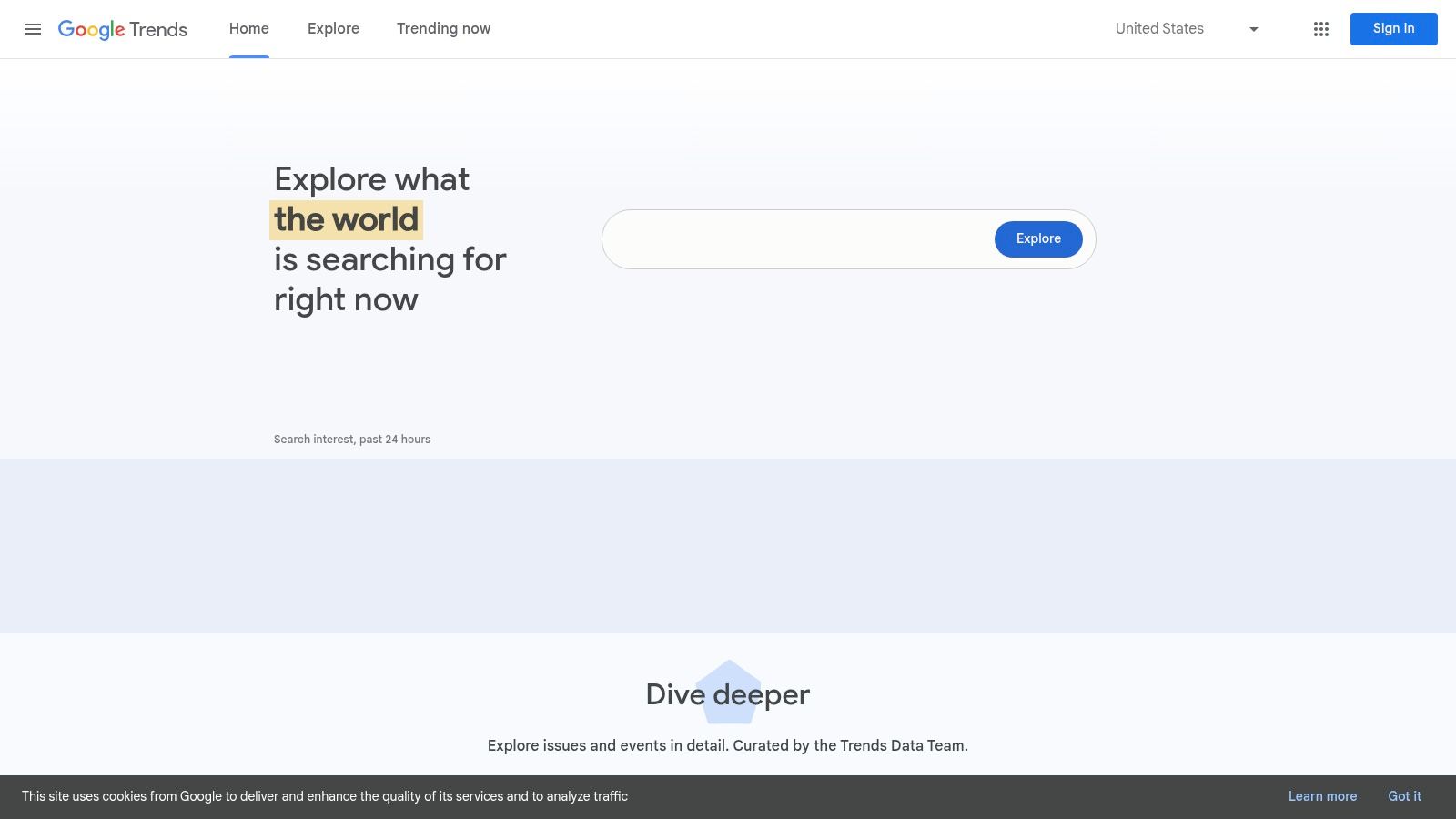
What makes Google Trends so valuable is its simplicity and speed. You can instantly compare interest in different product concepts or brand names to see which resonates most with the public. Exploring the "related queries" feature can uncover adjacent opportunities or highlight how your target audience is framing their problems. While it doesn't provide absolute search volumes, its relative data is perfect for spotting emerging trends without spending a dime.
Key Details & Pricing
Feature | Details |
|---|---|
Best For | Early-stage startups needing to gauge market demand, identify seasonality, and spot emerging trends quickly. |
Strengths | Completely Free: Provides invaluable directional data at no cost. Speed & Simplicity: Get insights in seconds with an intuitive interface. Global & Regional Data: Filter search interest down to the city level. |
Weaknesses | Relative Data: Shows indexed interest (0-100), not absolute search volume. Limited Granularity: Best for high-level directional signals, not deep keyword analysis. |
Pricing | Completely free to use. |
Website |
Top 12 Startup Market Research Tools Comparison
Tool | Core capability | Target audience | Key strengths (USPs) | Ease of use | Price |
|---|---|---|---|---|---|
Clura | No-code AI web scraper & agents — one‑click CSV exports | Sales, marketing, recruiting, e‑commerce, research teams | Wide source coverage, smart templates, automated agent runs, instant clean data | Chrome extension, one-click, minimal setup | Free (300 rows/mo); Grow from $15/mo (1k rows) — scales to 15k+ rows |
SurveyMonkey (Momentive) | Template-driven surveys + market-research methods | Founders, product/market teams, researchers | Large template library, AI survey builder, integrations, panel add‑on | Fast setup, user-friendly | Freemium → paid tiers; advanced features on higher plans |
Qualtrics | Enterprise research & experience-management platform | Large orgs, rigorous research teams | Advanced logic/methods, security/compliance, extensive support | Powerful but complex; steeper learning curve | Quote-based (can be expensive); limited free account + 30‑day trial |
Semrush | SEO, paid search, content & competitive intelligence | Marketing, SEO, growth, competitive analysts | Keyword/domain insights, market trends, strong reporting & API | Feature-rich; moderate learning curve | Subscription plans; add-ons increase cost |
Similarweb | Web & app traffic, audience & eCommerce intelligence | Competitive analysts, product & strategy teams | Quick competitor snapshots, TAM proxies, freemium trials | Self-serve with trials; easy to sample | Freemium → paid tiers; some trials require annual commitment |
Statista | Vetted market & industry statistics, reports & charts | Researchers, analysts, investors, comms teams | Millions of stats, clean XLS/PPT exports for decks | Easy exports and browsing | Limited free access; paid subscriptions for full content |
Crunchbase | Company, funding & market-signal database | Investors, business development, sales teams | Advanced company search, alerts, AI summaries, exports | Straightforward to use; scalable tiers | Pro monthly; Business/API tiers cost more (quote) |
NIQ (NielsenIQ) | Retail scanner & consumer-panel data for CPG/retail | CPG brands, retailers, analysts, investors | High-quality retail & shopper data, pricing & promotion analytics | Enterprise product; specialized onboarding | Quote-based enterprise pricing |
UserTesting | On-demand qualitative testing (moderated & unmoderated) | UX, product, marketing teams validating concepts | Fast qualitative feedback, global panel, AI-assisted insights | Simple test setup; best with steady volume | Typically quote/enterprise; priced per testing plan |
UserInterviews | Participant recruiting & study management | Researchers needing targeted respondents (B2C/B2B) | Large participant pool, scheduling, incentives, screening | Pay-as-you-go recruiting; easy study management | Pay-per-session + platform fees; subscription options |
U.S. Census Bureau (data.census.gov) | Official US demographic, business & economic datasets | Analysts doing TAM/SAM, location & demographic research | Free, authoritative, high geographic granularity | Data requires cleaning and joins; steeper learning | Free |
Google Trends | Search-interest analytics by term, time & region | Marketers, product, researchers spotting demand signals | Fast, free signal for seasonality and interest comparisons | Very easy to use, no login required | Free |
Build Your Research Stack Today
You now have a map of the essential market research tools for startups. From deep-diving into competitor strategies with Semrush to capturing the voice of your customer with UserTesting, the power to make data-driven decisions is more accessible than ever. We’ve covered everything from scraping real-time market data with Clura to leveraging free sources like the U.S. Census Bureau.
The key isn't to use every tool. It's about building a smart, lean research stack that aligns with your current stage and most pressing questions. Your goal is to create a continuous feedback loop where insights fuel action, and action generates new data.
Your Action Plan: How to Get Started
So, where do you begin? Don't let analysis paralysis stop you. The key is to start small and scale your efforts as you grow.
Here’s a simple framework:
Define Your Goal: Are you trying to find your first 100 customers, validate a new feature, or understand churn? Your objective dictates the tool. For customer discovery, start with UserInterviews. For competitive pricing, a scraping tool like Clura is your best bet.
Start with a "Core Stack": You don't need a dozen subscriptions. A powerful initial stack for most startups could include a survey tool (SurveyMonkey), a competitive analysis platform (Semrush), and a flexible data collection tool (Clura). This combination covers internal feedback, external market positioning, and targeted data needs.
Embrace "Good Enough": As a startup, you need directional insights that reduce uncertainty and help you make the next decision with more confidence. Don't wait for a perfect 10,000-person survey; a dozen in-depth customer interviews often provide more actionable wisdom.
Integrate and Automate: The real magic happens when these tools work together. Pipe survey feedback into your product roadmap. Set up automated alerts from Google Trends to track interest in your niche. Use a tool like Clura to scrape competitor reviews and feed that sentiment data into your marketing strategy.
The most successful founders embed market research into their company's DNA. The tools we've explored level the playing field, giving you the same level of market intelligence once reserved for massive corporations. Your ability to ask the right questions, choose the right tools, and act on insights is what will set you apart.
Ready to unlock market data without the manual work? Clura is an AI-powered browser automation tool that lets you scrape any website to gather competitor pricing, enrich lead lists, or monitor market trends in minutes. Explore prebuilt templates and build the ultimate market research workflow for your startup.
