
Discover what is market intelligence and how it drives smarter decisions. A concise guide with actionable tips and examples to boost your strategy.

Ever feel like you're running your business with a blindfold on? It’s a common feeling. Markets move fast, and making smart decisions without a clear view of the landscape is a recipe for disaster. This is where market intelligence comes in—it’s your business's real-time GPS, guiding you through the competitive chaos.
Think of it as the ultimate cheat sheet for your industry. It shows you where your competitors are, what your customers are thinking, and the clearest path to growth.
What Is Market Intelligence and Why It Matters

So, what exactly is market intelligence? At its core, it’s the process of collecting and analyzing data about your industry, competitors, customers, and market trends to make better decisions. It’s all about looking outside your company to understand the world you operate in.
This isn’t about dusty, static reports that are outdated the moment they're printed. True market intelligence is a live feed, helping you track everything from a competitor’s sudden price drop to a subtle shift in customer sentiment online. It’s about knowing what’s coming before it happens.
The Core Goal of Market Intelligence
The goal is simple: replace guesswork with data-backed confidence. When you truly understand the external forces shaping your industry, you can make smarter, faster decisions that drive sustainable growth. For a deeper dive, see how insights marketing to transform strategy with smart data can be a game-changer.
A proactive approach lets you:
Spot Emerging Trends: See new opportunities before they go mainstream and get a head start.
Find Hidden Gaps: Uncover untapped markets or discover weaknesses in your competitors' offerings.
Anticipate Threats: Foresee competitive moves or market shifts and prepare your strategy in advance.
Understand Your Customers: Gain deep insights into what your audience actually wants, so you can build products they love.
This isn't just a "nice-to-have." The global market intelligence industry was valued at USD 12.1 billion in 2024 and is projected to hit USD 21.4 billion by 2031. This explosive growth shows just how vital data-driven strategy has become.
From Raw Data to Actionable Insight
Great market intelligence isn't about hoarding mountains of data. The magic happens when you turn that raw information into sharp, actionable insights that guide your strategy.
It’s the difference between seeing that a competitor lowered their price and understanding why they did it, what it means for the market, and how you should respond.
Market intelligence provides the essential external view, helping you understand both your competition and the wider market so you can position your company for success. It’s about being proactive with your strategy, rather than just reacting to others' moves.
Ultimately, market intelligence gives every team—from sales and marketing to product and leadership—the clarity to operate with a full understanding of the world outside their office walls. This outward focus is what separates the companies that lead from those that play catch-up.
The Four Pillars of Modern Market Intelligence
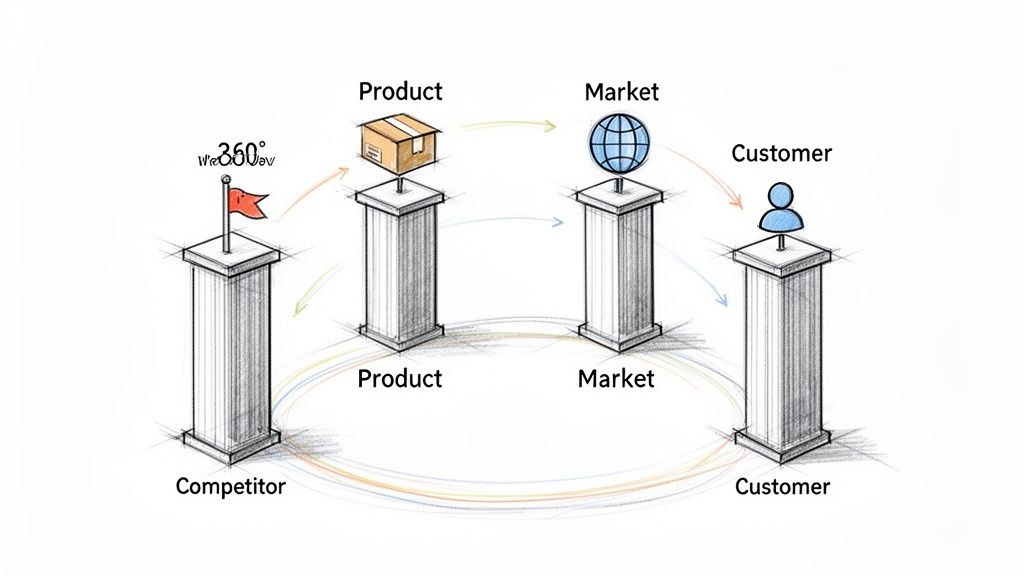
To really understand market intelligence, think of it as a foundation supported by four pillars. Each one provides a unique perspective, and together, they offer a 360-degree view of your business landscape.
This isn't just about collecting data. It’s about building a framework for smart, proactive strategy. Each pillar helps answer urgent questions, turning raw information into confident decisions. Get all four right, and you'll stop reacting to the market—you'll start leading it.
1. Competitor Intelligence
This is your secret weapon for understanding your rivals inside and out. It’s the process of ethically gathering information on who you’re up against, what they’re doing, and what their next move might be. This goes far beyond just listing their names on a spreadsheet.
Competitor intelligence answers key questions:
What new products or features are they launching?
How are they adjusting their pricing and promotions?
What is their core marketing message?
Where are they hiring? New roles can signal a shift in strategy.
Keeping a close eye on the competition helps you anticipate their moves, identify your own advantages, and avoid being caught off guard. For more, check out our guide to the best competitor analysis tools that can automate this process.
2. Product Intelligence
If competitor intelligence is about the company, product intelligence puts their offerings under a microscope. This is a deep dive into the features, performance, pricing, and—most importantly—user reviews of what they sell.
It’s here, in the product details, that you can find huge opportunities to innovate.
Product intelligence isn't just a feature checklist. It's about figuring out the "why" behind your competitor's product decisions and finding the gaps they've overlooked—gaps your customers are desperate for you to fill.
This pillar helps you achieve product-market fit by asking:
What do customers love or hate about competing products? (Check reviews on G2, Capterra, or the App Store.)
How does their pricing and packaging compare to yours?
What features are they adding or removing, and what does that signal about their strategy?
3. Market Understanding
Now it’s time to zoom out. Market understanding is about analyzing the broad industry and economic trends that affect everyone in your space—not just you and your direct rivals. This is where you see the whole forest, not just the trees.
This macro-level view helps you spot large-scale shifts and ride the next big wave. It covers everything from new regulations and supply chain issues to emerging tech and changes in buyer behavior. Staying tuned in here makes a business resilient and relevant for the long run.
4. Customer Understanding
Finally, we have customer understanding. This is the heart of it all. This pillar is dedicated to getting inside the minds of the people you serve. It's about knowing who they are, what they need, and what motivates them.
This means gathering insights from various sources:
Social Media: What are people saying about your brand, your competitors, and your industry on platforms like X (Twitter) and Reddit?
Customer Reviews: What pain points and moments of joy are they sharing on review sites?
Surveys and Feedback: When you ask them directly, what challenges do they share?
When you genuinely understand your customers, everything else falls into place. You can build products they can't live without, create marketing that connects, and deliver experiences that turn them into your biggest fans.
How to Gather Powerful Market Intelligence Data
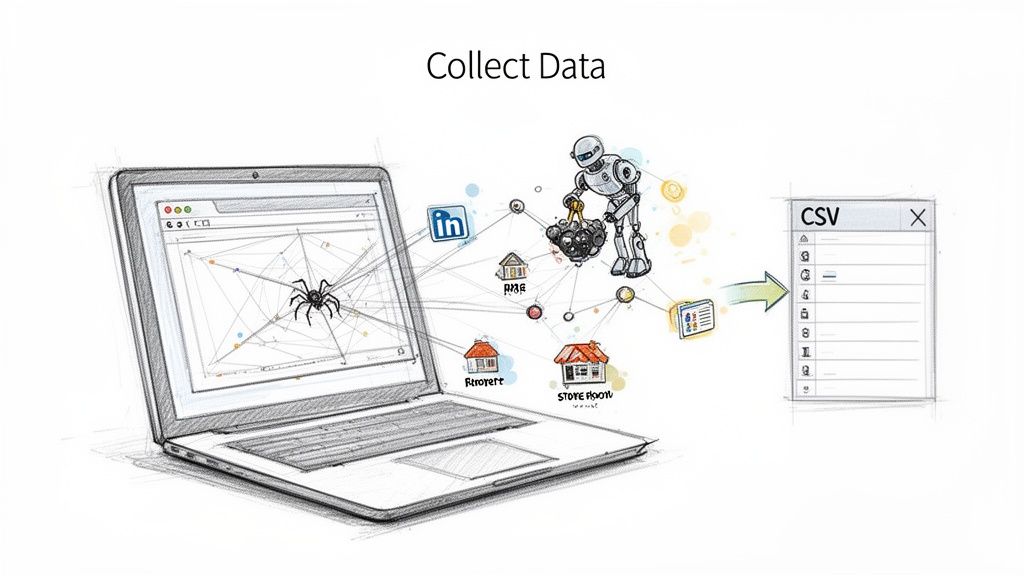
This is where the magic happens—turning the vast, chaotic web into your own intelligence goldmine. Gathering powerful data isn't about aimless Googling. It's about building a smart, modern toolkit that blends reliable methods with powerful new technology.
To get this right, you first need to understand the two main types of data. Grasping both is crucial before we dive into the automated methods that are changing the game.
Primary vs. Secondary Data Sources
Primary data is information you collect yourself, straight from the source. It’s fresh, original, and tailored to your specific questions.
Customer interviews and surveys: The most direct way to ask your audience about their pain points, needs, and opinions.
Focus groups: Guided conversations that are great for uncovering deeper insights into group dynamics.
Direct observation: Watching how people interact with your product (or a competitor's) can reveal more than they could ever tell you.
Secondary data is information that has already been collected and published by others. This is your go-to for understanding the big picture and spotting broad market trends.
Industry reports and white papers: High-level analysis from research firms that gives you a bird's-eye view of the market.
Government data and public records: Sources like census data or economic reports are perfect for a macroeconomic perspective.
News articles and press releases: A simple way to keep a finger on the pulse of company announcements and industry news.
Both types of data are vital, but they have their limits. Primary research can be slow and expensive, while secondary data can be outdated or too generic. This is where modern data collection tools, like web scraping, come in to save the day.
The Modern Toolkit: Web Scraping and Automation
Let's be real: the internet is the single largest, most up-to-date database on the planet. Web scraping is the process of automatically extracting public data from websites and organizing it into a clean, usable format. Years ago, this required coding skills, but today’s AI-powered tools have opened the doors for everyone.
With modern browser-based AI agents, any professional—whether you're in sales, marketing, or recruiting—can pull structured data from any website without writing a single line of code. It’s a complete game-changer for market intelligence.
This automated approach bridges the gap between primary and secondary data, giving you real-time information at a scale that was previously unimaginable. While you can find guides on the best competitive analysis tools, the key is knowing how to apply them.
Practical Data Collection Examples
So, what does this look like in practice? Instead of manually copying and pasting information for hours, you can set up automations to do the heavy lifting for you.
Here are a few powerful ways to put web scraping into action:
Build Laser-Focused Lead Lists: Scrape LinkedIn or industry directories to create hyper-targeted prospect lists with names, titles, and company details.
Monitor Competitor Pricing: Automatically track product prices on e-commerce sites like Amazon or Shopify to stay competitive.
Spot Hiring Signals: Extract job postings from sites like Indeed or competitors' career pages to see where they're investing and growing.
Analyze Customer Sentiment: Collect customer reviews from platforms like G2, Capterra, or the App Store to instantly understand what people love (and hate).
Real-time data is the name of the game. Businesses are shifting from stale, historical reports to instant insights. It's no wonder the US market research industry has grown to $36.4 billion in revenue—the value of timely data is clear. This empowers teams to be more agile and responsive, turning the live web into their ultimate source of market intelligence.
Your Actionable Market Intelligence Workflow
Let’s be honest: data is just digital noise until you have a solid plan to use it. It's time to get practical with a simple, repeatable workflow that takes you from a raw idea to a winning decision. This is a straightforward framework for doing market intelligence, from start to finish.
Think of this workflow as your roadmap. It ensures every piece of data you gather has a clear purpose and leads to a measurable outcome. By following these steps, you’ll build a system that consistently delivers results, whether you’re hunting for new leads or tracking your competition.
Step 1: Define Your Goal
Before you collect any data, you must know what you’re trying to achieve. A fuzzy goal like "get more leads" isn't enough. You need something specific, measurable, and actionable to guide the entire process.
A sharp goal gives you focus and saves you from drowning in irrelevant information. It’s like putting an address into your GPS before you start driving.
For instance, a sales team might set a goal like this:
Goal: Find 100 new SaaS leads in the North American fintech sector that have recently hired a Head of Growth.
Now that's a goal. It’s crystal clear. It tells you exactly who to look for, where to find them, and what trigger (hiring a Head of Growth) signals a perfect fit.
Step 2: Collect the Data
With a focused goal, data collection becomes a targeted mission. This is where modern tools shine, automating what used to be a tedious manual task. Instead of spending days copying and pasting from browser tabs, you can use AI-powered agents to do the work in minutes.
For our SaaS lead generation example, the collection phase looks like this:
Tool: Use a browser-based AI agent like Clura.
Action: Scrape LinkedIn Sales Navigator for profiles matching the criteria—fintech industry, North America, and job titles like "Head of Growth."
Outcome: A raw, unfiltered list of potential prospects who fit the initial target profile.
Step 3: Organize the Data
Raw data is a mess. The next step is to clean it up and structure it so you can actually work with it. A well-organized dataset is the foundation of accurate analysis.
This stage transforms a chaotic data dump into a pristine, usable resource. A clean CSV or a well-structured spreadsheet is your best friend here.
The point of organizing isn't just about being tidy; it's about creating clarity. When your data is laid out logically, patterns and big ideas practically jump off the page in the next step.
Continuing with our example, organizing the data means:
Exporting the scraped LinkedIn data into a clean CSV file.
Standardizing fields like job titles and company names for consistency.
Removing any duplicates or irrelevant entries to ensure your list is accurate.
Step 4: Analyze for Insights
Now it’s time to find the gold. Analysis is where you dive into your clean data to spot patterns, uncover opportunities, and extract the insights that will power your strategy. This step connects the data back to your original goal.
You're looking for the "so what?" behind the numbers. For our lead gen workflow, this means sifting through the organized list to pinpoint the highest-potential prospects.
This usually involves a few key moves:
Enrich the Data: Add more context. Pull in company size, recent funding, or tech stack details from other sources.
Filter for Fit: Zero in on companies that perfectly match your ideal customer profile (ICP), like those with 50-200 employees.
Prioritize the Leads: Segment your final list into tiers (A, B, C) based on how well they match your ICP for smarter outreach.
Step 5: Act on the Intelligence
This is the most important step. It’s time to turn your hard-won insights into action. All the data collection and analysis in the world is worthless if it doesn't lead to a business outcome. This is where your strategy comes to life.
Armed with a prioritized list of top-tier leads, the sales team can launch a highly targeted and relevant outreach campaign.
Action: Start a multi-channel outreach sequence (email, LinkedIn, maybe a call).
Personalization: Tailor the messaging to mention their recent "Head of Growth" hire, showing you’ve done your homework.
Result: You'll see higher engagement and response rates, which leads to more qualified meetings and, ultimately, more customers. This workflow closes the loop, drawing a straight line from market intelligence to revenue.
To make this clearer, here's a simple table showing how this process flows from a raw data point to a business decision.
Example Workflow: From Data to Decision
Step | Action | Example Tool/Method | Outcome |
|---|---|---|---|
1. Goal Setting | Define a specific target: 100 fintech SaaS companies in North America that recently hired a "Head of Growth." | Internal Strategy Meeting | A clear, measurable objective for the sales team. |
2. Data Collection | Scrape LinkedIn Sales Navigator for profiles meeting the criteria. | Clura AI Agent | A raw CSV file with hundreds of potential leads. |
3. Data Organization | Clean the CSV: remove duplicates, standardize job titles, and format for consistency. | Google Sheets or Excel | A clean, structured dataset ready for analysis. |
4. Data Analysis | Enrich the list with company size and funding data, then filter for companies with 50-200 employees. | Clay or manual research | A prioritized list of the top 100 most promising leads. |
5. Action | Launch a personalized email and LinkedIn outreach campaign referencing the new hire. | Outreach.io or HubSpot | Higher response rates and more booked meetings. |
This table shows how each step builds on the last, transforming a simple observation into a powerful, revenue-generating sales campaign. It's a repeatable system for success.
Market Intelligence Use Cases for Every Team
So, how does market intelligence help you win in the real world? It’s not a high-level concept just for the strategy team. When done right, it delivers tangible value to every single department.
It’s all about equipping each team with the specific external insights they need to crush their goals.
From a sales rep hunting for their next big account to a recruiter trying to land a rockstar engineer, market intelligence provides the context to stop guessing and start acting with precision. Let's look at how different teams can put these ideas to work.
At its core, the process is simple: collect data, analyze it for insights, and then take action.
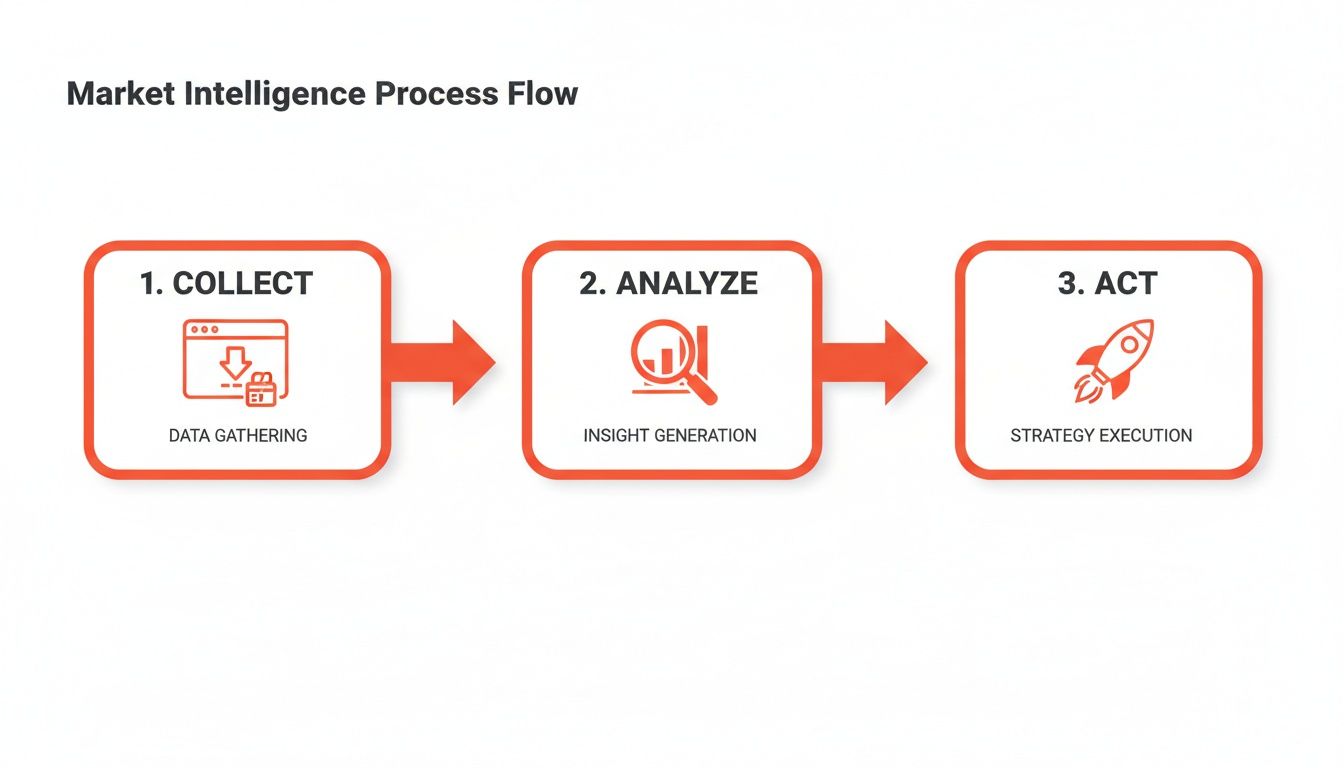
This isn’t a one-and-done project. It’s a continuous loop of learning and improving that keeps your business sharp.
Fueling the Sales Engine
In sales, speed and relevance are everything. Generic outreach is dead. Market intelligence turns a cold call into a warm conversation that actually goes somewhere.
Imagine you’re a sales development representative (SDR) looking for fresh leads. Instead of blasting out a thousand generic emails, you can use MI to build a laser-focused prospect list.
The Goal: Find SaaS companies that just secured Series A funding. This is a huge buying signal—they have cash and an urgent need to scale.
The MI Play: Use an AI-powered scraping tool to automatically pull a daily list of companies from sites like Crunchbase or PitchBook that fit this profile.
The Payoff: Every morning, you get a fresh, hyper-qualified lead list. Your outreach becomes incredibly specific: "Congrats on the new funding! As you scale, companies often run into [common challenge]." The result? We've seen teams achieve a 30% increase in meeting booking rates with this strategy.
Sharpening Marketing Campaigns
Marketers are in a constant battle for attention. Market intelligence is the secret weapon for creating campaigns that cut through the noise and connect with people.
Let’s say you’re a marketing manager preparing for a product launch. To nail the positioning, you need to know what your competitors are doing and what customers are saying.
Effective marketing isn't about shouting the loudest; it's about being the most relevant. Market intelligence is the key to understanding what "relevant" means to your audience right now.
The Goal: You’re not sure how to message a new feature because your top competitors have something similar.
The MI Play: Scrape customer reviews for all three competing products from sites like G2 and Capterra. Analyze the data to spot the most common complaints and praises.
The Payoff: The data reveals a golden insight: customers are consistently frustrated with the competitors' clunky user interface. Now you can build your launch campaign around your product's superior ease of use and beautiful design, hitting a known market pain point head-on.
Optimizing E-commerce Strategy
In the fast-paced world of e-commerce, your pricing and product mix can make or break you. Market intelligence gives online sellers the agility to react to market changes in real time.
Think about a Shopify store owner trying to keep prices competitive without hurting profit margins. Manually checking dozens of competitor sites every day is impossible.
The Challenge: Keep tabs on the prices for your top 50 products across your three main competitor websites.
The Automated Solution: Set up a web scraping agent to automatically monitor those product pages daily. It can extract the product name, price, and even stock status.
The Measurable Outcome: You get an instant alert the moment a competitor changes a price. This lets you make smart, immediate adjustments, protecting your market share and maximizing revenue.
Elevating Recruiting and HR
You might not think of HR as a data-heavy field, but recruiting teams can get a huge advantage with market intelligence. Knowing hiring trends, salary benchmarks, and where the best talent hangs out is critical.
Picture a recruiter struggling to fill a senior software engineer role. They need to know what similar companies are offering to create a compelling package.
Data Collection: Scrape job postings for similar roles from LinkedIn and Indeed, filtering by industry and location.
Insight Generation: Analyze the data to find the average salary range, the most common benefits, and the exact skills in demand.
Strategic Action: Armed with this data, the recruiter adjusts the job description and compensation to match the market. The result is a 40% increase in qualified applicants.
The Future of Market Intelligence with AI
Looking ahead, the world of market intelligence is getting a major upgrade, all thanks to Artificial Intelligence. AI is changing the game entirely. We're moving from insights that describe what happened to a new era of intelligence that can predict what’s going to happen and even suggest the best way to react.
Think of it this way: instead of just getting a report on last quarter’s sales, you get a sharp forecast of next quarter’s market demand. This is about making intelligence smarter, faster, and more accessible than ever before.
From Hindsight to Foresight
The old way of doing things involved staring at spreadsheets, trying to connect dots from past data. AI flips that script. It can process millions of real-time data points to spot subtle patterns humans would miss, turning market intelligence into a forward-looking powerhouse.
This isn't just a small tweak; it's a massive leap. AI-powered tools are replacing old-school, backward-looking analysis with real-time insights. In fact, 78% of organizations reported using AI in 2024, a huge jump from 55% just one year before. You can dive deeper into these trends and learn how AI is shaping market research in 2025.
AI doesn’t just give you a better rear-view mirror; it hands you a crystal ball. It’s about anticipating market shifts, not just reacting to them after the fact.
This forward-looking capability is where the real magic happens. It gives businesses the power to be proactive and stay several steps ahead of the competition.
Smarter Decisions, Not More Work
So, is AI coming to replace human experts? Not at all. The goal is to supercharge them. AI is brilliant at handling the grunt work—the tedious, time-consuming tasks of data collection and initial processing. This frees up your team to focus on what they do best: strategic thinking, creative problem-solving, and making big moves.
Automated Summaries: Imagine an AI that can read thousands of customer reviews and produce a one-page summary of the key themes and overall sentiment.
Predictive Lead Scoring: AI algorithms can analyze countless signals to predict which leads are most likely to convert, letting your sales team focus their energy where it counts.
Sentiment Tracking: Keeping a finger on the pulse of public perception is vital. Learn how to automate this in our guide to social media sentiment analysis tools.
Ultimately, bringing AI into your workflow means your team spends less time drowning in data and more time making brilliant, insight-driven decisions that push the business forward. It's about augmenting human intelligence, not replacing it.
Your Market Intelligence Questions, Answered
You've got the basics down, but a few common questions always come up when you're ready to get started. Let's tackle some of the big ones.
Think of this as your quick-reference guide. We'll clear up the confusion around key terms and give you practical advice to get started, whether you're a one-person shop or part of a larger team.
What’s the Difference Between Market Intelligence and Business Intelligence?
This is the most common question, and the answer comes down to one thing: perspective.
Business Intelligence (BI) is like holding up a mirror to your company. It's about looking inward. You analyze internal data—sales numbers, operational costs, team performance—to find ways to improve what you’re already doing.
Market Intelligence (MI) is like using a telescope to look outward. It focuses on the external world your business operates in. You watch competitors, listen to customers, track industry shifts, and monitor the economic big picture.
Here’s a simple way to remember it: BI is about your company. MI is about the world your company operates in. You need both to see the full picture.
The magic happens when you bring them together. For example, your BI reports might show a sudden drop in sales. That’s the what. MI can deliver the why—maybe a competitor just slashed their prices or launched a killer new feature.
How Can a Small Business Start with Market Intelligence?
You don't need a huge budget or a data science degree to get started. For a small business, the secret is to think lean, stay focused, and use smart tools to do the heavy lifting.
Here’s a simple game plan to get started:
Pick One Goal. Don't try to track everything at once. Start with something specific and achievable, like "track the prices of my top three competitors" or "find 20 new sales leads on LinkedIn this week."
Use Free and Low-Cost Tools. Set up Google Alerts to get an email every time a competitor is mentioned online. Use social media to see what people are saying about your industry.
Automate One Key Task. This is the biggest game-changer. Use a simple web scraping tool to automatically pull public data for you. For instance, you could track new job postings on a competitor's site to see their expansion plans.
Is Web Scraping Legal for Market Intelligence?
This is a big one. The short answer is yes, web scraping is legal for gathering public data. The keyword here is public. If the information is accessible to anyone on the internet—not behind a login or a paywall—it’s generally fair game.
However, it’s crucial to be a good internet citizen. This means respecting a website's robots.txt file (the "rules of the road" for bots) and not overloading their servers with too many requests. Good, modern scraping tools are built to handle this responsibly, so you can gather intelligence ethically and without causing problems. This makes web scraping a powerful—and legitimate—way to collect MI data at scale.
Ready to stop manually copying and pasting and start turning market intelligence into your secret weapon? Clura makes it simple to extract clean, structured data from any website, no coding required.
