Learn how to scrape data from any website with this easy-to-follow guide. Discover the best AI tools and workflows for clean, actionable data.
Learning how to scrape data is easier than you think, especially with the right tools. It’s a simple process: pick a website, tell an AI-powered browser agent what to grab (like names, prices, or emails), and export it all into a neat CSV file. Forget wrestling with complex code; modern tools have turned this into a simple point-and-click workflow.
Unlock the Power of Web Data in Minutes
In a world overflowing with information, the ability to quickly gather and organize data gives you a powerful advantage. For too long, web scraping felt like a complex skill reserved for developers writing Python scripts. That’s no longer the case. Today, anyone can learn how to scrape data with intuitive, AI-driven browser tools that do all the heavy lifting for you.
This isn't just a niche tech skill; it’s a core business activity. The global web scraping market is booming, valued at over $1 billion and expected to double by 2030. This signals a huge shift in how companies operate. Businesses now rely on scraped data for everything from monitoring competitors to generating fresh sales leads.
Why Every Professional Should Scrape Data
Modern tools have opened the door for non-technical pros to build seriously powerful, automated workflows. The possibilities are endless.
Here’s how teams are using it:
Sales teams build targeted lead lists by pulling contact details from LinkedIn or industry directories.
E-commerce brands monitor competitor prices on Amazon and Shopify to stay competitive.
Marketers scrape customer reviews from G2 or Capterra to understand market sentiment.
Recruiters compile profiles from job boards to build a pipeline of top talent.
Think of it like this: an AI-powered tool sees a messy webpage and instantly transforms it into structured, usable data.
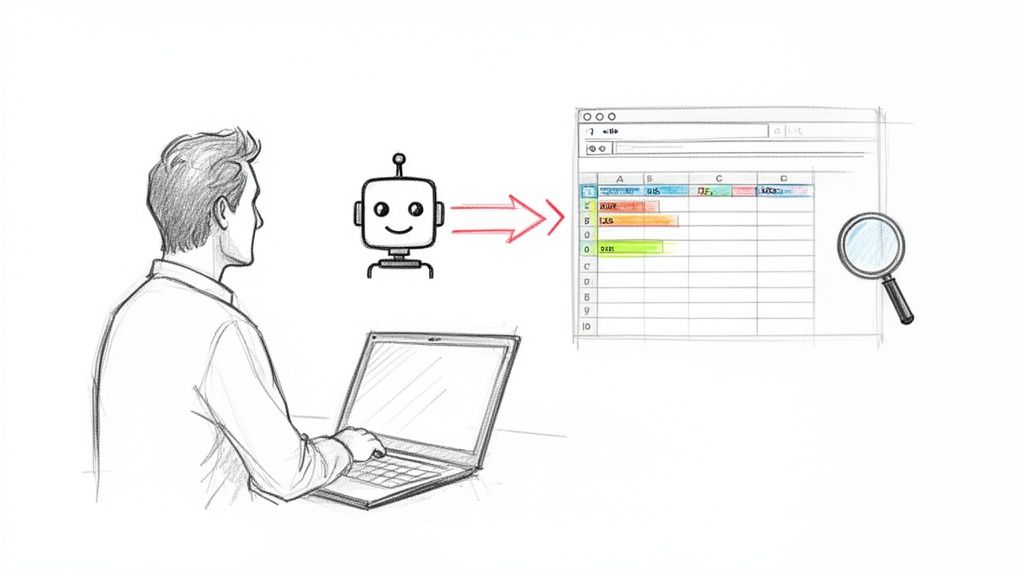
This process turns raw web content into organized, actionable intelligence in minutes, not days of manual work.
Your Roadmap from Manual Work to Automation
This guide is your roadmap to mastering no-code web scraping. We'll walk through everything, from planning your first project to exporting a perfect CSV. You'll learn how to pinpoint the data you need, navigate common hurdles like websites with multiple pages, and turn any site into your own private data source.
If you're new to this, checking out a Beginner Guide To Web Scraping can help you grasp the basics. Get ready to ditch manual data entry and embrace a smarter, automated workflow.
How to Plan Your First Data Scraping Project
Before you click that "scrape" button, let's talk about what separates a successful data project from a frustrating waste of time: a clear plan. A few minutes of strategy now will save you hours of headaches later and ensure your final CSV is pure gold.
Without a clear objective, you’re just collecting random information and will end up with a messy spreadsheet you can't use.
Step 1: Define Your Goal
Start with one simple question: What problem am I trying to solve with this data? Your answer will guide every decision you make.
Are you trying to:
Build a lead list? You'll need contact info for specific decision-makers.
Monitor competitors? You'll want product names, prices, and stock levels.
Conduct market research? You might pull job postings to analyze hiring trends or scrape reviews to understand customer sentiment.
Let's use a real-world example. Imagine you're a salesperson who needs to find marketing managers at B2B tech companies. Your goal is clear: build a targeted list of potential leads.
Step 2: Identify Your Data Sources
With your goal locked in, it's time to find where this data lives online. Pinpoint the websites that contain the exact information you need.
For our sales lead example, where would we find marketing managers?
LinkedIn Sales Navigator is the top source for professional titles and company details.
Crunchbase is great for company profiles, industry, and funding status.
Niche job boards or industry communities can also reveal who’s hiring and what roles are in demand.
Choosing the right source is crucial. A focused scrape on a site like Crunchbase will yield better results than a broad search on a generic business directory. Always prioritize quality over quantity.
Step 3: Pinpoint the Exact Data You Need
You have your goal and your target websites. Now, let's get specific. What columns do you want in your final spreadsheet? Map out the individual pieces of information that will make your project a success. Avoid grabbing everything—over-collecting just creates noise.
For our lead generation goal, the essential data fields are:
Full Name (e.g., Jane Doe)
Job Title (e.g., Head of Marketing)
Company Name (e.g., Acme Innovations Inc.)
Company Website
LinkedIn Profile URL
By defining these fields ahead of time, you give your AI scraping agent a perfect blueprint. It knows exactly what to look for, which means you get a clean, organized, and immediately useful dataset. This preparation is the secret to learning how to scrape data like a pro.
Let an AI Scraping Agent Do the Work for You
You've done your homework and have a solid plan. Now for the fun part: collecting the data. This is where you get to see a website transform into a clean, structured spreadsheet right before your eyes.
With a modern AI agent like the Clura Chrome extension, learning how to scrape data is as easy as pointing and clicking on what you want. The AI figures out the complex code behind the scenes, so you can focus on the information.
You're basically training a robot assistant to see the webpage the way you do, and it handles all the repetitive work for you.
A Step-by-Step Guide to Your First Scrape
Getting started is a breeze. Once the extension is added to your browser, it's ready to go on any website. Let's walk through a real-world scenario of scraping product details from a competitor's e-commerce site.
Navigate and Activate: Go to the product category page you want to scrape. Click the extension icon in your browser to open the AI agent's interface.
Point and Click: Start selecting what you need. Click on the first product's name. The AI instantly understands the pattern and highlights the names of all other products on the page.
Build Your Columns: Do the same for each piece of data you want—price, star rating, or product link. Each click adds a new column to your dataset, and you can see a live preview of your spreadsheet taking shape.
This visual process removes any guesswork. You build the dataset in real-time, so you know you're getting the right information from the start.
How to Handle Multiple Pages and Dynamic Content
What happens when a site has thousands of products spread across hundreds of pages? No one has time to click "next" over and over. This is where AI-powered pagination handling is a lifesaver.
Simply show the agent where the "Next Page" button is, and it will automatically click through every page, scraping each one until the job is done.
Modern websites also use "infinite scroll," where new content loads as you scroll down. An intelligent agent handles this with ease by mimicking real user behavior, ensuring you capture everything, not just the first few results. This is essential for scraping social media feeds, job boards, or any modern web app.
How to Get Around Common Scraping Roadblocks
Web scraping is powerful, but sometimes websites have defenses. You might hit a login wall, get your IP address blocked, or encounter a messy website layout. Don't worry. These are common hurdles, not dead ends. With the right strategy and tool, you can navigate them easily.
Why Websites Put Up Defenses
Websites use anti-bot measures like CAPTCHAs and IP tracking to protect their servers and data from malicious bots that can crash servers or steal content. These defenses are designed to filter out clumsy, old-school scraping scripts.
A wild statistic for you: 37% of all internet traffic is now bots and scrapers. Old-school scraping methods fail 70-80% of the time against modern websites. This is why AI-driven browser automation is a game-changer for tasks like tracking competitor prices or building prospect lists, where fresh data can boost conversion rates by 20-30%. Discover more web scraping statistics and trends on dataprixa.com.
The AI Agent Advantage
Modern AI-powered browser agents work inside a real browser, just like you. They mimic human behavior so well that they're nearly invisible to websites.
They handle cookies and sessions automatically.
They click, scroll, and wait for pages to load naturally.
They move between pages at a human speed.
This makes them far more reliable than traditional scrapers. To the website, it just looks like another curious user, so you get the data you need without setting off alarms.
How to Handle Logins and Rate Limits
Need data from behind a login? Just log in to the site as you normally would. The AI agent will operate within your logged-in session, allowing it to see and scrape everything you have access to.
You might also encounter rate limits, where a site temporarily blocks you for making too many requests too quickly. A smart AI agent automatically scrapes at a reasonable, human-like pace to avoid this, dramatically lowering your chances of being flagged.
How to Scrape Data Ethically
With great power comes great responsibility. Always start with an ethical approach. Check a website’s Terms of Service and robots.txt file to understand their rules for bots.
Stick to publicly available information and avoid personal data. Your goal is to gather intelligence, not disrupt a site's operations or invade privacy. Being a respectful scraper helps keep the web an open resource for everyone. For a deeper look, read our complete guide on the legality of web scraping.
How to Turn Raw Data into Actionable Insights
You've successfully collected a mountain of information—now it's time to turn that raw data into a clean, powerful, and usable asset.
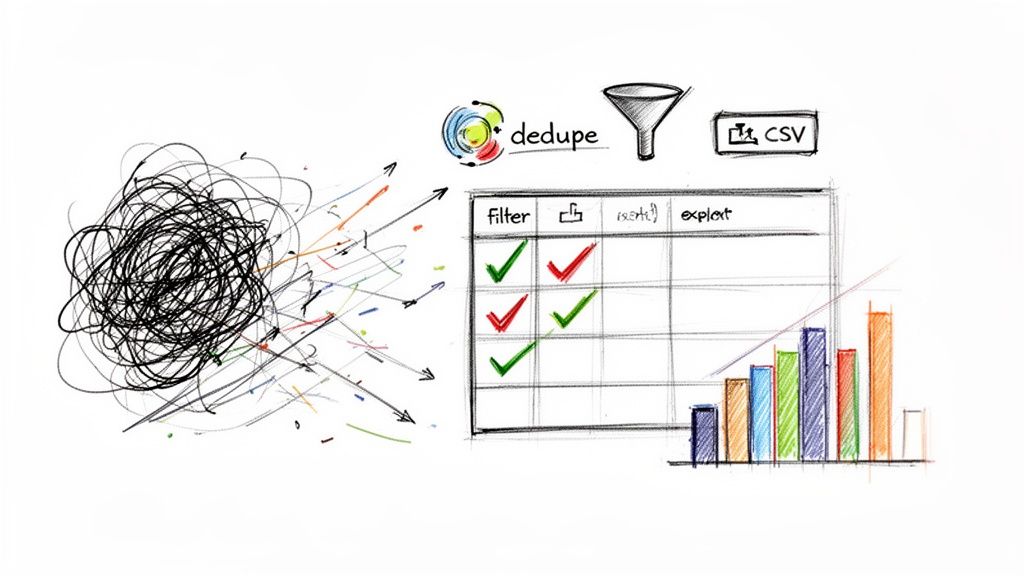
Raw scraped data is rarely perfect. You'll find duplicates, formatting quirks, and missing pieces. A few minutes of cleaning is what separates a messy scrape from a professional-grade dataset that’s ready for your CRM.
Step 1: Clean and Validate Your Data
Think of scraped data like fresh ingredients. Before you cook, you have to prep them. Modern tools provide a spreadsheet-like view of your data right in the browser, making it easy to spot-check for errors before you export.
Here are common cleanup tasks:
Remove Duplicates: Ensure every lead or product entry is unique.
Standardize Formats: Make sure all phone numbers or dates follow the same pattern.
Fix Typos or Casing: Convert messy entries like "acme inc." to a professional "Acme Inc."
Enrich Records: Fill in gaps by adding a company’s industry or employee count from another source.
This quick review ensures your final output is polished and ready to use.
Step 2: Export to a CSV File
Once your data is clean, the final step is simple: export it. With a single click, your AI agent packages all the structured data into a universally compatible CSV (Comma-Separated Values) file.
Why a CSV? Because it’s the gold standard. Every spreadsheet program, CRM, and data analysis tool—from Google Sheets and Microsoft Excel to Salesforce—can open a CSV file flawlessly. No compatibility issues, just pure, usable data.
The goal of learning how to scrape data is to make that data immediately useful. A one-click export to a clean CSV turns a complex web page into a simple file you can plug into any workflow.
Step 3: Put Your Data to Work
The real magic happens when you use your clean, organized data. You can unlock its true potential with tools for AI Data Analysis to uncover trends and insights.
A sales team’s exported lead list is a pristine file with columns for
Name,Title, andCompany, ready to be uploaded into an outreach tool.An e-commerce brand’s CSV contains
Product Name,Price, andCustomer Rating, perfectly formatted for competitive analysis.
You start with a messy website and end with an organized dataset that drives real business decisions.
How to Put Your Data Collection on Autopilot
Your first successful scrape is a great start, but the real breakthrough is building a data engine that works for you 24/7. It's about scaling your efforts to get incredible results without adding more work to your plate.
The key is to think in repeatable workflows. Why manually scrape a competitor's site every Monday when you can build a reusable "recipe" that does it for you? This mindset shift turns web scraping from a task into a powerful, strategic asset.
Build a Library of Automated Scrapers
Think about the data you check repeatedly. These are your best opportunities for automation. You can build a library of specialized scraping agents, each designed for a specific task. Set them on a schedule, and they'll deliver fresh data to your inbox automatically.
Imagine having automated workflows like these:
Weekly Price Monitoring: An agent scans your top competitors' product pages every Friday and sends you a pricing report.
Daily Social Media Monitoring: A scraper runs every morning to catch new trends and mentions of your brand on platforms like X.
Continuous Lead Generation: A scraper watches a niche job board and alerts you whenever a company posts a new role—a perfect signal that they're growing.
The Future is Autonomous Agents
The next leap in how to scrape data is using truly autonomous systems. We're now seeing AI agents that can run complex data pipelines in the background and even fix themselves when a website's layout changes.
This new wave of AI is changing everything. Autonomous systems can adapt on the fly, a massive advantage for teams monitoring Amazon prices or tracking competitor product launches. AI is slashing scraper breakage from a frustrating 60% down to under 10%.
In fact, browser-based AI agents, which users have rated 4.9/5, are saving teams 80-90% of the time they used to spend on manual data work. You can learn more about this AI revolution in data extraction on actowizsolutions.com.
Once you set up these automated workflows, you're building a reliable, hands-off information pipeline that gives your team a strategic advantage with almost zero ongoing effort.
Try this workflow today.
Frequently Asked Questions About Web Scraping
It's normal to have questions as you start web scraping. Here are answers to the most common ones so you can move forward with confidence.
Is web scraping legal?
The short answer is yes, scraping publicly available data is generally legal. If you can see it on a website without logging in, a scraper can "see" it too. The key is to be an ethical scraper. Always check a site's Terms of Service and robots.txt file (usually at sitename.com/robots.txt) to see what they allow. As a rule, avoid personal data, copyrighted material, or anything behind a login wall unless you have clear permission.
How do I scrape data from behind a login?
Modern browser-based scrapers make this easy because they work with your existing browser session. Simply log into a site like LinkedIn or a private forum as you normally would. Once you're in, the scraping tool can see and interact with everything you can. Just be sure your actions align with that site’s terms for logged-in users.
How do I avoid getting blocked?
The best way to avoid getting blocked is to not act like a robot. Today's AI-powered tools are much smarter than older scrapers. They operate inside a real browser, mimicking how a person would click, scroll, and navigate a site. This "human" behavior makes them difficult for websites to detect. They handle technical details like cookies and sessions for you, allowing you to fly under the radar.
Do I need to know how to code to scrape data?
Not anymore! The new wave of scraping tools is designed for everyone, not just developers. With a modern, point-and-click interface, you just show the AI what you want. It figures out the rest, building a powerful scraping workflow for you behind the scenes. No code required.
Ready to ditch the soul-crushing copy-and-paste routine? With a tool like Clura, you can transform any website into an organized spreadsheet in minutes.
Explore prebuilt templates to get started right away.
