Explore the essentials of web scraping legality, including landmark cases and practical, compliant data collection tips to avoid legal risks.
Let's cut to the chase. The million-dollar question: is web scraping legal?
The short answer is a resounding yes, but with some important guardrails. Think of it less as a black-and-white issue and more as a digital landscape with clear rules of the road. The legality of any web scraping project hinges entirely on what data you're collecting, how you're getting it, and what you plan to do with it.
Scraping public data is like taking a photo in a public park. Generally, it's perfectly fine. But the moment you start peeking into private windows or hopping fences, you've crossed a line. The same common-sense principles apply online.
This guide cuts through the legal jargon to show you exactly where those lines are drawn, so you can gather the data you need with total confidence.
Your No-Nonsense Guide To Web Scraping Legality

We’ll break down why the law protects public information but puts up a hard stop when it comes to a few key areas:
Personally Identifiable Information (PII): Think emails, phone numbers, or health data—anything that can identify a specific person.
Copyrighted Content: This includes original articles, music, or unique images you don't have a license to republish.
Data Behind a Login: Any information that requires a username and password to access is off-limits.
Our goal is to give you the clarity and confidence to move forward. We'll explore the big-picture factors—like a website's Terms of Service and data privacy laws—that separate ethical data gathering from the kind of risky behavior that gets you into trouble.
Why This Conversation Is More Important Than Ever
Let's be clear: web scraping is no longer a niche activity. It's a full-blown industry. The global market is projected to skyrocket from $1.03 billion in 2025 to a massive $2.00 billion by 2030, growing at a blistering 14.2% CAGR. This explosion is fueled by sales, marketing, and e-commerce teams who need this data to compete.
But this data gold rush is happening on a legal landscape that can feel a bit like the Wild West. The good news? We have solid precedent. The landmark HiQ Labs v. LinkedIn case, reaffirmed in April 2022, was a game-changer. It established that scraping publicly accessible data does not violate the U.S. Computer Fraud and Abuse Act (CFAA).
Simply put, the courts decided that if information is visible to anyone on the public web, you don't need special permission to access it.
This was a massive win for data accessibility. But—and this is a big but—it’s not a blank check. That ruling doesn't override a website's own rules (Terms of Service) or critical data privacy regulations. This guide will walk you through navigating that balance so you can build your data operations on a rock-solid, ethical foundation.
Before we dive deep, here's a quick cheat sheet summarizing the key factors that will keep your web scraping projects on the right side of the law.
Key Factors That Determine Web Scraping Legality
Factor | What It Means for Your Team | Simple Guideline to Follow |
|---|---|---|
Public vs. Private Data | This is the most fundamental distinction. Is the data openly accessible to any web visitor, or is it behind a login or paywall? | If a human can see it without logging in, a bot generally can too. Never try to access password-protected accounts. |
Personal Data (PII) | Are you collecting information that could identify an individual, like names, emails, or phone numbers? This triggers privacy laws like GDPR and CCPA. | Avoid collecting PII unless absolutely necessary. If you must, ensure you have a clear legal basis and are fully compliant with relevant data protection laws. |
Copyrighted Material | Are you scraping original creative works like articles, photos, videos, or extensive databases? | Do not reproduce or republish copyrighted content without permission. Scraping for analysis or indexing might be okay, but republishing is a major risk. |
Terms of Service (ToS) | Does the website's ToS explicitly forbid scraping? While not always legally binding in court, violating them can get your IP blocked or your account banned. | Always read the ToS and the |
Scraping Behavior | How aggressively is your scraper hitting the website's servers? Overloading a site can be seen as a "denial-of-service" attack. | Be a good internet citizen. Scrape at a reasonable, human-like pace, respect |
Understanding these five pillars is the first step toward building a responsible and effective data-gathering strategy. Keep them in mind as we explore the specific laws and court cases that shape this field.
Understanding The Major Legal Battlegrounds
To scrape data with total confidence, you need to know the rules of the road. This isn’t about becoming a lawyer overnight; it’s about understanding the key landmarks in the legal world so you can navigate around them without running into trouble.
Let's break down the essential laws and court cases that shape the conversation around web scraping. Think of these as your practical field guide to making smart, informed decisions. We'll hit the big three: digital trespassing in the U.S., personal data protection in Europe, and the universal rules about using someone else's creative work.
The CFAA and The Digital Trespassing Rule
The first major piece of legislation you’ll always hear about is the U.S. Computer Fraud and Abuse Act (CFAA). Enacted back in 1986 to fight hacking, it's been at the center of the scraping debate for years.
The easiest way to think about the CFAA is as a law against digital trespassing. It makes it illegal to access a computer "without authorization." For a long time, companies argued that simply putting "no scraping allowed" in their Terms of Service was enough to revoke "authorization." This created a massive legal gray area.
Thankfully, the landmark HiQ v. LinkedIn case brought much-needed clarity. The court’s final ruling in 2022 was a game-changer: the CFAA does not apply to publicly accessible web pages.
The court's logic was simple and powerful: you can't be trespassing if there isn't a locked door to begin with. If information is visible to anyone on the internet without needing a password, then accessing it is not a CFAA violation.
This decision was a huge win for data accessibility and set a critical precedent. It means that for public data, the threat of a CFAA lawsuit has been seriously defanged. But this isn't a free pass to ignore a website's rules or to start scraping private, behind-a-login data.
GDPR and The Personal Data Minefield
Next, let's hop over to Europe, where the General Data Protection Regulation (GDPR) reigns supreme. This is one of the world's toughest privacy laws. Here's the kicker: if you collect data related to anyone in the European Union, GDPR applies to you—no matter where your company is located.
GDPR is all about protecting personally identifiable information (PII), and its definition is incredibly broad. We're talking about:
Names and email addresses
Phone numbers and physical addresses
IP addresses and location data
Social media handles
Under GDPR, you need a "lawful basis" to process any personal data. For scraping, the most common argument is "legitimate interest," but this requires a careful balancing act. You have to prove that your interests don't trample on an individual's fundamental rights to privacy. Staying compliant is non-negotiable. For a deeper dive, creating documentation like GDPR compliance and data processing registers is a fantastic practice.
The bottom line? If you're scraping anything that could be linked back to a person, you must treat it with extreme care and have a clear, defensible reason for doing so.
Copyright Law and The Photographer Analogy
Finally, we have copyright law, which is a global concern. Copyright protects original creative works—think articles, photos, videos, and even the unique structure of a database. But here's the important distinction: facts themselves cannot be copyrighted. Things like a product's price or a company's address are fair game.
Imagine a photographer’s online portfolio. You're free to browse the gallery. You can even make a list of your favorites. What you can't do is download those photos and start selling prints or stick them on your own website. That’s a clear violation.
Scraping copyrighted material works the same way.
It's generally okay to scrape copyrighted text for internal analysis, like training an AI model on news articles to understand market sentiment. This is often considered "transformative use."
It's a big no-no to scrape those same news articles and republish them on your blog. That's infringement. For example, our guide on web scraping Google Search results is for your own analysis, not for building a rival search engine.
Always ask yourself: am I just analyzing the data, or am I trying to republish someone else's protected work? Answering that honestly will keep you on solid legal ground.
What Really Happens When Scraping Goes Wrong?
So, we've talked theory. But what happens when you actually cross the line? Ignoring the rules of web scraping can set off a chain reaction of serious, real-world consequences that hit everything from your bottom line to your company's good name.
The first punch usually comes from the tech side. Websites actively defend themselves against aggressive or unauthorized scrapers. The moment your tool hammers their server too hard or ignores their robots.txt file, the simplest outcome is getting your IP address permanently blocked. Just like that, your access to a critical data source is cut off.
From Digital Blocks to Legal Threats
If getting your IP blacklisted doesn't get your attention, things can escalate fast. The next step for many website owners is to send a formal warning. This is where you face very real risks of legal action like cease and desist orders. This isn't a polite request; it's a legally loaded demand to stop all scraping activities immediately.
Getting one of these letters is a massive wake-up call. It’s the other side saying, "We're serious, and we're ready to sue." Ignoring it is a high-stakes bet that can turn your data project into an expensive legal nightmare.
Make no mistake: the financial penalties for unlawful web scraping can be brutal. This isn't just about paying lawyers; it's about facing statutory damages designed to punish.
The numbers alone should get your attention. Copyright violations, for instance, can hit you for up to $150,000 per infringed work. Under GDPR, fines can skyrocket to €20 million or 4% of your company's global annual revenue—whichever is higher.
It's shocking, but some surveys show 17.4% of scrapers still think the practice is a complete free-for-all. Thankfully, a more clued-in 43.5% understand that clear lines exist around Terms of Service and personal data.
The Lasting Stain on Your Reputation
Even if you navigate the financial and legal minefield, there's a quieter consequence: the damage to your brand. Operating unethically can permanently tarnish your company's reputation. Once you're publicly labeled as a "bad actor" for aggressive scraping, that mud sticks.
This reputational hit causes downstream problems:
Trust Evaporates: Customers and partners get nervous about working with a company known for shady data practices.
Bad Press: A public legal fight is a magnet for negative media attention.
Partnerships Dry Up: Other companies will think twice before partnering with you.
The fallout from a scraping project gone wrong creates a ripple effect of technical headaches, legal battles, and reputational crises. That’s why an ethical, compliance-first approach isn't just a nice idea—it's essential for long-term growth.
This flowchart paints a clear picture of what happens when you cut corners. What starts with a simple IP block can quickly spiral into much bigger problems.

As you can see, ignoring the rules just isn't a sustainable strategy.
Your Practical Checklist for Ethical Scraping
Knowing the legal theory is one thing, but putting it into practice is what separates the pros from the amateurs. Think of this as your pre-flight checklist before launching any scraper. Following these five core rules isn't just about dodging legal bullets; it’s about building a smart, sustainable way to gather data. Let's dive in.
1. Read the Rules of the Road First
Before you write a single line of code, do your homework. Check two critical documents on any site you plan to scrape: the Terms of Service (ToS) and the robots.txt file. The ToS is the website's official rulebook. Ignoring it is the fastest way to get your IP address banned. The robots.txt file gives clear instructions to bots, telling them which pages are off-limits. Respecting these directives is non-negotiable.
2. Stick to Public Data Only
This is the golden rule. Only scrape data that is 100% publicly visible to any visitor, no login required. The second you try to get behind a password-protected wall, you're wandering into a legal minefield called "unauthorized access." The landmark HiQ v. LinkedIn case gave a green light to scraping public data, but that protection vanishes the moment you access private areas. Always ask: "Can a random person see this information without an account?" If the answer is no, stay away.
3. Treat Personal Data Like It's Radioactive
Seriously. Personally Identifiable Information (PII)—like names, emails, and phone numbers—is a massive liability. Under laws like GDPR, messing this up can lead to eye-watering fines. Unless you have a rock-solid, legally defensible reason to collect personal data, just don't. For most business goals, like tracking competitor prices or finding B2B sales leads, you can get everything you need without ever touching sensitive PII.
4. Don't Be a Bulldozer
Your scraper should be a polite guest, not a battering ram. Smashing a website with thousands of requests a second is a great way to crash their server, which can look a lot like a Denial-of-Service (DoS) attack.
Here's how to be a good neighbor:
Slow Down: Add a "crawl-delay" between your requests to mimic how a real person browses.
Scrape After Hours: Run your jobs during the target website's off-peak hours (like the middle of the night).
Spread the Load: Use rotating proxies so your requests come from different IP addresses instead of one source.
5. Fly Your Flag: Identify Your Scraper
This might sound counterintuitive, but don't hide. The best practice is to be transparent by setting a clear user-agent string for your bot. A user-agent tells the web server what’s making the request. Including your company name and a contact email (e.g., MyCoolCompany-Scraper/1.0; mailto:scraping@mycoolcompany.com) shows you're operating in good faith. If the site owner has a problem, they can email you instead of bringing down the ban hammer.
Want to see all these steps in action? We break it down in our complete guide on how to scrape the web responsibly.
Ethical Scraping Dos and Don'ts
To make things even simpler, here's a quick cheat sheet. Think of this table as your go-to reference for making smart decisions on the fly.
Practice | Do This (Low Risk) | Don't Do This (High Risk) |
|---|---|---|
Check Rules | Always read the | Ignore |
Data Access | Only collect data that is publicly available without a login. | Attempt to bypass login walls, CAPTCHAs, or other access controls. |
Personal Data (PII) | Avoid collecting names, emails, or phone numbers unless absolutely necessary and legal. | Scrape and store large amounts of PII without a clear legal basis or user consent. |
Scraping Rate | Use delays between requests and run scrapers during off-peak hours to minimize server load. | Hit the server with a high volume of rapid-fire requests that could disrupt service. |
Identification | Use a clear user-agent string that identifies your bot and provides a contact method. | Masquerade as a standard web browser or use a generic, unidentifiable user-agent. |
Data Usage | Use the data for its intended purpose and respect intellectual property/copyright. | Republish copyrighted content wholesale or use data in a way that violates privacy or the law. |
Sticking to the "Do This" column is your best bet for building a data pipeline that is effective, ethical, and built to last.
How Modern Tools Help You Scrape Responsibly
Staying on the right side of the law doesn’t have to be a constant, nail-biting effort. Trying to manage it all by hand is a recipe for disaster. This is where smart, modern tools come into play, acting as your automated compliance partner and taking the guesswork out of the equation.
A top-tier scraping platform isn't just about pulling data; it's built from the ground up for responsible gathering. By automating best practices, it frees up your team to focus on finding insights, not worrying about legal landmines.
It’s all about scraping smarter, not harder—giving you both incredible efficiency and total peace of mind.
Automating Ethical Scraping Practices
The best tools today have ethical features baked right into their DNA. Instead of forcing you to manually tweak settings, these platforms do the heavy lifting, making sure every data request is respectful and effective.
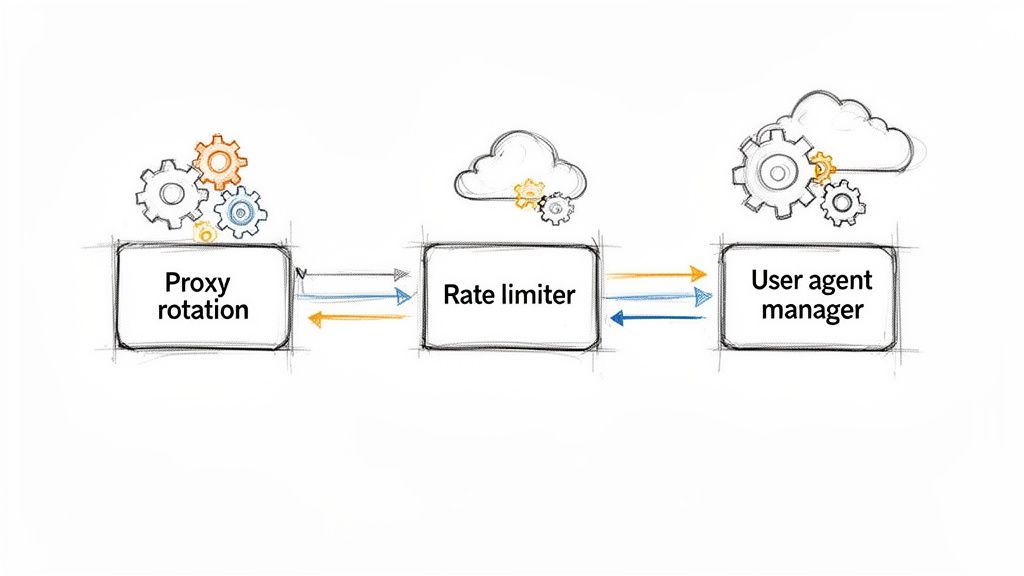
Think of them as built-in guardrails that keep your projects on the right side of the law. Here are the must-have features:
Built-in Rate Limiting: This is huge. It automatically throttles your requests so you don't bombard a website's servers, preventing you from accidentally causing a disruption that gets your IP banned.
Automatic Proxy Rotation: This feature intelligently spreads your requests across a huge pool of different IP addresses. Your activity looks less like an aggressive attack and more like natural traffic from many different users.
User-Agent Management: Great tools help you properly identify your scraper to web servers. This is a sign of good faith and gives website admins a way to contact you if there’s an issue.
These automated systems don't just shield you from liability; they also protect the websites you're gathering data from. It’s all about creating a more sustainable, respectful data ecosystem.
The Power of Compliant-by-Design Tools
The sheer volume of web scraping happening right now makes responsible tooling more critical than ever. A recent report estimates that in 2025, a staggering 10.2% of all global web traffic will be from scrapers. This is completely reshaping industries like fashion (53% of sites are scraped) and hospitality (49%). With that much data flying around, using compliant tools isn't just a good idea—it's essential. You can dive deeper into these stats in the 2025 State of Web Scraping Report.
A truly responsible scraping tool treats a website's
robots.txtfile as gospel. The whole point is to build a system where every single one-click export is designed to be lawsuit-proof from the very beginning.
This approach is backed by landmark court wins, like the HiQ v. LinkedIn case, which confirmed that scraping publicly available data is generally permissible. The key is that this protection hinges on respecting a site’s rules and not stepping on any copyright or Terms of Service landmines.
Tools built for compliance often go through tough audits to prove their methods are above board. This gives you confidence that you’re standing on a platform engineered for legal and ethical integrity. For more on this, check out our guide to the best social media scraping tools that put responsible data gathering first.
Time to Scrape Smart and Grow with Confidence
Alright, let's pull all of this together. The secret to confident, powerful web scraping isn't about memorizing every statute—it's about building your strategy on a few core principles: stick to public data, play by the website's rules, and be a good internet citizen.
This isn't just about dodging legal bullets. It's about building a sustainable, scalable data engine that drives your company's growth. When you operate from a place of clarity, web scraping stops being a risk and transforms into a strategic superpower.
Your Go-Forward Game Plan
By internalizing the lessons from big cases involving the CFAA and getting a handle on privacy laws like GDPR, you're ready to put that compliance checklist into action.
Always come back to these pillars:
Public Data is Your Playground: If it’s behind a login, it’s off-limits. Period.
Respect the House Rules: Make checking the Terms of Service and
robots.txta non-negotiable first step.Don't Be "That" Bot: Scrape at a considerate pace. Your goal is to gather data, not crash someone’s server.
Keep It Impersonal: Actively steer clear of personally identifiable information (PII). Unless you have an ironclad legal reason, don't touch it.
The real aim here is to shift your team's mindset from fear to empowerment. When you're armed with the right knowledge, you can finally gather the insights you need to find killer leads, monitor the competition, and innovate faster than ever.
Moving Forward with Total Clarity
Sure, specific laws will continue to evolve. But the fundamental principles of ethical, responsible data collection are here to stay. Committing to these best practices doesn't just make you compliant today; it makes your entire data operation resilient and future-proof.
You've got the knowledge. You've got the framework. Now you can move forward, make smart decisions, and operate with confidence. The web is overflowing with game-changing information. Go get it—the right way.
Explore prebuilt templates
Frequently Asked Questions
When you're digging into the world of web scraping, a few key questions always pop up. It's totally normal—the legal side can feel a bit murky. Let's tackle some of the most common head-scratchers so you can scrape with confidence.
Can I Get In Trouble For Scraping A Site Like Amazon Or LinkedIn?
This is a big one. Thanks to the HiQ v. LinkedIn court battle, we know that scraping publicly available data isn't a federal crime under the CFAA. That's a massive win! But that’s not the whole story. Big players like Amazon and LinkedIn have iron-clad Terms of Service (ToS) that almost always forbid automated scraping.
Breaking their ToS is a breach of contract. While that won't land you in criminal court, it can get you blocked, or in rare cases, they might send a cease-and-desist letter or sue for that breach.
So, what’s the smart move? Be a good guest. Scrape slowly, at a rate that mimics human browsing, and never hammer their servers. Most importantly, only collect data that’s visible to the public without an account. Stick to public product listings or basic profile info—if you have to log in to see it, it's off-limits.
What Is The Difference Between Public And Private Data?
Honestly, this is the most critical distinction in all of web scraping. Getting this right is 90% of the battle.
Public Data: This is anything you can see on a website without logging in. Think product prices on an e-commerce site, headlines on a news page, or business addresses in a directory. It's out there for the world to see.
Private Data: This is anything behind a digital barrier, like a login page or a paywall. This includes your account details, private messages, or exclusive member content.
Scraping private data is a huge no-go. The moment you try to bypass a login, you're entering the realm of "unauthorized access," which is exactly what laws like the CFAA are designed to stop. The golden rule is simple: if you need a password to see it, don't scrape it.
The core principle is simple: if the data isn't freely available to any random visitor on the internet, it's off-limits for your scraper. Trying to get around a digital "locked door" is where the real legal risks begin.
Does Using A VPN Or Proxies Make My Scraping Legal?
Let's be crystal clear on this: absolutely not. Using a VPN or a proxy network is a technical tactic, not a legal shield. These tools are great for managing your operations and preventing simple IP blocks, but they provide zero legal protection.
Think of it this way: wearing a disguise doesn't make it legal to trespass. Hiding your IP address won't change a thing if your scraping activities violate a site's ToS, copyright law, or data privacy rules like GDPR.
Your legal standing comes from what you collect and how you collect it—ethically, respectfully, and transparently. Focus on building a compliant process from the ground up, not looking for ways to hide.
Ready to scrape data the right way? Clura is a browser-based AI agent that helps your team collect clean, structured data from any website in just one click—no code required. Automate your lead generation, competitor monitoring, and market research workflows with a tool designed for responsible and efficient data gathering.
