Master lead generation for attorneys with practical SEO, social media, and automation tactics to attract high-value clients.

Generating a steady stream of new clients is the lifeblood of any successful law firm. But in today's world, that process starts online. When someone needs legal help, their first move isn’t to the Yellow Pages—it's to Google. That’s why having a smart digital strategy isn't just a nice-to-have; it's the core of modern legal marketing. This guide breaks down the practical steps you can take to attract more of the right clients, right now.
How Modern Clients Find Attorneys Online

The days of relying only on a firm handshake and word-of-mouth referrals are over. While a great reputation is still gold, the path a potential client takes to your door has changed for good.
Think about it. When someone faces a car accident, a messy divorce, or a business dispute, their immediate reaction is to grab their phone. They’re searching for answers, guidance, and a lawyer they can trust.
This shift means your law firm has to operate differently. Your website is now your digital front door, and your ranking on Google is your new curb appeal. If you aren't visible when and where potential clients are looking, you're invisible to a huge pool of people actively seeking your expertise.
The Digital Journey of a Potential Client
People don’t just wake up and decide to hire a lawyer. It starts with a problem that triggers a search for solutions. Understanding this journey is key to building a system that consistently brings in new cases.
Here's what that journey looks like:
Problem Awareness: First, they try to understand their situation. They ask Google questions like, "what are my rights after a workplace injury?" or "how to file for divorce in Texas." They aren't looking for a lawyer yet, just information.
Solution Exploration: Once they understand their issue, their search gets more specific. Now they’re typing in "personal injury lawyer near me" or "best family law attorney in Chicago."
Vetting and Comparison: Before they pick up the phone, they do their homework. They scroll through reviews on Google and Avvo, check out your website, and compare your firm's experience against your competitors.
Why You Can’t Afford to Ignore Digital Channels
The numbers don't lie: the internet is where you’ll find your next client. A staggering 57% of people start their search for a lawyer online. Even better, firms that nail their search engine optimization (SEO) see an incredible 7.4% visitor-to-lead conversion rate. That's a massive return.
Your firm's ability to show up on the first page of Google for relevant searches is the single most important factor in modern lead generation. It's the digital equivalent of having the best-located office on the busiest street in town.
So, how do you make sure you're the one they find? Let's look at the most powerful channels law firms are using to attract high-quality leads right now.
Top Lead Generation Channels for Law Firms
Channel | Primary Strength | Best For Reaching |
|---|---|---|
SEO | Long-term, high-quality organic traffic | Clients actively searching for specific legal services. |
PPC Ads | Immediate visibility and targeted lead generation | Clients with urgent needs who are ready to hire now. |
Professional networking and B2B opportunities | Corporate clients, in-house counsel, and referral partners. | |
Referrals | High-trust, warm leads | Clients from other attorneys and professional networks. |
Local Events | Building community trust and personal connections | Individuals and small business owners in your community. |
Each of these channels offers a unique way to connect with potential clients. For an even deeper look, check out this comprehensive guide to lead generation for attorneys. For now, just remember: your next client is online, searching for you at this very moment. The real question is, can they find you?
Build a High-Traffic Website with SEO and Content

Your website is more than a digital business card. It's your single most powerful lead generation engine. To get it working for you, you have to nail your SEO and content strategy. This isn't about tricking Google—it's about making it simple for people who need your help to find you.
SEO puts your firm front and center the moment a potential client starts searching, creating a reliable pipeline of high-quality leads that land right on your digital doorstep.
Master Keyword Research to Understand Your Clients
Great lead generation starts by understanding the exact words your ideal clients are using. You need to know what they’re typing into that search bar when they’re stressed, confused, and looking for legal help. That’s the magic of keyword research.
Forget targeting broad terms like "lawyer." The real gold is in long-tail keywords—those longer, more specific phrases that show clear intent. These are your ticket to attracting prospects who are ready to take action.
Look at the difference:
Broad: "personal injury lawyer"
High-Intent: "motorcycle accident attorney in Austin Texas"
Broad: "family law firm"
High-Intent: "how to file for uncontested divorce in Florida"
See the shift? These specific phrases capture people who are much further along in their decision-making process. They aren't just browsing; they're looking to hire someone.
Think of every page and blog post on your site as a direct answer to a potential client's urgent question. The more specific and helpful your answers are, the more Google will see you as the go-to authority and send traffic your way.
Turn Keywords into Compelling Content
Once you've got your list of high-intent keywords, it's time to put them to work. The goal is to build a resource hub on your website that educates potential clients and guides them toward booking a consultation. This content needs to be practical, easy to read, and speak directly to their problems.
Your content strategy should boil down to two core pillars:
In-Depth Practice Area Pages: These are the foundations of your site. Each page should be a complete guide for a specific service you offer, optimized for keywords like "criminal defense lawyer [your city]." Detail the types of cases you handle, walk them through the legal process in plain English, and have clear calls-to-action.
Helpful Blog Posts: Use your blog to answer the burning questions your clients are already asking. Create posts around long-tail keywords like "what to do after a slip and fall accident" or "steps to creating a will." This attracts organic traffic and positions your firm as a trusted expert.
Dominate Local Search to Win Your Neighborhood
For most law firms, clients aren't coming from across the country—they're right in your backyard. That makes mastering local SEO an absolute must. When someone searches for an "attorney near me," you have to be at the top of that list.
Your first move is to claim and optimize your Google Business Profile (GBP). This is the info box that pops up in Google Maps and on the side of search results. A complete, active, and well-managed profile is one of the most powerful local ranking factors.
Here's a quick checklist for a killer GBP:
Claim and Verify Your Listing: This is step one. Don't skip it.
Fill Out Every Single Section: Add your firm's name, address, phone number (NAP), hours, and website. Keep this NAP information 100% consistent everywhere online.
Encourage Client Reviews: Positive reviews are pure gold. They provide powerful social proof and are a massive signal to Google. Actively ask happy clients for a review and respond to every single one, good or bad.
Use High-Quality Photos: Show off your office, your team, and your firm's branding. It makes your profile far more engaging and helps you stand out.
By putting in the work to build a strong SEO foundation, you're creating an asset that works for you 24/7, attracting the right clients when they need you most.
Get in Front of the Right People with Social Media & Paid Ads
A great website that ranks high on Google is your long-term engine for growth. But what about when you need to get your firm in front of the right people, right now? That's where the precision of social media and the speed of paid advertising come in.
These channels let you stop waiting for clients to find you and start proactively reaching them where they already are.
An incredible 84% of law firms are pulling in leads from their organic social efforts, and 71% of lawyers say these platforms are a key source for new clients. To get a piece of that action, you have to be smart about where you show up and what you say.
Connect and Conquer on LinkedIn
If your practice is B2B—think corporate law, intellectual property, or commercial real estate—LinkedIn is a goldmine. It's a digital networking event filled with in-house counsel, executives, and business owners looking for credible expertise.
Your LinkedIn game should be about establishing yourself as an authority and building genuine relationships. Forget the hard sell; it doesn't work here. Instead, focus on giving away massive value.
Here are a few post ideas that build credibility and get you noticed:
Mini Case Studies: Strip out identifying client details and share a quick story about a complex case. Lay out the challenge, your firm's approach, and the killer outcome you achieved.
"What This Means for You" Updates: Did new legislation just drop that affects a specific industry? Perfect. Write a quick, jargon-free analysis explaining what it means for businesses and what they should do next.
Quick-Hit Video Tips: Record a 90-second video debunking a common legal myth in your niche. It’s a fantastic way to put a face to the firm name and show off your expertise.
LinkedIn is about playing the long game. You're not trying to land a client from one post. The real goal is to become the first person a connection thinks of when a legal need pops up. Consistency and value are the secret sauce.
Ready to make this channel work for you? Check out our complete playbook on LinkedIn lead generation strategies for more advanced tactics.
A well-rounded social strategy means picking the right platform for your ideal client. While LinkedIn is king for B2B, other platforms have their own strengths.
Social Media Platform Strategy for Attorneys
Platform | Primary Audience | Best Content Type | Use Case Example |
|---|---|---|---|
Business Professionals, In-House Counsel, Executives | In-depth articles, industry analysis, case studies, professional networking | A corporate lawyer shares an analysis of new compliance regulations affecting the tech industry. | |
General Consumers (Broad Demographics) | Community building, client testimonials, educational videos, life event targeting | A family law attorney targets ads about prenuptial agreements to users who recently got engaged. | |
Younger Demographics (Under 45), Visually-Driven | Short video clips (Reels), infographics, behind-the-scenes content | A personal injury firm posts a Reel with "3 Things to Do Immediately After a Car Accident." | |
X (Twitter) | Journalists, Policymakers, Tech-Savvy Professionals | Quick legal commentary, breaking news analysis, links to blog posts | An IP attorney live-tweets commentary during a major patent infringement court ruling. |
Your goal is to be present and valuable on the platforms where your potential clients spend their time.
Reach Your Ideal Clients with Facebook and Instagram Ads
If your firm serves individuals—like in family law, personal injury, or estate planning—the targeting power of Facebook and Instagram is unmatched. You can target your audience based on demographics, interests, and even major life events that often lead to needing a lawyer.
A family law attorney can serve ads about prenuptial agreements directly to people who just updated their status to "Engaged." A PI firm can target motorcycle enthusiasts in a 20-mile radius. The magic happens when you pair this targeting with ad creative that speaks directly to their problem and sends them to a landing page built to convert.
Capture Urgent Legal Needs with Google Ads
When someone has an urgent legal crisis, where do they go first? Google. Every time. Google Ads lets you put your firm right at the top of the page for high-intent keywords like "car accident lawyer near me" or "emergency DUI attorney."
Unlike SEO, a well-tuned Google Ads campaign can have your phone ringing in hours. But there's a catch: your landing page has to be flawless. It needs to load in a flash and have a crystal-clear call-to-action that makes it easy for a visitor to get in touch.
For many firms serving a local area, Google Local Services Ads (LSAs) are an even bigger deal.
These show up above the traditional ads and search results and come with a "Google Screened" badge that builds instant trust. Best of all? You only pay when a qualified lead calls or messages you through the ad. It’s one of the most efficient ways to generate high-quality leads for your practice.
Put Your Outreach on Autopilot and Watch Your Firm Grow
Generating a steady flow of leads is a huge win. But if you’re still manually tracking every interaction and writing follow-up emails from scratch, you're leaving growth on the table. The secret to scaling your firm is building an automated system that nurtures those leads for you.
This is the shift from working in your firm to working on it. Automation frees you from repetitive tasks so you can focus on what you do best—consulting with clients and winning cases. It’s how you turn your lead generation into a well-oiled machine that runs 24/7.
Build Laser-Focused Prospect Lists with Web Scraping
If your firm focuses on B2B—think corporate, real estate, or IP law—your ideal clients are out there, but they aren't always actively looking for you. You have to go to them. This is where AI-powered web scraping becomes your secret weapon.
Modern AI browser tools let you quickly pull together targeted prospect lists from public sources without ever touching copy-paste. Imagine you specialize in commercial real estate law. You could instantly build a list of all new construction companies from a specific city's online business directory.
This isn't just a random list; it’s a hyper-specific directory built on your exact criteria:
Industry: Go after businesses you know need your expertise, like tech startups or manufacturing firms.
Location: Zero in on companies within a specific city, state, or even an industrial park.
Company Size: Filter for businesses that fit your ideal client profile, whether they’re small businesses or established corporations.
For instance, you could scrape a site like Martindale to build a list of potential referral partners in a practice area that complements your own. Simple, fast, and incredibly effective.
Turn Names into Opportunities with Data Enrichment
A list of company names is a great start, but it’s not the whole story. To make your outreach connect, you need the right contact information. That's where data enrichment comes in.
Enrichment tools take your basic list and add the crucial details: direct email addresses, phone numbers, and even LinkedIn profiles for key decision-makers. Instead of sending a generic "info@" email, you can reach the CEO, General Counsel, or Head of HR directly. This single step can send your response rates through the roof.
Automation isn’t about being robotic; it's about being strategic. By automating the grunt work of list-building and enrichment, you save your energy for what truly matters: crafting personalized messages that resonate with the right people.
Once you have a clean, enriched list, you're ready to start your outreach machine: automated email sequences.
This flowchart maps out the journey of a paid ad—from targeting and bidding to conversion. It’s a powerful process, and automating the follow-up is what ensures you get the maximum return on every dollar spent.
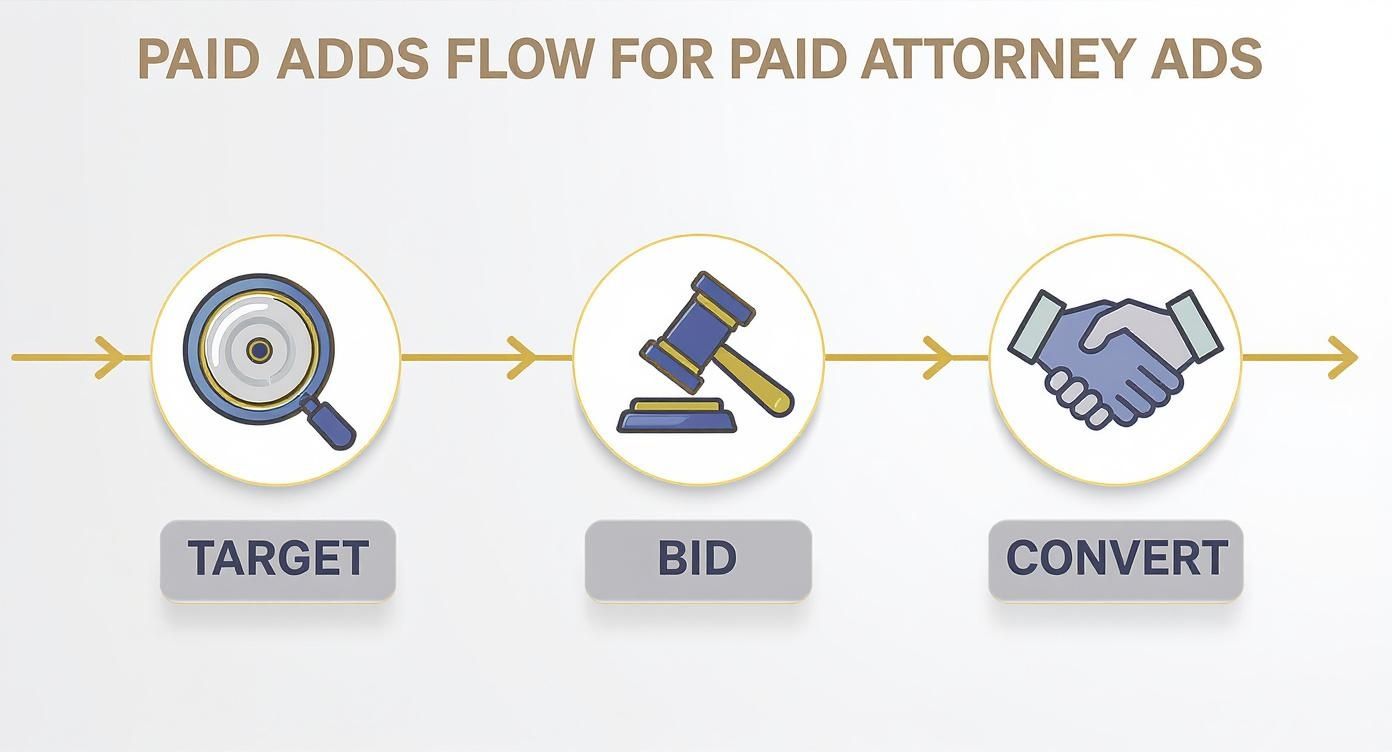
The key insight here is that every stage requires attention, but automating what happens after a lead converts is the secret to making your ad spend work harder for you.
Set Up Automated Email Sequences That Nurture Leads
An automated email sequence is a series of pre-written emails sent to a prospect over a set period. It’s the safety net that ensures no lead ever falls through the cracks and keeps your firm top-of-mind without you lifting a finger.
Think of it as your digital assistant who never forgets to follow up. You can build different sequences for different lead types—one for new B2B prospects, another for website inquiries, and a third for old contacts you want to warm back up.
Here’s a simple three-email sequence you can use for a new B2B prospect:
The Value-First Intro: Your first email should never be a sales pitch. Offer something genuinely useful. Share a link to a relevant blog post, a short guide on a common legal pitfall in their industry, or an invite to a free webinar.
The Gentle Nudge: A few days later, a short, friendly email is all it takes. "Just wanted to make sure you saw my previous note. Did you find that guide on [Topic] helpful?" This keeps the conversation alive without being pushy.
The Final Check-In: After about a week, send one last message offering to be a resource. "I know you're busy, so I'll leave it here for now. If you ever have questions about [Your Practice Area], my door is always open."
You write these emails once, and your software sends them to hundreds or thousands of prospects. As you grow, you can explore more advanced strategies covered in our guide to marketing automation best practices. This is how you build a powerful, scalable lead generation system that works around the clock.
Master Your Intake Process to Convert More Leads
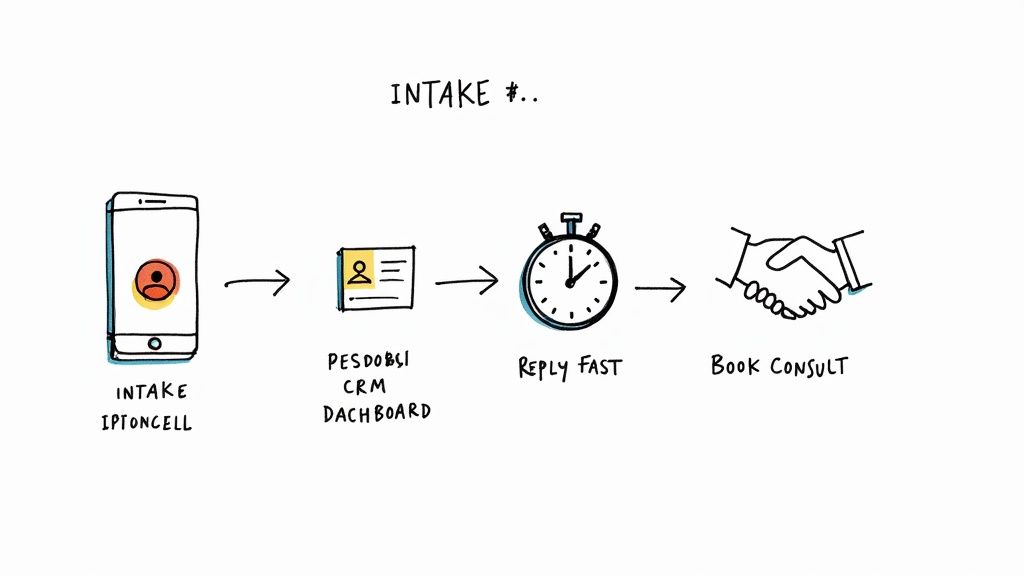
All the hard work you pour into SEO, ads, and outreach is for nothing if your client intake process is leaky. A lead is just a name and an email until they sign a retainer agreement, and that critical transition happens in the first few moments after they reach out.
Firms with amazing marketing can lose clients because their intake was slow, disorganized, or clunky. Mastering this final step is what separates firms that just get by from the ones that truly scale.
The Staggering Importance of Speed
In the legal world, speed is a competitive weapon. When potential clients are in the middle of a legal crisis, they are in a state of high urgency and will not wait around.
The data on this is eye-opening. Studies show that 80% of legal consumers will hire another firm if they don't get a response within 48 hours. But in reality, 48 hours is an eternity. The top-performing firms know the real magic happens much faster. In fact, 25% of law firms already respond to new inquiries in under five minutes.
Every minute you wait to respond to a new lead, the odds of them calling your competitor skyrocket. Your goal should be to make contact almost instantly, even if it's just an automated text saying, "We got your message and will call you in 5 minutes."
That first touchpoint sets the entire tone. A fast, professional response builds immediate trust and signals that you take their problem seriously.
Actionable Strategies to Boost Your Response Time
Getting back to someone in minutes might sound impossible, but it’s achievable with the right systems.
Automated Email & Text Acknowledgments: Set up an immediate auto-responder for your web forms. It should confirm you received their message and tell them exactly when to expect a personal follow-up. This simple trick buys you time and manages expectations.
Use a Simple CRM: A Customer Relationship Management (CRM) tool is your command center for new leads. It stops inquiries from getting buried in a messy inbox and can automatically route leads to the right person for immediate follow-up.
Live Chat and SMS Options: Not everyone wants to pick up the phone. Offering live chat on your site or a text-to-connect option can be a game-changer for capturing leads who prefer instant messaging.
If you're ready to get serious, exploring dedicated client intake software for law firms can completely transform your ability to convert leads into paying clients.
Nail the First Call with Proven Best Practices
That first call is your audition. It's your one shot to make a great first impression and turn a nervous person into a booked consultation.
Here’s how to nail it every time:
Lead with Empathy: Start the conversation by acknowledging their situation. A simple, "That sounds incredibly stressful, I'm glad you called us," immediately puts them at ease.
Ask Open-Ended Questions: Don't just fire off a checklist of questions. Instead, ask things like, "Can you walk me through what happened from the beginning?" This gets them talking, and your job is to listen more than you speak.
Outline Clear Next Steps: End the call with a firm plan. Tell them exactly what happens next, whether it’s "I'm emailing you our intake form right now," or "Jane will call you in the next hour to schedule your consultation."
Track Your KPIs to Find and Fix Bottlenecks
You can't improve what you don't measure. Tracking a few key performance indicators (KPIs) will show you exactly where your intake process is strong and where it's breaking down.
Start monitoring these essentials:
Lead-to-Consultation Rate: What percentage of qualified leads book a consultation? If this number is low, something is wrong with your initial response or the first call.
Consultation-to-Client Rate: Of all the people you consult with, how many sign on as clients? This metric shows how effective your attorneys are at closing during the consultation.
Average Response Time: Track, in minutes, how long it takes for that first contact to happen. Push your team to get this number as close to zero as possible.
By obsessing over these KPIs, you can find and eliminate friction in your process, turning more of those hard-won leads into revenue.
Frequently Asked Questions
Jumping into lead generation stirs up a lot of questions. From budgets to bar association rules, you need real answers to build a plan that works. Let's break down some of the most common topics.
How Much Should a Law Firm Spend on Lead Generation?
Everyone wants a magic number, but the honest answer is: it depends. The go-to benchmark is somewhere between 2% to 15% of your gross revenue.
That's a huge range. A brand-new firm will invest more heavily than an established practice coasting on referrals.
Instead of obsessing over the initial spend, focus on your return on investment (ROI). You don't need a massive budget to get started.
Start lean. Pick one or two channels, like Google's Local Services Ads or a targeted local SEO push. Put a smart, manageable budget there first.
Track everything. Know your cost per lead (CPL), but more importantly, know exactly what it costs you to acquire a new, signed client.
Double down on winners. Once you find a channel that’s bringing in profitable cases, that's when you can confidently open up the budget and scale.
What Are Common Ethical Pitfalls in Attorney Advertising?
Navigating your state bar association’s advertising rules is non-negotiable. One small slip-up can lead to massive headaches.
Most of the time, attorneys get into trouble over a few key things:
Making claims that sound like a guarantee ("We'll win your case!").
Using actors in testimonials without a clear disclaimer.
Directly soliciting clients in prohibited ways, like contacting recent accident victims.
In the digital age, this gets even trickier. Every online testimonial has to be real and verifiable. You can't just say you "specialize" in something unless you have the official certification to back it up. Before a single ad, email, or blog post goes live, have another lawyer review it for compliance.
How Long Does It Take for Attorney SEO to Show Results?
Think of SEO as investing in real estate, not playing the lottery. It's a long-term strategy that builds a valuable asset for your firm over time.
You'll probably see some encouraging signs—keywords climbing the ranks, a bump in traffic—within the first 3 to 4 months. But for a game-changing increase in leads, you need to be patient. We're typically talking 6 to 12 months to see a major impact, depending on how competitive your practice area is.
Local SEO can often get you wins much faster. The key is relentless consistency. Keep creating helpful content, fine-tuning your site, and building local directory listings. The results will come.
Tired of building prospect lists by hand? Clura is a browser-based AI agent that does the heavy lifting for you—scraping, organizing, and exporting clean data from any website with a single click. Explore prebuilt templates today!
