
Discover 10 sales prospecting best practices to build better lists, personalize outreach, and close more deals. Learn how to automate workflows and win.
Struggling to build high-quality lead lists and get responses? In today's crowded market, generic outreach and manual research no longer cut it. Winning sales teams are ditching high-volume, low-quality tactics for data-driven, personalized engagement. The difference lies in using modern tools to find the right prospects, understand their needs, and reach them at the perfect moment.
This guide unpacks the most essential sales prospecting best practices that transform your process from a guessing game into a predictable revenue engine. Forget outdated cold-calling scripts and endless manual list-building. We’re diving straight into actionable strategies that deliver real results and help you connect with genuinely interested buyers.
You’ll learn how to:
Build hyper-targeted lists with automated data enrichment.
Monitor real-time buying signals and trigger events.
Personalize outreach at scale using research-backed insights.
Implement multi-channel cadences that actually get replies.
We're going beyond the basics to provide a clear, step-by-step framework for modernizing your entire prospecting workflow. For an in-depth look at implementing modern strategies, you can explore these 10 Sales Prospecting Best Practices which offer a great foundation. By mastering these techniques, you'll stop chasing dead-end leads and start building a pipeline filled with opportunities ready to close. Let’s get started.
1. Build Targeted Prospect Lists with Data Enrichment
Forget casting a wide, ineffective net. The foundation of successful sales prospecting is starting with a hyper-targeted, data-rich prospect list. Data enrichment is the game-changing process of taking a basic list of names or companies and layering on crucial details that turn raw data into actionable intelligence. This means adding missing contact info, firmographics, and even behavioral signals to build a complete picture of your ideal customer.
Instead of just having a company name, you'll have the direct email and LinkedIn profile of the Head of Marketing, their company’s annual revenue, the technologies they use, and recent hiring trends. This strategic approach ensures your outreach is relevant, timely, and directed at decision-makers who actually have the authority to buy. To dig deeper into how this process works, you can explore the fundamentals of what data enrichment is and how it powers modern sales teams.
How to Implement Data Enrichment
This practice is essential when you need to transform an incomplete list into a high-value asset for your sales team. It's particularly powerful for B2B SaaS companies entering a new market or recruiting agencies building candidate pipelines.
Define Your ICP First: Before enriching any data, have a crystal-clear Ideal Customer Profile (ICP). Document the job titles, company sizes, industries, and geographic locations you're targeting. This prevents wasting resources on irrelevant contacts.
Automate List Building: Use an AI-powered browser automation tool like Clura to automate prospect discovery from multiple sources simultaneously. For example, you can create a workflow that scrapes new Director-level marketing roles from LinkedIn and automatically enriches those profiles with verified corporate email addresses.
Validate and Verify: Enriched data is only useful if it's accurate. Implement a verification step to check email formats and confirm that a contact still works at the target company. This dramatically reduces bounce rates and protects your sender reputation.
Segment for Prioritization: Don't treat your enriched list as a single entity. Segment it by tiers based on decision-making authority, company size, or engagement signals to prioritize your outreach effectively.
2. Monitor Buying Signals and Intent Data
Timing is everything in sales. Instead of cold calling a static list, the most effective sales prospecting best practices involve listening for "buying signals" that indicate a prospect is actively looking for a solution like yours. Intent data is the fuel for this strategy, tracking digital behaviors like website visits, content downloads, and technology changes that signal a prospect is entering a buying cycle. It’s about moving from "who" to "when."
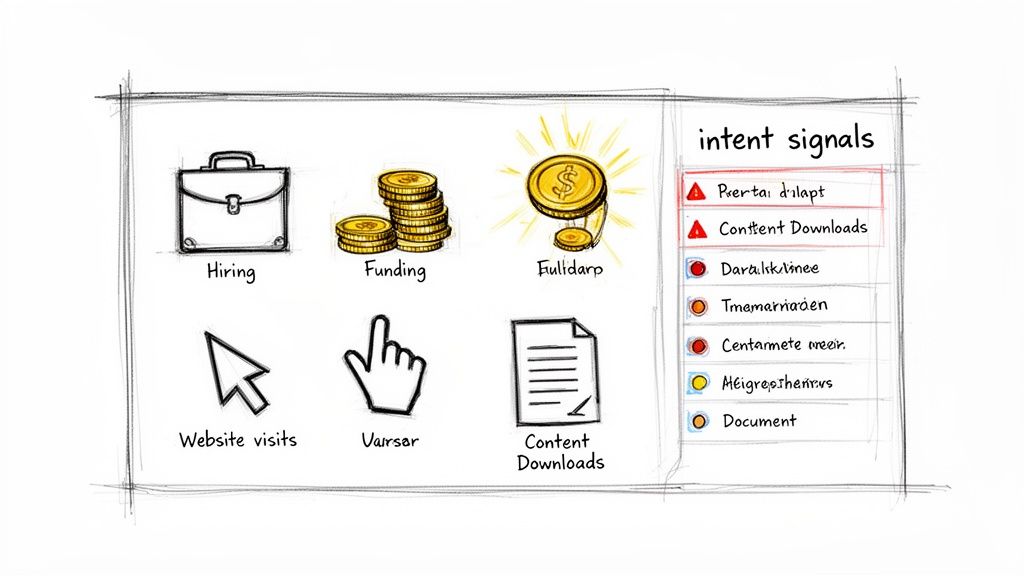
This proactive approach transforms your outreach from an interruption into a timely, relevant conversation. By monitoring signals like new executive hires on LinkedIn or recent funding announcements on Crunchbase, you can engage prospects at the precise moment they have a problem, a budget, and an urgent need to solve it. This ensures you’re not just reaching out—you’re reaching out at the perfect moment.
How to Implement Intent Data Monitoring
This practice is crucial when you want to focus your team’s efforts on the most "in-market" buyers to shorten sales cycles and improve efficiency. It is especially powerful for B2B technology companies selling high-value solutions or any sales team looking to gain a competitive edge.
Define Your Key Signals: Identify the specific events that indicate a company is a good fit. For a cybersecurity firm, this could be a new CISO hire. For an HR software provider, it might be a surge in "Recruiter" job postings.
Automate Your Monitoring: Use a workflow automation tool to create triggers for your key signals. For instance, set up an alert that notifies you whenever a target account in your CRM posts a job for a "Head of Sales Operations," indicating a potential need for new sales tools.
Combine Multiple Signals: Increase your confidence by layering different intent signals. A company that recently received Series B funding and is hiring its first-ever VP of Marketing is a significantly hotter lead than a company showing only one of these signals.
Act with Speed: The window of opportunity is small. When a high-intent signal is detected, aim to make contact within 24-48 hours. Create pre-built outreach templates tailored to specific signals (e.g., "Congrats on the new funding!") to enable rapid, relevant engagement.
3. Implement Multi-Channel Prospecting Outreach
Don’t limit your outreach to a single channel. One of the most critical sales prospecting best practices is to engage potential customers across multiple platforms in a coordinated sequence. This multi-channel approach recognizes that prospects have different communication preferences; some live in their inbox, while others are more responsive on LinkedIn or even a quick phone call. By strategically combining email, social media, and phone calls, you amplify your message and significantly increase your chances of getting a response.
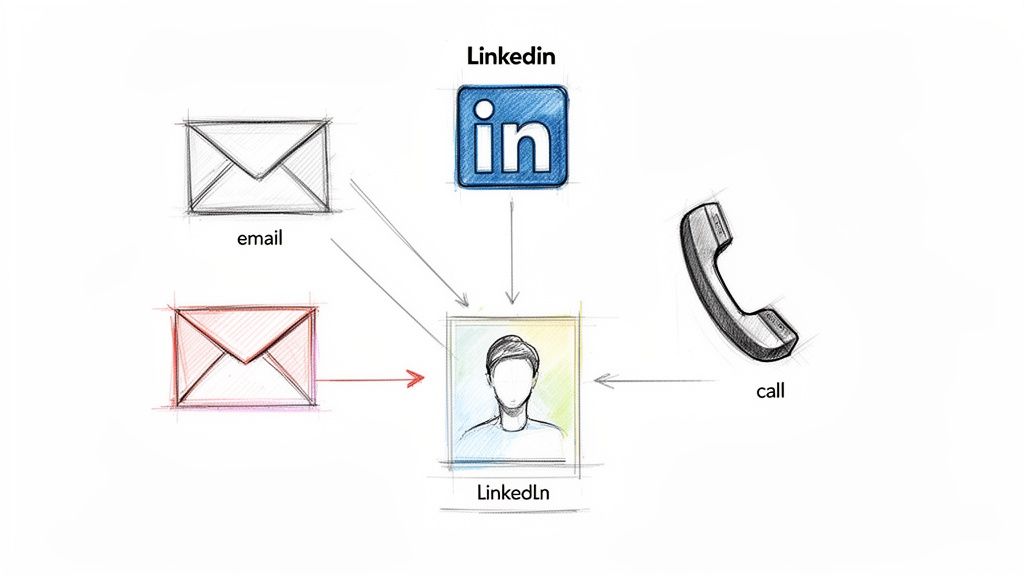
Executing this strategy effectively means moving beyond random acts of outreach. Instead, you build intentional sequences, or cadences, that create a persistent, professional, and valuable presence. The goal isn't to overwhelm prospects but to connect with them where they are most active, building familiarity and trust with each interaction.
How to Implement Multi-Channel Outreach
This practice is indispensable for any modern sales team, especially account executives targeting high-value accounts or recruiters pursuing passive candidates. It ensures your message breaks through the noise by creating multiple opportunities for engagement.
Map Your Ideal Sequence: Plan your outreach cadence before you start. A proven sequence might be: Day 1 - Personalized Email, Day 2 - LinkedIn Connection Request, Day 4 - Follow-up Email, Day 6 - LinkedIn Profile View or Post Engagement, Day 8 - Phone Call. This structured approach keeps you organized and persistent.
Personalize Each Touchpoint: Tailor your message to the channel. Your email can be more detailed, your LinkedIn message more conversational, and your phone call focused on a single, compelling question. Avoid copy-pasting the same message everywhere.
Enable Seamless Execution: To run a multi-channel strategy, you need complete contact profiles. Use a tool like Clura to find both a prospect's verified email address and their LinkedIn profile URL from the start. This prevents delays and allows you to execute your sequence smoothly.
Track Channel Performance: Pay close attention to which channels yield the best results for different personas. You might find that C-level executives respond better to email, while VPs of Sales are more active on LinkedIn. Use this data to refine your sequences over time.
4. Personalize Outreach with Research-Backed Insights
Move beyond simple mail-merge fields like {{first_name}}. True personalization is crafting customized messages grounded in deep research about your prospect's company, role, recent activities, and specific challenges. This research-backed approach demonstrates a genuine understanding of their world, transforming your outreach from intrusive spam into a welcomed, consultative conversation. It’s a core tenet of modern sales prospecting that dramatically improves response rates.
Instead of sending a generic pitch, you’re referencing a new product they just launched, a recent executive hire, or a specific challenge mentioned in their latest quarterly report. This strategy proves you’ve done your homework and aren't just blasting a template to thousands of contacts. It shows you respect their time and are serious about providing value.
How to Implement Research-Backed Personalization
This practice is non-negotiable for any high-value outreach, especially when targeting enterprise accounts, senior decision-makers, or competitive markets. It's the difference between being ignored and starting a meaningful sales dialogue.
Create a Research Checklist: Before contacting a prospect, build a template to quickly gather key insights. This should cover their company’s recent news, their specific role and responsibilities, recent LinkedIn activity (posts, comments, articles), and any available tech stack information.
Leverage Automated Research: Use an AI-powered browser scraper to rapidly collect data from a target company’s website, career page, and news releases. For instance, a sales rep can identify that a company is hiring for new "data analyst" roles, then reference this team expansion as a trigger to introduce their analytics software.
Reference Specific, Recent Events: Your opening line should be a hook. Instead of "I see you work in marketing," try "Congrats on the launch of your new eco-friendly product line last week; the packaging looks fantastic." This is specific, timely, and relevant.
Connect on a Human Level: Look for common ground beyond business. Mention shared connections, alma maters, or interests from their LinkedIn profile. This builds rapport and makes your message stand out in a crowded inbox.
5. Focus on an Account-Based Prospecting Strategy
Move beyond targeting individuals and start treating high-value companies as entire markets of one. Account-Based Prospecting flips the traditional sales funnel on its head. Instead of casting a wide net for individual leads, you identify and engage multiple key stakeholders within a specific set of target accounts simultaneously. It's a coordinated, strategic approach designed to win complex, high-value deals.
This methodology aligns sales and marketing efforts to deliver personalized, relevant messaging to the entire buying committee. For example, an enterprise software company can map out the key decision-makers at a Fortune 500 account and coordinate email, LinkedIn, and event invitations to the CEO, CTO, and Head of Procurement, ensuring a consistent and powerful message. This approach is one of the most effective sales prospecting best practices for enterprise sales.
How to Implement an Account-Based Strategy
This highly focused strategy is essential for B2B companies with long sales cycles and high-value contracts. It’s perfect for breaking into large, complex organizations where multiple approvals are required to close a deal.
Select Your Target Accounts: Don't try to boil the ocean. Start with a focused list of 20-50 high-value accounts that perfectly match your Ideal Customer Profile. Prioritize accounts with the highest revenue potential and strategic value.
Map the Buying Committee: Use a tool like Clura to instantly identify and map the complete buying committee within each target account. Instead of spending hours on manual research, you can quickly find all relevant stakeholders, from executive sponsors to technical evaluators and end-users.
Create Persona-Specific Messaging: Tailor your outreach for each role. The CFO cares about ROI and cost savings, while the CTO is focused on integration and security. Your messaging should reflect a deep understanding of each stakeholder's unique challenges and priorities.
Coordinate Multi-Channel Outreach: Align your team's efforts across different channels. A sales rep might send a personalized email to the VP of Sales while marketing targets them with relevant case studies on LinkedIn, creating a surround-sound effect that builds familiarity and trust.
Track Account-Level Engagement: Shift your metrics from individual lead scores to account-level engagement. Monitor how many stakeholders from a target account are interacting with your content, visiting your website, or responding to outreach to gauge overall buying intent.
6. Leverage Trigger Events for Timely Outreach
One of the most powerful sales prospecting best practices is capitalizing on trigger events. Instead of reaching out cold, trigger-based prospecting involves monitoring key events at a target company that signal an urgent need or a window of opportunity. These events, like a new funding round, a key executive hire, or a merger, create an immediate and compelling reason for a prospect to consider new solutions.
This approach transforms your outreach from an interruption into a timely, relevant conversation. Imagine reaching out to a newly hired VP of Engineering right as they are evaluating their tech stack. This strategy ensures you connect with decision-makers at the exact moment they are most open to change. To excel at this, you must understand the landscape of what competitive intelligence is and how it fuels proactive sales plays.
How to Implement Trigger-Based Outreach
This practice is a must-have for any B2B sales team that wants to move faster and connect with more relevance than its competitors. It’s especially effective for tech sales teams, M&A advisors, and service providers whose solutions align with major business changes.
Systemize Your Monitoring: Create a dedicated system to track multiple trigger sources daily. Use an AI-powered scraping tool to set up alerts for news, LinkedIn job changes, funding announcements on Crunchbase, and new technology adoption signals across your target accounts.
Develop Trigger-Specific Playbooks: Don't use a one-size-fits-all message. Build specific outreach templates and talking points for each trigger type. For example, a message for a new CTO hire should be different from one sent after a major funding round.
Act with Urgency: The window of opportunity for a trigger event is small. Assign responsibility for a rapid response, aiming to make contact within 24-48 hours of detecting the event. Speed is a massive competitive advantage here.
Identify All Key Stakeholders: When a trigger event occurs, like an acquisition, the initial contact might not be the only decision-maker. Use a tool like Clura to quickly map out the entire relevant buying committee at the company to enable a multi-threaded outreach strategy.
7. Build Relationships Before Asking for the Sale
Move away from the transactional mindset and embrace the power of genuine connection. The best sales prospecting practices prioritize building trust and rapport long before a pitch is ever made. This relationship-first approach recognizes that modern buying decisions are rooted in credibility and value, not aggressive sales tactics. By consistently providing helpful insights and engaging authentically, you transform from a cold caller into a trusted advisor.
This strategic patience builds a foundation of goodwill that dramatically increases conversion rates when you finally make an ask. Instead of pushing for a meeting immediately, you earn the right to their time. This method ensures that when you do reach out directly, the prospect already knows who you are and recognizes the value you bring to the table.
How to Implement Relationship-Based Prospecting
This practice is crucial for high-value B2B sales cycles where trust is a major factor. It’s a long-term strategy that builds a sustainable pipeline of warm, receptive leads.
Engage with Intent: Use a tool to identify a prospect’s LinkedIn profile and recent activity. Don't just "like" their posts; leave thoughtful comments that add to the conversation or share relevant articles that align with their interests.
Provide Value First: Create and share point-of-view content, such as industry research or insightful analysis, that your ideal prospects would naturally want to consume. Position yourself as an expert in their field.
Be a Connector: If you can introduce a prospect to someone valuable in your network without any expectation of return, do it. This selfless act builds immense social capital and credibility.
Track Your Engagement: Don't just track calls and emails. Monitor relationship-building metrics like the frequency of your non-sales interactions and the depth of your conversations. This helps you know when the time is right to ask for a meeting.
8. Automate Prospecting and Maintain Verified Contact Data
Scaling your prospecting efforts doesn't have to mean sacrificing quality. The most effective sales prospecting best practices involve smart automation that handles repetitive tasks while you focus on high-value conversations. This means automating list building, data enrichment, and even initial outreach—but with a crucial second component: rigorous data verification. This two-pronged approach ensures your pipeline is always full and your outreach is always accurate.
Think of it as building an intelligent prospecting machine. Instead of manually scraping LinkedIn profiles or company websites, an AI-powered automation tool does the heavy lifting, feeding fresh, relevant leads directly into your workflow. To master the first step of this process, you can explore the power of web scraping for lead generation and how it fuels modern sales engines.
How to Automate Prospecting Workflows
This strategy is a lifesaver for any team that needs to scale its outreach without hiring an army of SDRs. It’s perfect for a B2B SaaS company entering new verticals or a recruiting agency that needs to constantly source candidates from job boards.
Automate Data Gathering First: Start by automating the most time-consuming part of prospecting: finding leads. Use a tool like Clura to create workflows that automatically scrape job boards, professional networks, or company websites for new contacts that match your Ideal Customer Profile.
Layer in Outreach Automation: Once your list-building is on autopilot, connect it to your sales engagement platform. For example, have new leads from Clura automatically enter a personalized, multi-step email and LinkedIn sequence.
Prioritize Data Verification: Automation amplifies everything, including errors. Before any contact enters a sequence, run their email through a verification service. This protects your sender reputation and is vital to ensure strong email deliverability, making sure your messages actually land in the inbox.
Monitor and Refresh: Your automated system isn't "set it and forget it." Regularly monitor bounce rates, open rates, and reply rates to identify issues. Implement a quarterly data refresh to capture job changes and remove stale contacts, keeping your database clean and effective.
9. Qualify Prospects Using Defined Criteria (BANT/MEDDIC)
Stop wasting precious time chasing leads that will never close. One of the most critical sales prospecting best practices is systematically qualifying prospects before you invest significant outreach effort. Using established frameworks like BANT (Budget, Authority, Need, Timeline) or MEDDIC ensures your sales team focuses its energy exclusively on genuinely viable opportunities.
Instead of guessing if a prospect is a good fit, you assess them against a clear, objective checklist. This strategic discipline moves your process from a game of chance to a calculated science. It ensures that every minute spent on outreach is directed toward a lead that has demonstrated the core characteristics of a future customer.
How to Implement Prospect Qualification Frameworks
This practice is essential for any sales team looking to improve its close rate and shorten its sales cycle. It's especially powerful for enterprise software companies with long sales processes or B2B service agencies that need to ensure a prospect can afford their retainers.
Define Your Criteria Upfront: Before you even build a list, determine your non-negotiable qualification criteria. What is the minimum company size, required technology, or specific job title that makes a prospect viable? This acts as your first line of defense against poor-fit leads.
Use Data for Initial Filtering: Leverage data enrichment to pre-qualify prospects at scale. For example, a SaaS sales team can automatically filter for companies that have recently received funding (Budget), hired a new VP of Engineering (Authority), and are actively hiring for roles that use their technology (Need).
Create a Simple Scoring Model: You don't need a complex algorithm. Assign a simple point value to each of your key criteria (e.g., 5 points for having the budget, 3 for an identified need). This allows you to quickly rank and prioritize your outreach list, focusing on the highest-scoring prospects first.
Incorporate Behavioral Triggers: Go beyond static firmographics. Use signals like a key contact visiting your pricing page or a company posting a relevant job description as strong indicators of Need and Timeline. These real-time triggers are qualification gold.
10. Measure and Optimize Prospecting Performance
You can't improve what you don't measure. One of the most critical sales prospecting best practices is moving from a "spray and pray" mindset to a data-driven one by consistently tracking key performance indicators (KPIs). This practice involves defining, measuring, and analyzing quantifiable metrics throughout your prospecting funnel to understand what’s working, identify bottlenecks, and prove the return on your team's effort. It’s about turning your prospecting into a science, not an art.
This data-first approach empowers you to make strategic decisions backed by evidence. Instead of guessing which outreach channel is best, you’ll know. For example, a sales manager might track that prospect lists built with an AI-powered scraping tool from LinkedIn yield a 15% response rate, compared to just 6% from generic trade show lists. This single insight immediately tells them where to invest their list-building resources for maximum impact.
How to Implement Performance Measurement
This practice is essential for any sales team aiming for scalable, predictable growth. It's particularly vital when you’re testing new messaging, exploring new markets, or trying to optimize your team's efficiency and resource allocation.
Define Your Core Metrics: Before launching any campaign, establish your primary KPIs. Key metrics include outreach volume (emails sent, calls made), response rates, meetings booked, pipeline generated, and ultimately, closed-won deals from prospecting efforts.
Track Source Quality: Not all leads are created equal. Tag and monitor the performance of prospects from different sources. For instance, track if candidates sourced via LinkedIn have a higher placement rate than those from job boards.
Run A/B Tests: Continuously test variables to find what resonates. Pit different email subject lines, personalization tactics, or call-to-action phrases against each other and let the data declare the winner. For instance, test if referencing recent company funding news boosts reply rates.
Build Performance Dashboards: Create a centralized dashboard that gives everyone on the team real-time visibility into prospecting performance. This fosters accountability and allows you to spot trends, both positive and negative, early enough to take action.
10-Point Sales Prospecting Best Practices Comparison
Strategy | Implementation complexity | Resource requirements | Expected outcomes | Ideal use cases | Key advantages |
|---|---|---|---|---|---|
Build Targeted Prospect Lists with Data Enrichment | Moderate — integrate multiple data sources and enrichment tools | Data subscriptions, ETL/integration, validation processes | Higher conversion rates, precise segmentation, scalable lists | B2B lead gen, recruiting, market research | Qualified, contextual contact data; faster outreach prep |
Monitor Buying Signals and Intent Data | High — continuous monitoring and signal correlation | Intent platform, real-time feeds, analyst workflows | Timely outreach, shorter sales cycles, prioritized accounts | Time-sensitive selling, ABM, expansion plays | Detects active buyers; enables rapid, opportune engagement |
Implement Multi-Channel Prospecting Outreach | High — sequencing and channel integrations required | Engagement platforms, verified contacts, coordination effort | Increased contact and response rates; richer engagement data | Complex sales, varied personas, account penetration | Reaches prospects on preferred channels; personalization across touchpoints |
Personalize Outreach with Research-Backed Insights | Moderate–High — systematic research and templating | Research tools, time per prospect, personalization templates | Higher open/response rates; stronger credibility in first contact | High-touch outreach, enterprise deals, competitor displacement | Differentiated messaging; builds trust and relevance |
Focus on Account-Based Prospecting Strategy | High — account mapping and cross-team coordination | ABM tools, sales-marketing alignment, deep account research | Higher win rates, larger deal sizes, better retention | Enterprise accounts, strategic deals, long cycles | Multi-stakeholder engagement; efficient resource allocation |
Leverage Competitive Trigger Events for Outreach | Moderate — monitor events and maintain rapid response playbooks | News/job/funding feeds, rapid-response team, trigger templates | Higher receptivity when timed correctly; improved conversion | Competitive displacement, vendor replacement, M&A opportunities | Timely, event-driven outreach with strong conversation starters |
Build Relationships Before Asking for the Sale | Low–Moderate — consistent long-term effort, less tooling | Time, content creation, authentic social engagement | Stronger trust, higher-quality conversations, referrals over time | Thought leadership, passive candidate nurture, long-term accounts | Deep credibility and advocacy; lower buyer resistance |
Automate Prospecting and Maintain Verified Contact Data | High — build and maintain automation + verification workflows | Automation platforms, verification services, integrations, maintenance | Scale outreach, improved deliverability, reduced manual work | High-volume outreach, scaling SDR teams, repeatable ops | Efficiency at scale; data hygiene and consistent processes |
Qualify Prospects Using Defined Criteria (BANT/MEDDIC) | Moderate — implement scoring and process rigor | Qualification frameworks, scoring data, team training | Cleaner pipeline, shorter cycles, better forecasting accuracy | Complex sales, limited resources, prioritizing outreach | Focuses effort on viable opportunities; improves win rates |
Measure and Optimize Prospecting Performance with Key Metrics | Moderate–High — tracking and analytics infrastructure needed | Analytics/BI tools, disciplined data capture, reporting cadence | Data-driven improvements, validated ROI, optimized tactics | Scaling orgs, ops improvement, leadership reporting | Identifies effective tactics; enables continuous optimization |
Start Prospecting Smarter, Not Harder
You've made it through the definitive guide to modern sales prospecting. The era of cold calling from a phonebook is over. Today's most successful sales teams are working smarter, armed with data, technology, and a deep understanding of their ideal customer. The ten sales prospecting best practices we've explored are interconnected components of a powerful, modern revenue engine.
Think of it as building a high-performance machine. You start with your Ideal Customer Profile. Then, you source the highest quality parts by building targeted lists and enriching them with verified data. You add a sophisticated sensor system to monitor buying signals, intent data, and trigger events, ensuring you engage at the perfect moment. The fuel for this engine is authentic, research-backed personalization, delivered through a multi-channel outreach cadence that meets prospects where they are.
Weaving the Threads Together
The real magic happens when these practices become your team's core operating system. Account-based prospecting isn't just a strategy; it's a commitment to treating your most valuable potential customers like VIPs. Building relationships before you ask for the sale isn't just polite; it's the foundation of long-term trust and higher lifetime value.
To truly excel, you must embrace two final, crucial elements:
Intelligent Qualification: Stop chasing every lead. By rigorously applying frameworks like BANT or MEDDIC, you ensure your team's time is spent on opportunities with the highest probability of closing.
Relentless Optimization: You cannot improve what you do not measure. Tracking key metrics like conversion rates by channel and meetings booked isn't just about reporting; it's about gaining the insights needed to refine your approach.
Your Action Plan for Prospecting Excellence
Mastering these sales prospecting best practices is your ticket to a predictable, scalable sales pipeline. It’s the difference between hoping for a good quarter and engineering one. You now have the knowledge to transform your outreach from a scattergun blast into a series of surgical, well-timed engagements that resonate with buyers.
Don't let this be just another article you read. Pick one or two practices to implement this week. Start by automating your list-building process. Begin monitoring one key buying signal for your top accounts. Draft a new, highly personalized email template based on deep research. Small, consistent actions will compound into massive results.
Ready to put these sales prospecting best practices into action without the manual busywork? Clura is the AI-powered platform designed to automate your lead discovery, data enrichment, and outreach list-building in minutes. Explore our prebuilt templates and start building hyper-targeted, verified prospect lists today.
