Wondering what is data enrichment? Discover how to turn raw contact lists into powerful business intelligence that drives real growth and competitive advantage.
Data enrichment is the process of taking the raw, basic data you already have and making it better. It’s all about adding new, relevant information from external sources to create a complete, actionable picture of your customers, leads, or products.
Think of it like this: you have a blurry, black-and-white photo of a potential customer. Data enrichment turns that into a vibrant, high-definition portrait. You might start with a single piece of information, like an email address, and enrichment adds all the color and context.
It’s the secret sauce that transforms incomplete data from a liability into your most powerful strategic asset.
What Is Data Enrichment in Simple Terms?
Let's get practical. At its core, data enrichment means taking your internal data (like a simple list of names and emails) and merging it with fresh, verified information from trusted external sources.
The goal is to fill in the gaps and build a complete profile that tells a story. This extra info can be anything from a person’s job title and company size to their industry or even their professional social media profiles.
Data enrichment transforms raw data into a genuine business advantage. You go from just knowing who your customer is to truly understanding their professional world, their needs, and their background.
From Raw Data to Actionable Insights
Imagine your sales team gets a new lead—just a name and an email address. That's raw data. It’s a start, but you can’t do much with it.
Now, let’s apply data enrichment. Suddenly, that single contact point blossoms into a detailed profile.
You now have the kind of details that drive smart decisions:
Firmographic Data: You know the company’s size, annual revenue, and industry.
Demographic Data: You see their job title, seniority level, and location.
Technographic Data: You get a peek into the software and tools their company uses.
This is how a cold lead becomes a warm, qualified opportunity. Your team can now personalize outreach with incredible precision, segment audiences like never before, and qualify leads more accurately. In short, data enrichment makes every interaction smarter.
The table below shows the "before and after" effect, highlighting the business value you unlock.
Raw Data vs. Enriched Data at a Glance
This table compares basic data points with their enriched counterparts to show the added value.
Data Type | Raw Data Example | Enriched Data Example | Business Value |
|---|---|---|---|
Contact Info | John Doe, VP of Marketing, San Francisco | Enables personalized and role-specific outreach. | |
Company Name | Acme Corp | Acme Corp, 500+ employees, B2B SaaS | Helps qualify leads based on your ideal customer. |
Tech Stack | (Unknown) | Uses HubSpot, Salesforce, and Slack | Allows for targeted messaging around integrations. |
Social Profile | (Unknown) | LinkedIn: linkedin.com/in/johndoe | Provides insights into professional interests. |
See the difference? You move from vague to specific, from generic to strategic. That’s the power of having rich, contextual data at your fingertips.
Why High-Quality Data Is Mission-Critical
The game has changed. It's no longer about who collects the most data. The real winners are the ones who use data to outsmart the competition. This is where high-quality, enriched data becomes your secret weapon.
Trying to run a business on bad data is like navigating a new city with a blurry, outdated map—you’re just going to get lost. Incomplete or inaccurate information leads to wasted time, money, and missed opportunities. Data enrichment sharpens your map, giving you the clarity to make bold, confident moves.
The Explosive Growth of Data Enrichment
This isn't a fleeting trend; it's a massive shift in how modern businesses operate. The proof is in the market itself. The global market for data enrichment tools skyrocketed from $1.1 billion in 2020 to over $5 billion by 2025.
That explosive growth tells you one thing: companies everywhere are waking up to the power of turning basic information into a strategic asset.
And the momentum isn't slowing down. Forecasts suggest the market could surge to $15 billion or more by 2035, with cloud-based solutions leading the charge. The message is clear: if you want to stay relevant, mastering your data is non-negotiable.
The bottom line is simple: companies are investing billions because enriched data delivers a clear, measurable return. It's the engine behind smarter marketing, more efficient sales, and stronger customer relationships.
Driving a Real Competitive Advantage
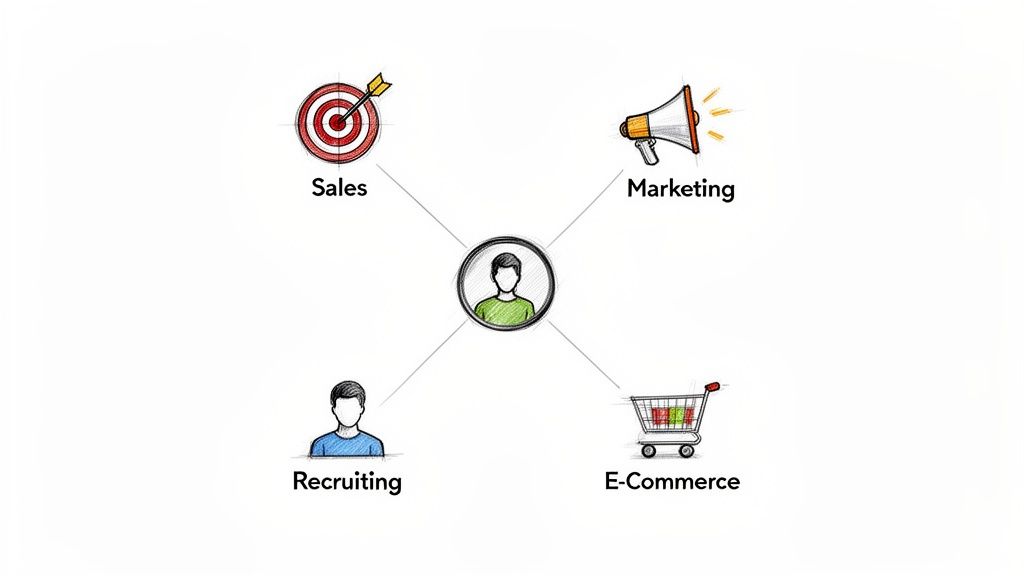
When your data is top-notch, every department gets a performance boost. Your sales team can spot the hottest leads. Marketing can craft personal campaigns that connect. Recruiters can find the perfect candidates before anyone else does.
This goes beyond just being more efficient. It’s about building a genuine, lasting edge. Whether you're a startup or a major enterprise, the quality of your data separates you from the pack.
Of course, knowing why you need great data is the first step. The next is learning how to improve data quality with practical strategies. Getting this foundation right ensures every decision is built on a rock-solid base of accurate information.
How the Data Enrichment Process Works
So, how does this data magic happen? It’s a straightforward process that’s now easier than ever, thanks to modern AI tools.
Think of it like being a detective. You start with a clue—like an email address. Then, you cross-reference that clue with reliable sources to build a complete profile. What used to be a manual, mind-numbing task is now an automated powerhouse for any team.
The 3 Core Steps of Enrichment
The data enrichment process turns a flimsy piece of information into a solid gold asset in three key phases.
Standardize and Validate: First, you have to clean up the data you already have. This step corrects formatting, fixes typos, and ensures everything is consistent. It's like tidying your desk before a big project—you need an organized foundation.
Match and Merge: Next, the system takes a unique identifier, like an email or a company domain, and scours massive third-party databases to find a match. Once found, it intelligently merges the new information with your original record, filling in the missing pieces.
Append New Data: This is the finale. All that fresh, verified information is officially added—or "appended"—to your contact's profile. Your blurry snapshot of a person instantly sharpens into a high-definition portrait, complete with their job title, company size, tech stack, and more.
This entire workflow has become incredibly simple thanks to modern tools. You don't need a data science degree anymore. In fact, the best data extraction software often has these enrichment steps built right in, putting this power at your fingertips.
The goal of enrichment is to create a single, accurate, and complete view of your customer. By automating these steps, you turn a time-consuming research task into an instant strategic advantage.
The chart below says it all. The explosive growth in the data enrichment market shows how essential this process has become.
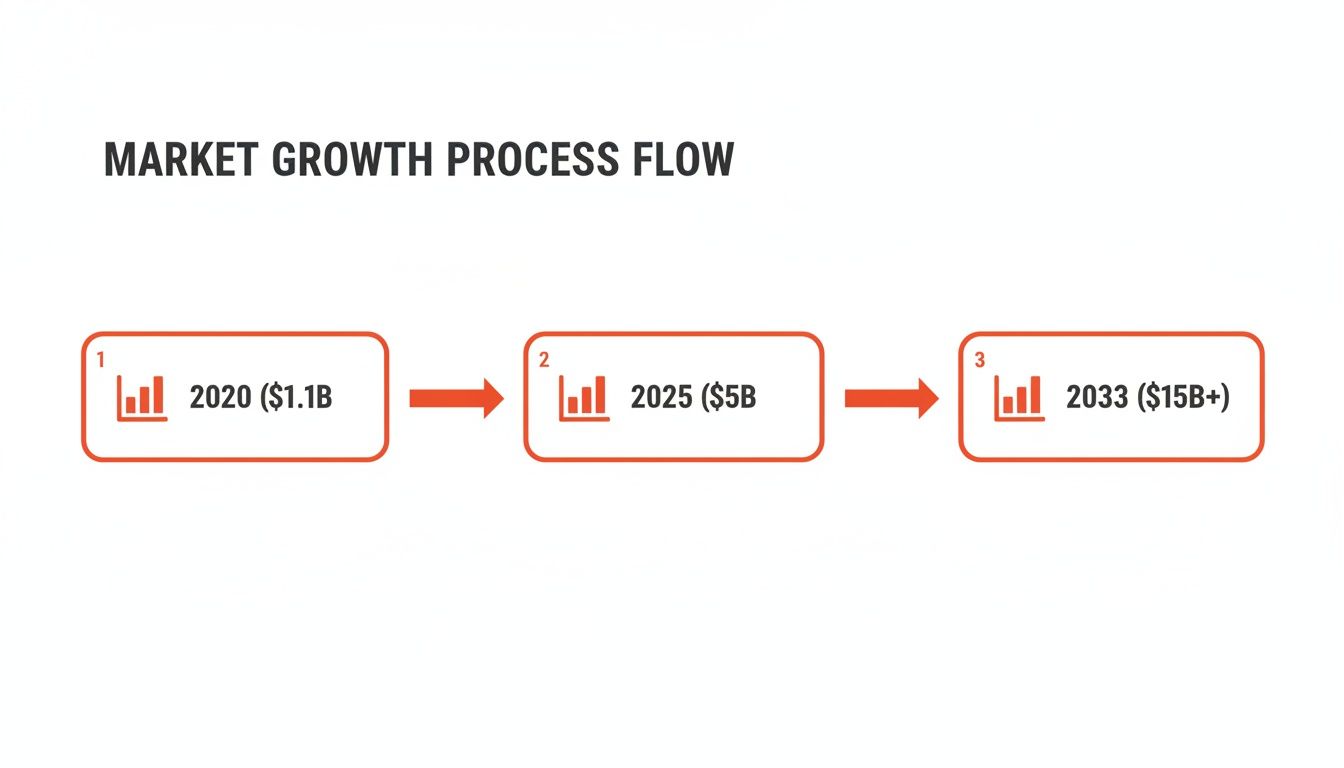
This jump from $1.1B in 2020 to a projected $15B+ by 2033 isn't just a trend—it's proof of the massive value companies are unlocking by automating their data workflows.
Practical Use Cases for Your Business
Now for the fun part—let’s see what data enrichment can actually do for you. This is about getting real, measurable results that ripple across your entire company.
Think of it as the secret ingredient that gives every team a competitive edge. It helps marketers create campaigns that connect and sales reps close deals they might have otherwise missed. Let's dig into some practical examples.
Supercharge Your Sales and Marketing
For any sales or marketing pro, incomplete data is a dead end. It’s why generic emails get ignored and sales calls go nowhere. Data enrichment turns a basic contact list into a strategic weapon.
Imagine you just hosted a webinar and have a list of attendee emails. Instead of handing them over for cold calls, you enrich them first. Suddenly, you know their job titles, company size, industry, and tech stack.
With that information, your teams can immediately:
Prioritize with precision. Spot high-value leads that match your ideal customer profile and focus all their energy there.
Personalize outreach at scale. Craft messages that mention a prospect's specific challenges, role, or company news.
Speed up the sales cycle. When you have the full picture, conversations are smarter, and you can qualify leads in a fraction of the time.
The results speak for themselves. Marketing teams using rich customer profiles see 22% higher conversion rates. That’s a massive advantage.
Streamline Recruiting and Talent Acquisition
Every recruiter knows the pain of sifting through a mountain of résumés to find the perfect candidate. Data enrichment is like giving your recruiting team a powerful magnet.
A recruiter might start with a list of profiles from LinkedIn. By enriching that list, they can uncover extra details like specific technical skills, past projects, or an up-to-date email not listed on their public profile. This simple step completely overhauls their workflow.
By enriching candidate data, recruiting teams can move beyond resumes and gain a complete view of a person’s professional background, skills, and potential fit.
Optimize E-Commerce and Product Catalogs
In the cutthroat world of e-commerce, your product data is your storefront. Incomplete information can kill a sale. Data enrichment helps businesses polish their product catalogs by adding key details like technical specs, supplier info, and even competitor pricing.
This allows online retailers to ensure their listings are complete and competitive, leading to a better customer experience and more sales. A well-maintained catalog is also foundational for effective market intelligence, helping you see exactly how your products stack up.
Data Enrichment Use Cases by Department
This table summarizes how various teams can use data enrichment to win.
Department | Common Challenge | Data Enrichment Solution | Expected Outcome |
|---|---|---|---|
Sales | Low-quality leads, generic outreach | Enrich contact lists with firmographic and technographic data. | Higher conversion rates, shorter sales cycles. |
Marketing | Poor personalization and segmentation | Add demographic and behavioral data for hyper-targeted campaigns. | Increased engagement, higher ROI, better leads. |
Recruiting | Difficulty finding and contacting top talent | Augment candidate profiles with skills, history, and contact info. | Faster time-to-hire, access to a wider talent pool. |
E-Commerce | Incomplete product listings | Append product catalogs with specs and real-time competitor data. | Better customer experience, improved search rankings. |
As you can see, data enrichment is a versatile tool that delivers tangible value to every corner of your business.
The AI Magic Behind Modern Enrichment
So, what makes today's data enrichment so fast and accurate? The answer is Artificial Intelligence (AI). AI has transformed a once-painful manual process into a smart, automated workflow.
The old way meant spending hours digging through websites, copying and pasting information. Now, AI does all of that in a flash, scanning millions of data points to find exactly what you need.
This is a huge deal. It means powerful tools are no longer just for data scientists. Anyone on your team can now get amazing insights without writing a single line of code.
How AI Makes Enrichment Smarter, Not Just Faster
AI isn't just about speed. It brings a new layer of intelligence to the process, ensuring the data you add is accurate and useful.
Here’s how AI pulls this off:
Spotting Hidden Connections: AI models see patterns a human would miss. It can analyze clues online to predict a person's company, industry, and job title from just an email address.
Checking and Double-Checking: AI algorithms cross-reference information from multiple sources to confirm it's accurate. This live validation means you get data you can truly rely on.
Seeing the Future with Predictive Insights: This is where it gets really exciting. AI can analyze online buying signals to score your leads or flag companies ready to buy, giving your sales team a massive advantage.
The real game-changer with AI is its ability to turn raw data into a predictive weapon. It’s not just filling in blanks—it’s helping you see what’s around the corner.
The New Standard for Business
This isn't fringe technology anymore; it’s the standard for any business that wants to compete. Nearly 65% of Fortune 500 companies already use data enrichment tools in multiple departments.
The market is projected to grow at a staggering 24.7% CAGR through 2030, driven almost entirely by AI and the demand for real-time data.
With every breakthrough, like the Google Gemini 2.0 AI model, the possibilities keep expanding. Using this technology is the only way to build an efficient, scalable, and modern data operation.
Your Roadmap: Data Enrichment Best Practices
So, you see the potential of data enrichment. The real magic happens when you execute it smartly, avoiding common pitfalls. These best practices are your guide to building an enrichment program that’s powerful, responsible, and built to last.
Start With Your “Why”
Before you touch a single piece of data, ask the most important question: What are we trying to accomplish? Don't just collect data because you can. Get specific. What information will empower your teams to win? Is it finding more high-value leads? Crafting personal marketing campaigns? Spotting top-tier talent?
Start with your ideal customer profile and work backward. This simple exercise gives you incredible clarity and helps you avoid collecting useless information that just adds noise.
Prioritize Data Quality and Compliance
Where your data comes from is everything. Only partner with reputable providers who are transparent about their data collection methods. Using sketchy sources is a surefire way to poison your database with bad information.
Just as critical is staying on the right side of privacy laws like GDPR and CCPA.
Check Your Sources: Confirm your data provider is fully compliant with all major privacy regulations.
Keep It Fresh: Data has a shelf life. Set up a regular refresh cycle—at least quarterly—to ensure your information hasn't gone stale.
Integrate Seamlessly: Your enrichment process should fit into your existing workflows. For instance, data entry automation can help keep your profiles updated automatically, saving you from manual work.
When you build your strategy on a foundation of quality and compliance, you create a data asset you can truly rely on. This ensures your enrichment efforts deliver a powerful, long-term return on investment.
Common Data Enrichment Questions Answered
Still have a few questions? Let's tackle some of the most common ones.
Is data enrichment the same as data cleansing?
Not quite, but they work together. Data cleansing is about tidying up your existing data—fixing typos, removing duplicates, and standardizing formats.
Data enrichment is about adding new information from external sources. The pro move? Cleanse your data first, then enrich it. A clean foundation makes the new additions that much more powerful.
Do I need a huge budget for data enrichment tools?
Not anymore. While enterprise-level platforms exist, a new breed of AI-powered browser extensions has made powerful data enrichment accessible and affordable for everyone.
These tools are built to be easy to use. This means anyone—from a solo freelancer to a small team—can pull in rich data directly from websites like LinkedIn or company directories on the fly. No coding, no complicated setup.
What are the biggest mistakes to avoid?
The two biggest pitfalls are poor data quality and privacy non-compliance.
If you pull from unreliable or outdated sources, you're essentially poisoning your own database. This bad data can lead to costly mistakes.
At the same time, you must follow major privacy laws like GDPR and CCPA. The solution is to partner with a reputable tool that obsesses over data accuracy and legal compliance. It’s the only way to protect your business and ensure your data remains a true asset.
Ready to stop guessing and start winning with smarter data? Explore prebuilt templates.
