
Discover how web scraping AI revolutionizes data collection. Learn how AI tools automate lead generation, price monitoring, and research without any code.
Staring at a mountain of data you need to pull by hand? It’s a soul-crushing task we’ve all faced. But what if you could automate it away? That’s exactly what AI-powered web scraping does. It’s like having a super-smart assistant who can instantly read any website, understand what you’re looking for, and bring back perfectly organized data in minutes.
Think of it this way: you could wander through a massive library, aisle by aisle, hoping to find the right book. Or, you could ask a librarian who knows exactly what you need and hands you a perfectly curated stack. AI is that expert librarian for the web.
What Is Web Scraping AI and Why Does It Matter?
If you've ever spent an afternoon copying and pasting info from websites into a spreadsheet, you already understand the problem. The old way of gathering data is painfully slow, mind-numbingly repetitive, and full of human error. It’s a huge bottleneck for any sales, marketing, or research team that needs fresh, accurate data to succeed.
The internet is the biggest source of business intelligence on the planet, but most of it is unstructured—a chaotic mess of HTML, text, and images. AI web scraping is the key that unlocks it all, turning messy web pages into clean, structured data you can actually use.
A Smarter Way to Gather Data
Traditional web scrapers are rigid. They follow a strict set of rules, and the moment a website’s layout changes, they break. It’s frustrating and unreliable. AI-powered tools are different. They learn to understand the context of a page, not just its code.
This adaptive intelligence is a game-changer. It means the AI can reliably spot and pull the exact information you need—like names, prices, job titles, or contact info—even from the most complex and dynamic websites.
This modern approach gives your team serious advantages:
No Coding Required: Forget hiring developers or learning to code. The best tools are built for business users, letting you launch powerful scrapers with a few simple clicks.
Adaptable and Resilient: AI agents are smart enough to navigate website layout changes, JavaScript-heavy pages, and other hurdles that stop old-school scrapers in their tracks.
Speed and Efficiency: A task that used to take a week of manual labor can now be finished in the time it takes to grab a coffee. This frees your team to focus on what really matters—analyzing data and making smart decisions.
Web scraping AI isn't just about getting data faster; it's about getting smarter data. It gives you the power to automate grunt work and uncover insights that were previously impossible to find.
To dig into the fundamentals, this guide on AI web scraping is a great starting point. Ultimately, this tech lets you build laser-focused lead lists, monitor competitors in real-time, and track market trends without the usual headaches. It's a direct line to making sharper, data-backed decisions that drive real growth.
How AI Is Completely Changing the Web Scraping Game
Let's look under the hood to see what makes web scraping AI so special, without getting bogged down in technical jargon. Think of it as a team of super-smart specialists. Each has a unique skill, and together they can transform any messy website into a perfectly clean and organized spreadsheet. This isn't just a slightly faster way to copy and paste; it's a completely different, much smarter way to pull information from the web.
Traditional web scrapers are like robots on a fixed assembly line. They follow a rigid blueprint. If a website’s layout changes even a tiny bit—a button moves, a section gets renamed—the blueprint becomes useless, and the process grinds to a halt. AI scrapers act more like seasoned detectives. They don't just stare at the code; they understand the context and visual cues on a page to find the data, no matter how the furniture gets rearranged.
The Brains Behind the Operation
So, what are these specialized skills that make AI so good at this? At the core of web scraping AI, you'll find a few key technologies working together. Each one solves a specific problem that used to make data collection a total nightmare.
Here’s a quick look at the A-team doing the heavy lifting:
Natural Language Processing (NLP): This is the team's "language expert." NLP gives the AI the power to read and understand human text, just like you do. It can figure out the sentiment of a customer review, spot a company's name in a long paragraph, or find an email address buried on an "About Us" page.
Computer Vision: These are the "eyes" of the operation. Computer Vision analyzes the visual layout of a website, recognizing elements based on how they look, their size, and where they are. This is a lifesaver when a site's code is a mess because the AI can still spot a "Contact Us" button or a product price just by its appearance.
Intelligent Extraction Models: Think of these as the "data specialists." These AI models are trained to recognize and grab specific types of information. For example, one model might be an expert at identifying phone numbers, while another is a pro at finding job titles or street addresses, pulling them out with incredible accuracy.
This powerful combination lets AI-powered tools adapt to new websites on the fly, delivering clean, reliable data where older methods would just give up.
From Manual Drudgery to Automated Insight
The jump from manual data collection to AI-powered scraping is a massive leap forward in efficiency and intelligence. This graphic drives home the transition from slow, error-prone manual work to lightning-fast, automated results.
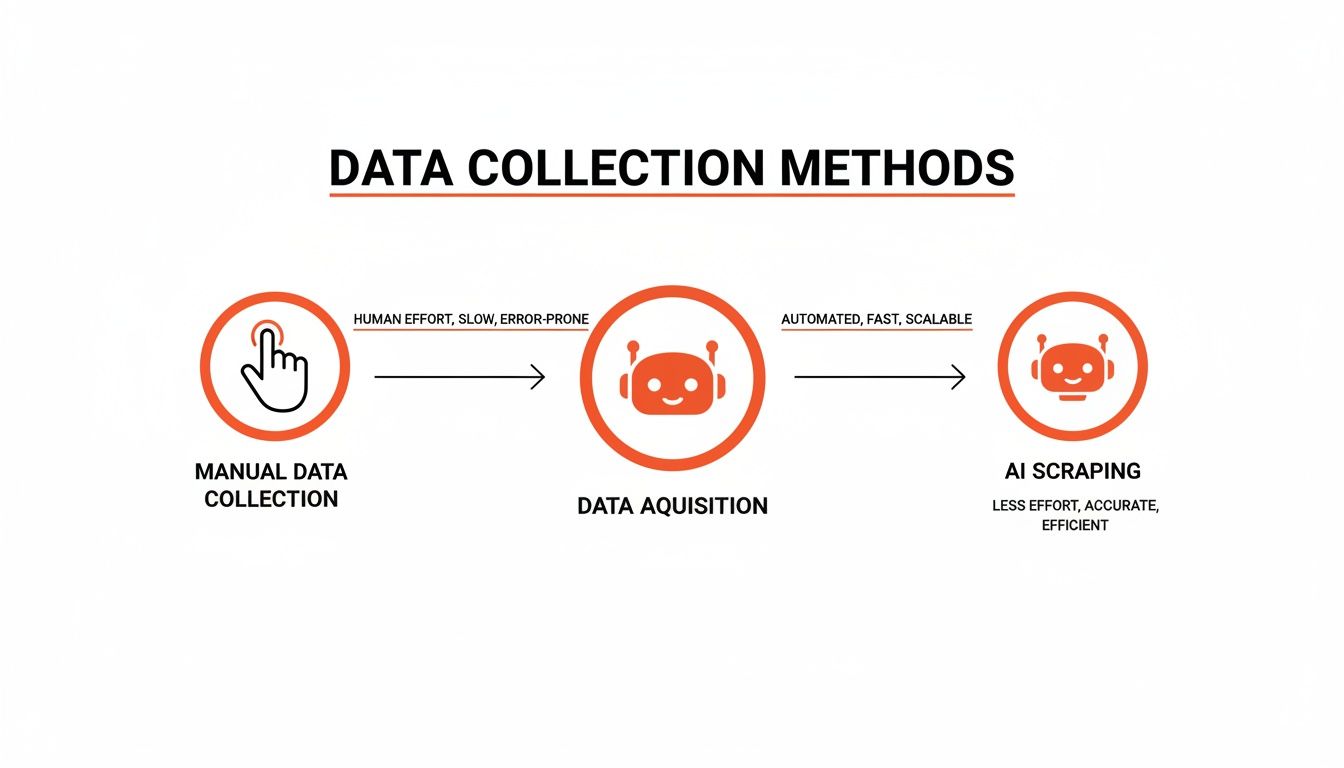
What this really highlights is a key benefit: AI completely removes the human bottleneck. It allows teams to scale their data gathering efforts instantly so they can focus on analyzing the data, not just collecting it.
Fueling a Multi-Million Dollar Market
The impact of this technology is impossible to ignore, and it’s fueling serious market growth. The web scraping services market, supercharged by AI, is on track to hit USD 762 million by 2034. We've also seen a recent 23% year-over-year jump, which signals intense demand. This boom makes sense when you realize that nearly 65% of companies now rely on external web data for market analysis and competitive intelligence.
For professionals using tools like Clura, tasks like monitoring competitor reviews or grabbing contact lists from LinkedIn can now be done with simple one-click exports, completely ditching the need for tedious code. You can learn more about these powerful market dynamics and what they mean for modern businesses.
In short, AI doesn't just scrape data—it understands it. This ability to interpret context is what transforms raw web content into a genuine strategic asset for your business.
This deeper understanding means the AI can tackle complex tasks that were once impossible to automate. It can navigate multi-step forms, handle interactive maps, and even extract data from elements that only appear after you click a button. This incredible adaptability is what truly sets web scraping AI apart.
So, What’s the Real Difference Between AI and Traditional Scraping?
To understand why web scraping AI is such a game-changer, let's draw a clear line between the old and new ways of pulling data from the web. Imagine you need to deliver a package across a bustling city.
Traditional scraping is like a train on a fixed track. It’s fast and efficient, but only as long as the track stays the same. The moment a single rail is moved—or a website’s code gets an update—the whole train derails. Your data pipeline grinds to a halt.
AI scraping is like a smart, all-terrain delivery drone. It doesn't need fixed tracks. It uses GPS, computer vision, and intelligent navigation to find the best path on its own. If one street is blocked, it just finds another way. It adapts on the fly to get to its destination, no matter what obstacles pop up.
The Old Way: A Rigid and Brittle Approach
Traditional web scrapers are built on a house of cards. They're hard-coded to look for data in very specific spots on a webpage using CSS selectors or XPath. These are basically super-specific directions, like, "Go to the third paragraph inside the second blue box and grab the text there."
This works… for a little while. But websites are constantly changing their look, feel, and code. When that happens, those old directions lead nowhere, and the scraper breaks.
This kicks off a frustrating and costly cycle:
Constant Babysitting: You need a developer to constantly monitor the scrapers and fix them every time they break. It's a never-ending maintenance headache.
High Technical Barrier: Building these scrapers requires a developer who’s fluent in HTML, CSS, and a language like Python. This puts it out of reach for most business professionals.
Struggles with the Modern Web: Today’s websites are packed with dynamic content that loads with JavaScript. Traditional tools often can’t see this data, leaving you with incomplete or wrong information.
The New Way: Smart, Adaptive Data Collection
AI-powered scraping flips the script. Instead of following brittle, code-based directions, it uses machine learning to understand a webpage the way a human would. It looks at the visual layout, understands the context of the text, and figures out what each element is—a price, a product name, a review—to find exactly what you need.
This intelligent approach brings incredible benefits to the table.
Here's the "a-ha!" moment: AI understands the what (e.g., "find the price"), while traditional tools only understand the where (e.g., "look in this specific HTML tag"). That shift from location to context is everything.
Ready to see how they stack up side-by-side? Let’s break it down.
AI Web Scraping vs. Traditional Web Scraping
Here's a direct comparison that highlights the night-and-day difference between modern AI-powered tools and older, traditional methods.
Feature | Traditional Scraping | AI-Powered Scraping |
|---|---|---|
Adaptability | Brittle: Breaks with any website layout change. | Resilient: Adapts to layout changes automatically. |
Setup Time | Slow: Requires custom coding and testing for each site. | Fast: Often works with a single click or pre-built templates. |
Data Accuracy | Inconsistent: Often misses data on complex or dynamic sites. | High: Excels at extracting data from JavaScript-heavy pages. |
Skill Required | High: Needs a developer with coding experience. | Low: Designed for non-technical users in sales, marketing, and research. |
The comparison says it all. You no longer have to be a developer or get stuck in a cycle of expensive, constant maintenance to get the mission-critical data your business needs. Web scraping AI makes powerful data collection accessible, reliable, and incredibly simple for everyone.
See It In Action: Powerful Use Cases for Your Sales, Marketing, and Research Teams
Let's move past the theory. This is where web scraping AI starts delivering real-world results. We're going to dive into specific, actionable playbooks your teams can use right now to drive immediate value.
Forget just collecting data faster. We're talking about giving your teams superpowers to hit their goals with incredible precision and speed.
Supercharge Your Sales Pipeline
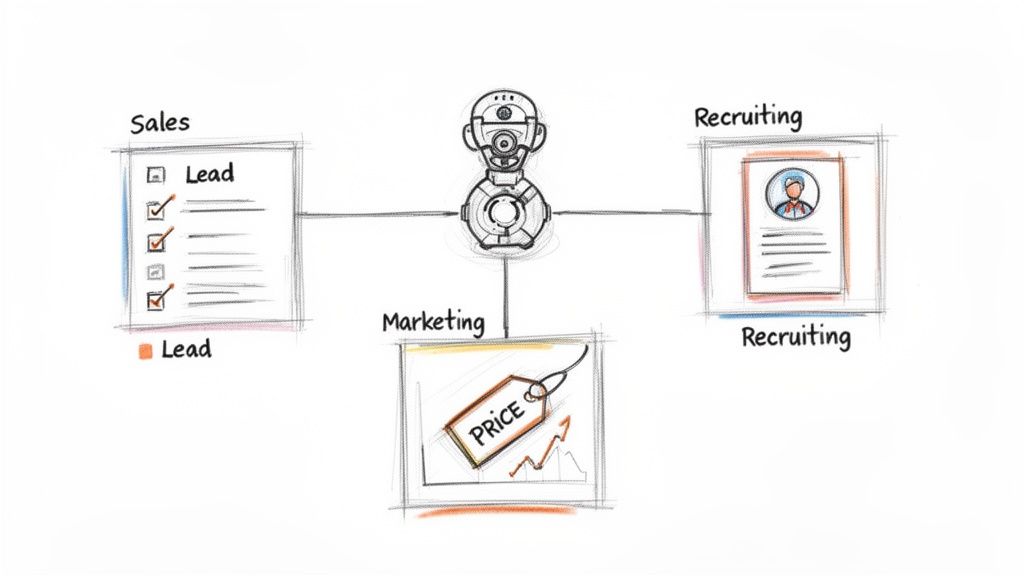
For sales teams, the hunt for qualified leads is a relentless grind. AI scraping automates the most time-consuming part of the job, freeing your reps to do what they do best: build relationships and close deals.
Build Hyper-Targeted Lead Lists: Stop buying stale, outdated lead lists. Instead, build your own from scratch, pulling fresh data from professional networks like LinkedIn or niche industry directories. Pinpoint names, job titles, and company details for your ideal customer.
Enrich Profiles with Contact Info: Once you have a list of names, the AI can visit company websites to hunt down direct email addresses and phone numbers. That simple name instantly becomes a fully actionable contact.
The result? A clean CSV file with 500 highly qualified leads, complete with verified contact info, ready to drop into your outreach sequence in under 10 minutes.
Gain a Competitive Edge in Marketing
Great marketers are always one step ahead, which means keeping a watchful eye on competitors and the market. AI-powered scraping delivers the real-time intelligence you need to make smarter, faster moves.
Could you manually check the prices of 50 competitors every single day? Of course not. But with AI web scraping, you can automate that entire workflow and get a live dashboard of the competitive landscape.
The goal is to shift from reactive analysis to proactive strategy. AI scraping gives marketers the data they need to anticipate market shifts, not just respond to them.
This capability is fueling massive industry growth. The AI-driven web scraping market is on track to add USD 3.16 billion in growth between 2024 and 2029, rocketing forward at a compound annual growth rate of 39.4%. As companies see tangible wins—like e-commerce brands boosting sales by 15% with AI-scraped pricing data—adoption is exploding. You can see the full breakdown in this Technavio market analysis.
Here's how marketers can put this power to work:
Monitor Competitor Pricing: Automatically track product prices, discounts, and promotions on competitor websites. This intel lets you adjust your own pricing strategy in real-time to win more customers.
Track Brand Sentiment: Scrape social media and review sites to see what people are saying about your brand and your competitors. AI can even analyze the sentiment, giving you a crystal-clear picture of public perception.
Streamline Your Recruiting and Research Workflows
For recruiters and researchers, pulling information from dozens of places is the job. AI scraping is a lifesaver here, eliminating hours of manual work while delivering more accurate, complete results.
A recruiter might need to find candidates with a rare skill set scattered across a dozen different job boards. An AI scraper can visit all of them at once.
Aggregate Candidate Profiles: Automatically pull candidate profiles from multiple job boards like Indeed, LinkedIn, and niche industry sites, then merge them into a single, unified spreadsheet. This creates a massive talent pool that's easy to search and filter.
Automate Market Research: Need to gather data for a market analysis? Quickly pull company funding rounds from Crunchbase, product reviews from G2, or industry news from multiple sources. You'll accelerate the research process and guarantee you're working with the most current information.
These use cases prove how web scraping AI delivers a tangible, immediate ROI. It's not just about getting more data; it's about arming your teams with the insights they need to win.
Your First AI Scraping Workflow: A Step-by-Step Guide
Alright, let's get our hands dirty and see this magic in action!
I’m going to walk you through your very first web scraping AI project. This is a simple, practical guide that shows you how to go from a messy website to a clean spreadsheet in just a few minutes.
For this example, we'll solve a classic business problem: extracting company contacts from an online directory. The mission is to build a high-quality lead list—complete with names, job titles, and company info—without ever touching copy-and-paste.
This walkthrough uses a modern AI scraper, like the Clura browser extension, to turn a mind-numbing task into a simple, automated workflow.
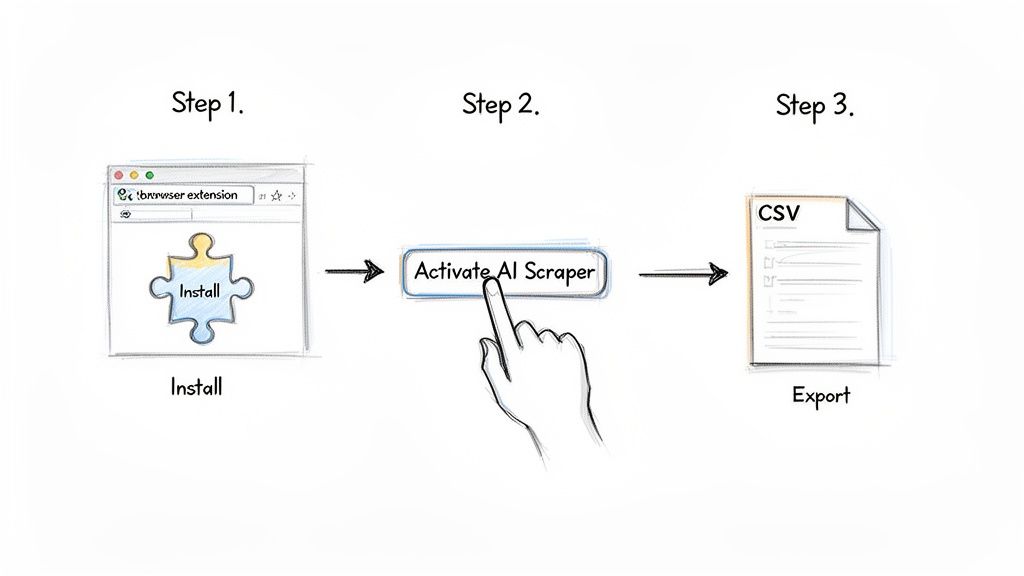
Step 1: Head Over to Your Target Website
First, open your web browser and go to the page you want to scrape. This could be a B2B directory, a professional networking site, or any public list of companies or people.
Find the main page that displays all the data you want in a list or grid. This is the page the AI will scan to understand the repeating pattern of information you’re after.
Step 2: Fire Up the One-Click AI Scraper
Okay, you’re on the page. Now for the fun part.
Just click the Clura browser extension icon in your toolbar. Instantly, the tool will analyze the page and start identifying all the valuable data points like names, companies, and roles.
This is where the "wow" moment of web scraping AI hits. You don’t have to highlight anything or write a single line of code. The AI does all the heavy lifting, showing you a sneak peek of the data it’s found.
That one-click activation is a total game-changer. It eliminates the technical setup that used to take hours with old-school scraping tools, making data extraction something anyone can do.
Step 3: Unleash the AI Agent and Watch It Go
Happy with the preview? Great! Now, just launch the AI agent.
Sit back and watch as the agent zips through the website, automatically clicking to the next page and systematically grabbing every piece of information you need. It’s like having a digital assistant working at warp speed.
The AI handles all the tricky stuff on its own:
Pagination: It automatically finds and clicks the "Next Page" button, so you get data from the entire list, not just the first page.
Data Structuring: It intelligently organizes everything into clean columns like "Name," "Title," and "Company."
Error Handling: If it hits a weird layout or an empty field, it just adapts and keeps on rolling without crashing.
Step 4: Export Your Data to a Perfect CSV
Once the AI agent is done, your data is ready to go. With one last click, you can export the whole collection into a perfectly formatted CSV file.
This file opens beautifully in Excel or Google Sheets, giving you a structured list that’s ready for whatever you have planned next.
And that’s it! You just automated a task that would have taken hours of painful manual work. For more tips, check out our guide on how to extract data from a website to Excel.
Navigating the Rules of Web Scraping Responsibly
With great power comes the responsibility to use it wisely. While web scraping AI gives you an incredible advantage, it's critical to collect data ethically. Think of it as being a good neighbor on the internet—you wouldn't just barge into someone's house, and that same courtesy applies online.
Being a good digital citizen isn't just about playing nice; it builds trust and ensures you can access the data you need for the long haul. It all comes down to playing by the rules and respecting the websites you visit.
Understanding the Ground Rules
The world of web data has a few key guidelines, and they're simple to follow. The most important one is the robots.txt file. Think of this as a website's digital "do not enter" sign. It's a text file that tells bots which pages they can visit and which are off-limits. Respecting these directives is always step one.
It's also important to be mindful of personal data. Regulations like GDPR exist to protect people's privacy, so always steer clear of collecting sensitive personal information. The goal is to gather public business intelligence, not to snoop on private lives.
The best way to scrape ethically is to act like a polite human visitor. Don't bombard a site's servers with requests all at once. That can slow the site down or even crash it for everyone else, which is a surefire way to get blocked.
How AI Helps You Scrape More Responsibly
This is where modern web scraping AI tools really shine. AI-powered scrapers are designed to mimic how a real person browses the web. They navigate pages, click on links, and even pause between actions, making them far less disruptive to a website's servers.
This human-like approach brings huge benefits for responsible scraping:
Lower Server Load: By intelligently pacing requests, AI tools avoid overwhelming a website, making your data collection less intrusive.
Smarter Navigation: They can understand and interact with a site gracefully, which dramatically reduces the risk of tripping aggressive anti-bot defenses.
Focus on Public Data: AI models are typically trained to spot public business information, helping you automatically avoid sensitive personal details.
This responsible approach is more important than ever. The AI-driven web scraping market was valued at USD 7.79 billion in 2025 and is projected to explode to USD 47.15 billion by 2035. That kind of growth is fueled by businesses that depend on ethical, real-time data to stay competitive.
To help guide AI models, you might want to look into using an llms.txt generator. For a deeper dive into the legal side of things, check out our guide on web scraping legality to make sure your workflows are always on the right side of the rules.
Got Questions About AI Web Scraping? We’ve Got Answers.
Jumping into the world of AI-powered web scraping can bring up a few questions. That's totally normal! Let's tackle some of the most common ones we hear.
Is AI Web Scraping Actually Legal?
Short answer: yes, scraping publicly available data is generally legal. The longer answer is that it all comes down to how you do it. Think of it as being a good guest.
Always respect a website's rules, which are often in a robots.txt file. It's also crucial to avoid gathering sensitive personal information. The golden rule is to behave like a courteous human user—don't bombard a site's servers with a flood of requests. Responsible AI tools shine here; they're built to be respectful, making them a much safer bet.
Can AI Really Scrape Data from Any Website?
AI-powered scrapers are incredibly good at what they do, especially on tricky, modern websites packed with JavaScript and changing layouts. Because the AI doesn't just read code but actually understands a page's visual structure, it can navigate complex designs that break traditional scrapers.
Now, is any tool 100% foolproof? Not quite. Super-strong anti-bot systems like advanced CAPTCHAs can sometimes throw a wrench in the works. But the sheer adaptability of web scraping AI means you'll successfully get data from the vast majority of sites you'll ever need.
The magic of AI is its resilience. It doesn't care if a developer changes the website's code tomorrow. Because it understands context, not just code, it keeps pulling the right data, time and time again.
How Is This Different from Regular Browser Automation?
This is a great question. While both interact with a web browser, they have different jobs.
Browser Automation is all about repeating a set of instructions. Think: "Click this button, then fill in that form, then click here." It’s a pure task-repeater.
Web Scraping AI is about understanding and extracting information. It doesn't just follow a script; it actively identifies, structures, and grabs the specific data you're after.
Here's an analogy: Browser automation is like a factory robot arm programmed to tighten the same bolt over and over. Web scraping AI is like a skilled mechanic who can look at any engine, identify the problem, and pick the right tool for the job.
Seriously, Do I Need to Know How to Code?
Nope, not at all! This is probably the best part. Modern web scraping AI tools were built for people in roles like sales, marketing, and research—not for developers.
Platforms like Clura deliver a completely no-code experience. We're talking a simple browser extension and one-click data collection. The AI does all the heavy lifting in the background, freeing you up to focus on using the data, not fighting to get it.
Ready to turn messy websites into clean, actionable data? With Clura, you can automate data collection in just one click. Explore prebuilt templates and get started for free today!
