Discover marketing automation best practices to segment audiences, personalize messages, and automate workflows for higher ROI.
Ready to turn your marketing automation platform from a simple email tool into a revenue-generating powerhouse? You're in the right place. Marketing automation is one of the most powerful tools for growth, but many teams barely scratch the surface of its potential. They fall into a "set it and forget it" routine, running basic campaigns that fail to engage customers or drive real results.
This guide dives into nine essential marketing automation best practices that will transform your strategy. We’ll move beyond generic advice to give you actionable techniques that deliver real impact. You'll learn how to refine lead scoring, design intelligent workflows, personalize every touchpoint, and align your sales and marketing efforts for maximum efficiency. While it's good to stay updated on trends, our focus is on foundational excellence. To further optimize your setup, check out these 9 Marketing Automation Best Practices for 2025.
Whether you're a marketer, sales pro, or e-commerce owner, these insights are designed to be implemented immediately. We'll cover everything from smart segmentation to omnichannel integration. Prepare to unlock the full power of your software, build smarter customer journeys, and achieve the scalable growth you've been aiming for. Let's get started.
1. Master Lead Scoring and Segmentation
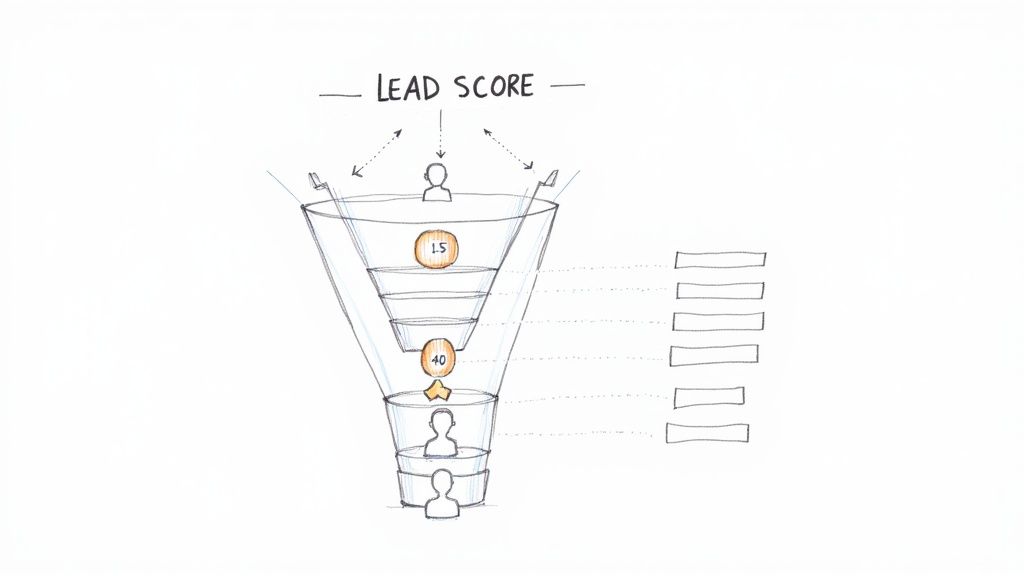
Turn your sales funnel from a wide-open firehose into a high-precision laser. Lead scoring and segmentation are two of the most powerful marketing automation best practices because they ensure you’re talking to the right people, with the right message, at the right time. This duo works by assigning points to prospects based on who they are (demographics) and what they do (behaviors), then grouping them into targeted segments. The result? Your sales team can stop chasing cold leads and focus only on hot, sales-ready opportunities.
Why It’s a Game-Changer
Instead of treating every new contact the same, this approach intelligently prioritizes your efforts. A prospect who downloaded a pricing guide gets a higher score than someone who only read a blog post. By segmenting these high-scoring leads, you can enroll them in hyper-personalized nurturing campaigns that speak directly to their needs, dramatically increasing engagement and conversion rates.
Actionable Steps to Get Started
Ready to put this into practice? Here’s how:
Align with Sales: Sit down with your sales team and define what an "ideal" lead looks like. Agree on key firmographic data (company size, industry) and behavioral triggers (demo requests, pricing page visits) that indicate strong sales potential.
Track Positive and Negative Signals: Don't just award points; subtract them too. A lead visiting your careers page might get a negative score, while one from a competitor's domain could be disqualified.
Start Simple, Then Refine: Begin with 5-7 core scoring criteria. You can always add more complexity later. Review your model monthly to see if high-scoring leads are actually converting. If not, it's time to adjust the criteria.
For a deeper dive into finding and qualifying prospects, explore our guide to LinkedIn lead generation strategies. This will help you feed your scoring model with high-quality leads from the start.
2. Personalize Every Email
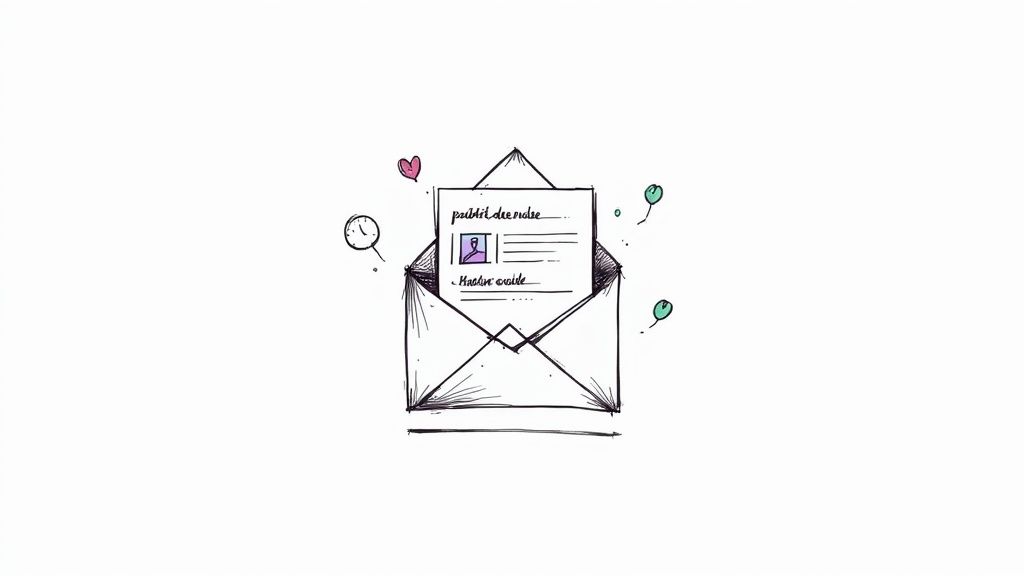
Move beyond just using a first name and start creating email experiences that feel like they were crafted for one person. Email personalization is a powerhouse marketing automation best practice that uses customer data to tailor content, offers, and recommendations. Instead of sending one generic message to everyone, you can deliver a unique, one-to-one communication at scale. This is the secret behind how brands like Netflix and Spotify make millions of users feel uniquely understood.
Why It’s a Game-Changer
Personalization transforms your email from a broadcast tool into a relationship-building engine. By sending content that aligns with a user's purchase history, browsing behavior, or lifecycle stage, you show that you understand their needs. This relevance skyrockets engagement, builds brand loyalty, and directly drives revenue.
Actionable Steps to Get Started
Ready to make your emails impossible to ignore? Here’s how:
Segment by Lifecycle Stage: Don't send a "welcome" offer to a loyal, long-time customer. Create distinct automated workflows for new subscribers, first-time buyers, repeat customers, and at-risk contacts.
Use Behavioral Triggers: Automate personalized emails based on user actions. Send an abandoned cart reminder with the exact items left behind, a follow-up with related products after a purchase, or a re-engagement campaign to inactive users.
Implement Dynamic Content: Use dynamic content blocks in your email templates to show different images, calls-to-action, or product recommendations based on a subscriber's segment, location, or past purchases.
3. Align Marketing and Sales (Smarketing)
Demolish the silos that kill deals and watch your revenue grow. Smarketing, the strategic alignment of your sales and marketing teams, is one of the most crucial marketing automation best practices for growth. This approach unites both departments under shared goals and unified processes. The result is a seamless customer journey where marketing perfectly tees up opportunities and sales closes them with incredible efficiency.
Why It’s a Game-Changer
When sales and marketing operate separately, you get friction. Marketing sends over unqualified leads, and sales ignores them. By creating a unified front, you ensure every marketing action supports sales objectives. This alignment creates a powerful feedback loop. Marketing gets direct insights into which campaigns generate revenue, while sales receives consistently high-quality leads.
Actionable Steps to Get Started
Ready to bridge the gap? Here’s how:
Establish a Service Level Agreement (SLA): Collaboratively define what makes a "Marketing Qualified Lead" (MQL) and a "Sales Qualified Lead" (SQL). Document the exact criteria and set clear expectations for sales follow-up times.
Create a Shared Dashboard: Use your CRM to build a single source of truth. This dashboard should display key metrics like MQL-to-SQL conversion rates, pipeline velocity, and marketing-sourced revenue.
Implement a Lead Feedback Loop: Create a simple, automated process in your CRM for sales to provide feedback on lead quality. This data is pure gold for marketing, helping them refine targeting and messaging.
Schedule Regular Alignment Meetings: Get both teams together bi-weekly to review the shared dashboard, discuss lead quality, and strategize on upcoming campaigns.
4. Build Smart Workflows and Triggers
Welcome to the engine room of marketing automation. Workflows and triggers are where your strategy comes to life, allowing you to automatically execute perfectly timed actions based on customer behavior. Think of them as your tireless digital assistants, nurturing leads and onboarding customers 24/7. By setting up event-based triggers like email opens or form submissions, you can deliver the right message at the moment it matters most.
Why It’s a Game-Changer
This is where automation becomes a strategic asset. Instead of batch-and-blast emails, you can create dynamic customer journeys that adapt to individual actions. An e-commerce shopper who abandons their cart gets a reminder, and a new SaaS user receives a helpful onboarding series. These automated sequences ensure no lead falls through the cracks, dramatically improving consistency.
Actionable Steps to Get Started
Ready to build your first automated workflow? Here’s how:
Map the Journey First: Before you touch any software, visually map out the ideal customer journey. What are the key touchpoints and decision moments? This blueprint will make building your workflow much easier.
Use Conditional Logic: Build smarter workflows with "if/then" branches. For example, if a lead clicks a link about "pricing," send them a case study; if not, send them a more general educational article.
Test and Monitor Rigorously: Always run a small test group through a new workflow before launching it to your entire audience. Once live, review performance metrics weekly to find opportunities for optimization.
By setting up intelligent workflows, you can also significantly cut down on manual tasks. For more ideas, see how you can automate data entry and free up your team for more strategic work.
5. Launch Account-Based Marketing (ABM) Campaigns
Say goodbye to casting wide, impersonal nets and hello to precision-guided spear-fishing. Account-Based Marketing (ABM) flips the traditional sales funnel on its head. Instead of chasing individual leads, you treat high-value accounts as their own unique markets. This strategic approach aligns your sales and marketing teams to create bespoke campaigns that target specific companies and the key decision-makers within them.
Why It’s a Game-Changer
ABM is one of the most effective marketing automation best practices for B2B because it focuses your resources where they have the greatest impact. Every touchpoint, from personalized emails to targeted ads, is designed to resonate with a specific account's pain points. This hyper-relevant approach fosters deeper engagement, shortens sales cycles, and increases the lifetime value of your most important customers.
Actionable Steps to Get Started
Ready to launch your first ABM campaign? Here’s your plan:
Identify Your Targets: Collaborate with sales to create an Ideal Customer Profile (ICP). Use this profile to identify a small, manageable list of 10-20 high-value target accounts to start with.
Map the Buying Committee: For each target account, identify all the key stakeholders involved in the purchasing decision. Develop detailed personas for each one.
Craft Hyper-Personalized Campaigns: Create unique content tailored to each account. Use marketing automation to deploy coordinated, multi-channel campaigns across email, social media, and display ads.
6. Map the Customer Journey and Lifecycle
Stop thinking in one-off campaigns and start building lifelong relationships. Customer journey mapping is a transformative practice because it forces you to see your brand through your customers' eyes. This approach visualizes every touchpoint a person has with your business, from their first spark of awareness to becoming a vocal advocate. By understanding this path, you can use automation to deliver perfectly timed, relevant messages at each lifecycle stage.

Why It’s a Game-Changer
Lifecycle marketing recognizes that a new lead needs different information than a loyal, repeat customer. For example, a SaaS company can create an automated onboarding sequence to drive product activation, while an e-commerce store can build a post-purchase workflow to encourage reviews. This strategic approach makes customers feel understood, building trust and increasing lifetime value (LTV).
Actionable Steps to Get Started
Ready to map your customer's experience? Here’s how:
Map All Touchpoints: Identify every possible interaction point across all channels, including your website, email, social media, and support. Talk to customers at each stage to understand their goals and pain points.
Identify Moments of Truth: Pinpoint the key decision-making moments in the journey, like a demo request or adding an item to a cart. These are the moments where your automated follow-up is most critical.
Build Persona-Specific Journeys: Your journey isn't a one-size-fits-all path. Create distinct maps for each of your key buyer personas, as their needs and touchpoints will differ.
To learn more about how to structure these communications, check out HubSpot's guide on Lifecycle Stage Marketing.
7. Use Analytics and Attribution Modeling
Stop guessing what works and start knowing for sure. Marketing analytics and attribution modeling turn your automation from a set of activities into a strategic, revenue-driving machine. This practice involves tracking every campaign interaction, measuring performance, and assigning credit to the touchpoints that lead to conversions. By doing this, you can prove ROI, double down on your most effective channels, and optimize your budget with precision.
Why It’s a Game-Changer
Without robust analytics, you're flying blind. This data-driven approach connects your marketing actions directly to business outcomes. You can identify exactly which blog post, email campaign, or social ad influenced a major sale. This ensures every dollar you spend is invested wisely.
Actionable Steps to Get Started
Ready to become a data-driven marketer? Here’s how:
Implement Universal Tracking: Ensure every campaign, link, and asset has proper tracking codes (like UTM parameters). Consistency is non-negotiable for clean data.
Choose the Right Attribution Model: Don't just default to "last touch." Consider a multi-touch model (like linear or time-decay) that better reflects your sales cycle.
Connect Marketing Metrics to Business Goals: Go beyond opens and clicks. Create reports that tie marketing performance to key business outcomes like pipeline generated and customer acquisition cost (CAC).
8. Nurture Leads with Valuable Content
Turn your marketing automation platform into a relationship-building engine. Content marketing and lead nurturing are fundamental best practices that fuel your entire funnel with value. This strategy involves creating and distributing relevant, educational content to attract your ideal audience and then using automated workflows to guide them through their buying journey. The goal is to build trust, so when a prospect is ready to buy, your brand is the first one they think of.
Why It’s a Game-Changer
Instead of hitting prospects with a hard sell from day one, this approach educates and empowers them. A new lead who downloads a beginner's guide is nurtured with related blog posts. As they engage more, your automation system can serve them more advanced content like case studies. This creates a seamless experience that transforms cold traffic into warm, qualified leads who view you as a trusted advisor.
Actionable Steps to Get Started
Ready to build a content-driven nurturing machine? Here’s how:
Map Content to the Buyer's Journey: Create distinct content for each stage: Awareness (blog posts), Consideration (webinars), and Decision (demos). Your automation workflows should deliver the right asset at the right time.
Gate Your Most Valuable Assets: Use forms to "gate" high-value content like in-depth guides or templates. This is a core lead generation tactic that feeds fresh contacts directly into your nurturing sequences.
Integrate SEO Best Practices: This ensures your valuable resources are discovered by new audiences through search engines, continuously fueling your automation funnels.
By strategically aligning your content with automated workflows, you can effectively build a robust sales pipeline that consistently delivers high-quality leads.
9. Create an Omnichannel Experience
Say goodbye to siloed channels and hello to a unified customer journey. Omnichannel marketing is the practice of synchronizing all your customer touchpoints—from email and SMS to social media—into one seamless, cohesive experience. This powerful marketing automation best practice ensures your message is consistent, timely, and always relevant, no matter where your audience interacts with your brand.
Why It’s a Game-Changer
Instead of sending disjointed messages on different channels, an omnichannel strategy puts the customer at the center. Imagine a customer who abandons their online cart. They might receive a reminder email, see a targeted ad on Instagram, and get an SMS with a special offer a day later. This coordinated approach, powered by platforms like Salesforce Marketing Cloud, ensures your brand is present and helpful without being repetitive.
Actionable Steps to Get Started
Ready to create a connected customer experience? Here's how:
Map the Customer Journey: Before you integrate, you need to understand. Map out the typical paths customers take, identifying all potential touchpoints across their lifecycle.
Unify Your Customer Data: A central data hub is non-negotiable. Implement a Customer Data Platform (CDP) to create a single, unified profile for each customer, pulling in data from your website, mobile app, and CRM.
Start Small, Then Scale: Don't try to connect every channel at once. Begin with 2-3 core channels where your audience is most active, such as email and your website. Perfect the integration before adding social media or SMS into the mix.
Start Automating Smarter, Not Harder
You’ve made it through the ultimate roundup of marketing automation best practices. Now it’s time to turn these concepts into real results. We've covered everything from the foundational pillars of lead scoring and segmentation to the sophisticated strategies of omnichannel integration. The path to automation mastery isn't about flipping a switch; it's about building an intelligent system that grows with your business.
The core theme connecting all these practices is a shift from generic, batch-and-blast marketing to creating personalized, timely, and relevant experiences at scale. Customers now expect you to understand their needs and guide them seamlessly through their buying journey.
Your action plan should focus on these three pillars first:
Prioritize Data Integrity: Your automation is only as good as the data that fuels it. Before you build another workflow, commit to cleaning, standardizing, and enriching your contact data. This single step will amplify the effectiveness of everything else you do.
Align Sales and Marketing (Smarketing): Break down the silos. The most successful automation strategies are built on a shared understanding of the customer lifecycle. Work with sales to define a qualified lead, establish a clear handoff process, and create feedback loops.
Map the Customer Journey: Don't automate in a vacuum. Start by mapping out the critical touchpoints and decision-making moments for your customers. This map becomes the blueprint for your lead nurturing and lifecycle marketing workflows.
Implementing these marketing automation best practices is a transformative journey. It’s about more than just saving time; it's about building a scalable growth engine that delivers consistent, predictable revenue. By automating the right tasks, you free up your team to focus on high-impact strategic work, like building stronger customer relationships and crafting brilliant creative campaigns. To ensure your efforts truly pay off, it's vital to focus on mastering marketing automation ROI.
You now have the framework to elevate your strategy from basic email sends to a fully integrated, data-driven marketing machine. Pick one area from this guide—whether it’s refining your lead scoring or building your first personalized nurturing sequence—and commit to mastering it.
Ready to fuel your automation with high-quality, real-time data? Clura is the AI-powered data collection platform that helps you scrape websites to build targeted lead lists, enrich customer profiles, and monitor competitors without writing any code. Power your marketing automation best practices with the clean, accurate data you need to succeed by exploring Clura today. Explore prebuilt templates.
