Learn how to qualify sales leads with proven frameworks and tools to prioritize high-potential prospects ready to buy.
So, what does it really mean to qualify a sales lead?
In short, it’s about filtering your prospects to pinpoint those who have a real need for your product, the budget to buy it, and the authority to make a decision. This disciplined process separates serious buyers from window shoppers, ensuring your sales team pours its energy into deals that can actually close.
This strategic focus is the secret weapon behind a shorter sales cycle and higher win rates.
The High Cost of Chasing the Wrong Leads
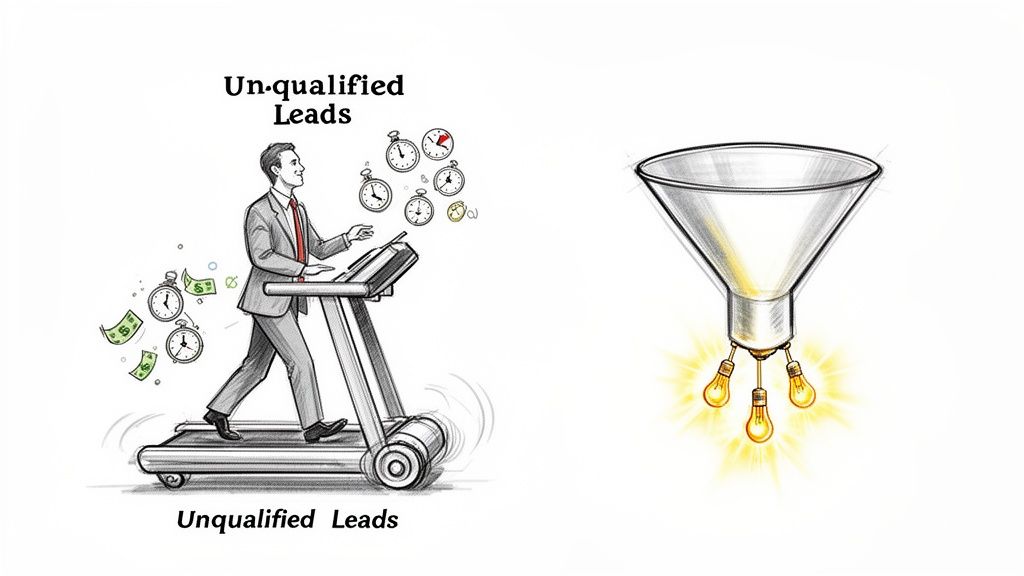
Ever feel like your sales team is running on a treadmill—working hard but getting nowhere fast? That’s the classic sign of chasing unqualified leads. It’s the biggest productivity killer in sales, quietly wrecking quotas and team morale.
When your reps spend their days talking to people who can't afford your solution, lack decision-making power, or don't actually need what you're selling, it’s not just a waste of time. It's a direct hit to your revenue.
The Real Impact of Poor Qualification
A weak qualification process kicks off a domino effect that can rattle your entire sales organization.
Think about what happens when you don't know how to qualify sales leads properly:
Wasted Resources: Every minute spent on a dead-end lead is a minute stolen from nurturing a future customer. It's no wonder that Salesforce data shows reps spend just 28% of their time actually selling—the rest is often gobbled up by chasing ghosts.
Sagging Team Morale: Nothing burns out a top salesperson faster than a pipeline packed with rejections from people who were never a good fit. Hearing "no" all day from mismatched leads is an absolute motivation-killer.
Inaccurate Forecasting: A pipeline full of unqualified leads is a house of cards. It paints a deceptively optimistic picture, leading to sales forecasts that leave leadership scrambling when targets are missed.
Missed Revenue Targets: At the end of the day, chasing bad leads means leaving good money on the table. Your ideal customers are out there, but your team is too bogged down to find and engage them effectively.
The problem is bigger than most sales leaders realize. A shocking 67% of lost sales are a direct result of reps failing to properly qualify leads before investing their time. These aren't just numbers; they represent massive, preventable revenue leaks.
Unqualified vs. Qualified Leads At a Glance
This table breaks down the stark contrast between a pipeline filled with noise and one filled with genuine opportunities.
Metric | Unqualified Leads | Qualified Leads |
|---|---|---|
Conversion Rate | Extremely low (<1%) | Significantly higher (20%+) |
Sales Cycle Length | Long and unpredictable | Shorter and more predictable |
Sales Team Effort | High effort, low return | Focused effort, high return |
Resource Drain | Drains time, budget, and morale | Optimizes all resources |
Forecasting Accuracy | Poor and unreliable | Accurate and dependable |
The data speaks for itself. Focusing on qualified leads isn't just a best practice—it's the only way to build a sustainable and scalable sales engine.
The Strategic Power of a Solid Process
It’s a huge mistake to see lead qualification as just another step in the sales process. Reframe it as your most powerful strategic advantage. A well-designed qualification process is like a high-powered filter, ensuring only the most promising opportunities make it into your team's pipeline.
By focusing on the right leads, you empower your team to invest their energy where it will produce the best results. This shift transforms the sales process from a numbers game into a strategic mission to solve real problems for ideal customers.
This is about more than just saving time; it's about changing the dynamic of your sales conversations.
When you're talking to a qualified lead, you’re no longer just pitching a product. You're collaborating with a prospect who has a recognized pain point and the resources to solve it. This approach is fundamental to understanding what a business lead truly represents in today's market.
First Things First: Define Your Ideal Customer
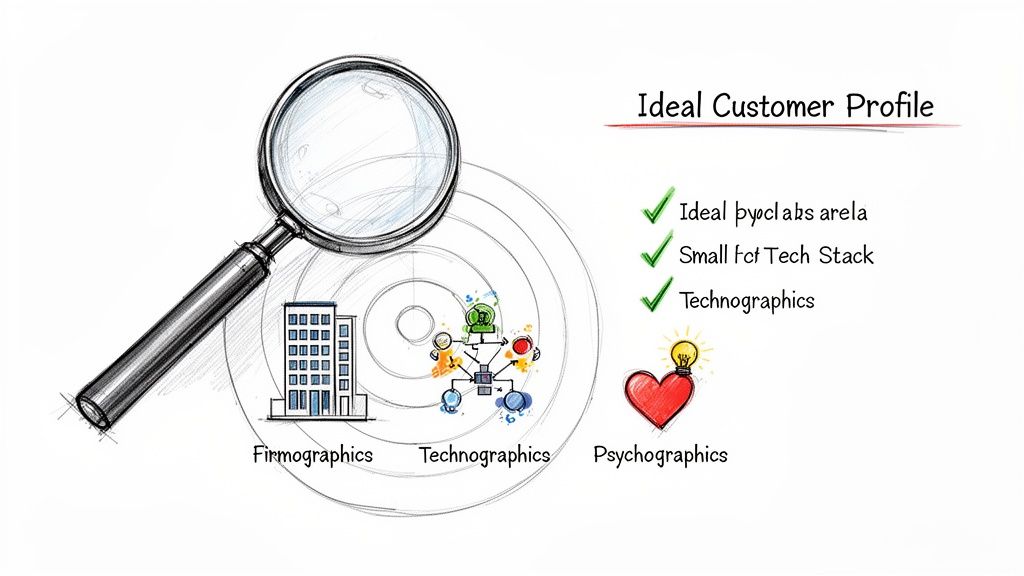
Before you can qualify a lead, you need to know exactly who you're looking for. This is where your Ideal Customer Profile (ICP) comes into play. Forget vague ideas—your ICP should be a documented, data-driven blueprint of the perfect company for your product. It’s the north star for your entire team.
Think of it as the ultimate filter. A solid ICP helps you instantly spot dream accounts and wave goodbye to the ones that will eat up your time. Flying without one? You're just hoping to get lucky.
Start With Your Best Customers
So, where do you begin? Look at the customers who already love you. Your happiest, most successful clients are a goldmine of information.
These are the people who just get it. They onboarded smoothly, they're power users, and they’re singing your praises. They're not just accounts; they're true partners who renew, expand, and send referrals your way.
Your job is to play detective. Dig into what makes them such a great fit, find the common threads, and reverse-engineer their success to find more just like them.
The Three Pillars of a Killer ICP
A powerful ICP isn't just about company size and industry. It’s a multi-layered profile that gives you a complete picture of your target, boiling down to three key areas.
Firmographics: This is the basic "who" and "where" of a company. Think of these as the company's stats sheet.
Technographics: This is all about the tech stack. It reveals the software and tools a company uses, giving you incredible clues about their needs.
Psychographics: This is the "why." Here, you uncover their goals, their biggest headaches, and the human motivations that drive a purchase.
Let's break down what you need to find out for each one.
The Questions That Build Your Profile
Grab your best customers and start asking these questions. The more specific you get, the more potent your ICP will become. And if you need more ideas on where to find this data, check out our guide on how to generate B2B leads.
1. Firmographic Data (The "Who")
What industry are they in? (e.g., SaaS, FinTech, E-commerce)
What's their annual revenue? (e.g., $5M - $25M ARR)
How big is the team? (e.g., 50-200 employees)
Where are they based? (e.g., North America, EMEA)
2. Technographic Data (The "How")
Which CRM are they using? (e.g., Salesforce, HubSpot)
What about marketing automation? (e.g., Marketo, Mailchimp)
Are they using a competitor's product?
What other tools are essential to their workflow?
3. Psychographic Data (The "Why")
What was the burning pain point that sent them looking for a solution?
Was there a "trigger event"? (Think: a new funding round, a key executive hire)
What are their biggest strategic goals for the next 12 months?
Who was the internal champion that drove the deal forward?
By combining these three data layers, you move from a generic description like "mid-sized tech companies" to a hyper-specific ICP: "B2B SaaS companies in North America with 50-200 employees and $10M-$50M in ARR, using Salesforce and struggling to scale their outbound sales team after a recent Series A funding round."
That level of clarity is a total game-changer. Suddenly, your sales and marketing teams are speaking the same language and aiming at the same bullseye.
Mastering Proven Lead Qualification Frameworks
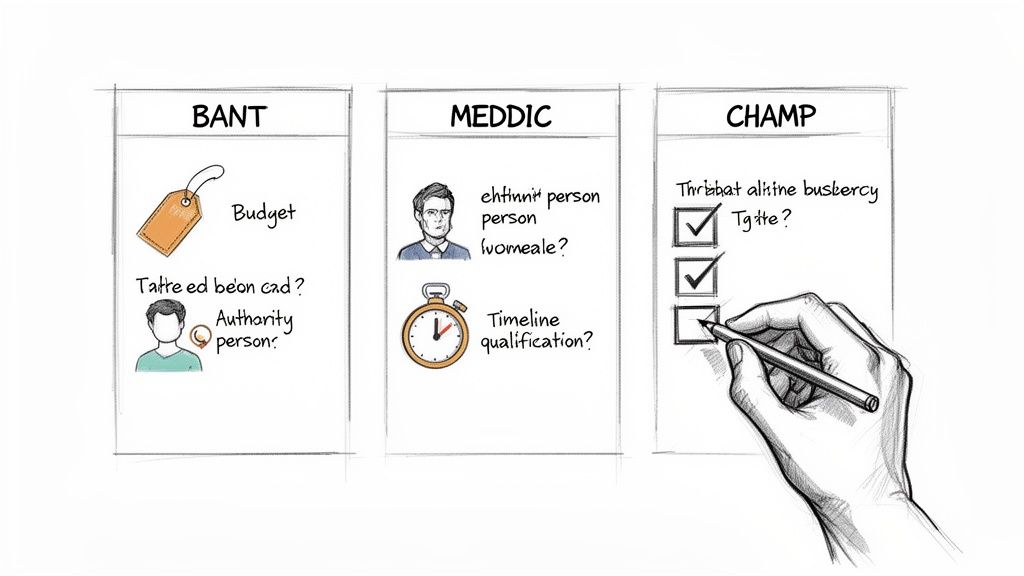
Okay, you've nailed down your Ideal Customer Profile. Now what? It's time to bring structure to your sales conversations. A qualification framework is like a GPS for your sales reps—it guides them through discovery calls, making sure they hit all the critical checkpoints needed to move a deal forward.
This isn't about turning reps into robots. A great framework is a roadmap for uncovering a prospect's real needs, their biggest headaches, and how they actually buy things. By adopting a structured method, your team can ditch the guesswork and start having consistently amazing conversations.
BANT: The Classic Framework for Speed
Developed by IBM, BANT is the original qualification framework. It's simple, memorable, and incredibly powerful for shorter, more transactional sales cycles. BANT stands for Budget, Authority, Need, and Timeline.
It’s your go-to for quickly figuring out if a prospect has the basic ingredients for a sale.
Budget: Do they have money set aside for a solution like yours?
Authority: Are you talking to the person who can sign the check?
Need: What's the real business pain they're trying to solve?
Timeline: When are they hoping to have a solution in place?
BANT is a rockstar when you need to qualify a high volume of leads, fast. It helps your reps avoid sinking time into prospects who simply can't buy.
MEDDIC: The Enterprise Sales Powerhouse
When you're dealing with complex, high-value deals, MEDDIC is the undisputed champion. It’s a more rigorous framework built for the tricky world of enterprise sales, where understanding internal politics is just as crucial as the technical fit.
MEDDIC forces you to go deep into the customer’s world, focusing on hard numbers and the org chart.
Metrics: What measurable results is the prospect targeting? (e.g., increase revenue by X%)
Economic Buyer: Who holds the ultimate P&L responsibility?
Decision Criteria: What are the specific technical and financial requirements they'll use to judge their options?
Decision Process: How do they actually make a decision? Map out the people, steps, and timeline.
Identify Pain: What's the primary business challenge, and what happens if they do nothing?
Champion: Who is your inside person? This is the one who will fight for you when you're not in the room.
Following MEDDIC gives you a 360-degree view of the opportunity, dramatically cutting the risk of a deal getting stuck.
CHAMP: The Customer-Centric Alternative
CHAMP is a modern, buyer-first twist on qualification. It starts the conversation by focusing on the prospect's problems, not their wallet, which creates a more collaborative vibe. CHAMP stands for Challenges, Authority, Money, and Prioritization.
This framework is fantastic for building rapport and positioning your reps as problem-solvers.
By starting with Challenges, you immediately frame the conversation around the prospect’s world. This simple shift can make all the difference, transforming a sales pitch into a problem-solving session.
Here’s how it works:
Challenges: What specific roadblocks are they hitting every day?
Authority: Who is part of the decision-making crew?
Money: Are there financial resources available to make these challenges go away?
Prioritization: How big of a deal is this, really? Is solving this problem a top priority for them this year?
CHAMP is the perfect play for teams who want to lead with value and forge strong relationships from the start.
Choosing The Right Qualification Framework
So, which one is for you? The "best" framework is the one that fits your business. It all comes down to your sales cycle, deal complexity, and average contract value. And you don't have to be a purist—many successful teams create a hybrid model, taking the best bits from each.
Here's a quick cheat sheet to help you decide.
Framework | Best For | Key Focus | Example Question |
|---|---|---|---|
BANT | High-volume, shorter sales cycles | The prospect's readiness to buy | "What budget has been allocated for this project?" |
MEDDIC | Complex, enterprise-level deals | Navigating the buyer's organization | "Who is the ultimate economic buyer for this decision?" |
CHAMP | Building consultative relationships | The prospect's core business pain | "What are the biggest challenges your team is facing right now?" |
By giving your team a proven framework, you're not just giving them a script. You're giving them the structure they need to have more meaningful, insightful, and effective conversations.
Automating Lead Scoring with Modern Tools
Let's be honest: manual lead qualification can be a grind. It’s slow, tedious, and often feels like a guessing game. Worse, it’s a massive time-suck that keeps your sales team digging for data when they should be talking to prospects.
But what if you could ditch the manual work and build a system that automatically surfaces your best leads? That's exactly what modern, AI-powered tools are for. This isn't about replacing your reps' intuition; it's about arming them with data so they can focus on what matters—building relationships and closing deals.
From Manual Grind to Automated Flow
The old-school approach is painful. Reps spend hours scouring LinkedIn and company websites just to piece together a basic profile for a new lead. Not only is it a waste of time, but the quality of that research can vary wildly from one rep to another.
Automation completely changes the game. Imagine a new lead enters your CRM, and within seconds, it’s updated with all the critical data points you need. Tools like Clura let you build workflows that instantly pull in key information that aligns with your Ideal Customer Profile.
What kind of information can you collect?
Job Title & Seniority: Is this person a decision-maker, an influencer, or an end-user?
Company Size & Revenue: Do they fit the firmographic profile of your best customers?
Technographics: What software are they already using? This is gold for figuring out compatibility and pain points.
Buying Signals: Did they just get a funding round or post 10 new sales jobs? These are massive green flags.
This instant data boost is the foundation of a powerful scoring system. To really get why this is so critical, it’s worth understanding what data enrichment is and how it fuels smarter sales motions.
Building Your Automated Scoring Model
Once your leads are enriched with fresh, accurate data, you can build a scoring model that grades them based on how well they match your ICP. Think of it as an instant sorting hat for your prospects.
It doesn’t have to be complicated. You simply assign points to the attributes you care about most.
For example, your model might look like this:
+20 points if their job title is "VP of Sales."
+15 points if the company has 50-250 employees.
+10 points if their tech stack includes a competitor's product.
+25 points for a buying signal, like a recent funding announcement.
The real magic happens when you set a threshold. For instance, any lead that scores over 50 points gets automatically flagged as a Sales Qualified Lead (SQL) and is immediately routed to a sales rep.
This simple workflow ensures your team always focuses on the hottest leads first, which has a massive impact on their efficiency and close rates.
This screenshot from Clura shows just how easy it is to extract structured data from a website, which is the first step in building your automation engine.
By automating data collection, you build a clean, consistent foundation for your lead scoring rules and say goodbye to manual data entry for good.
Integrating Automation Across Your Funnel
But why stop at scoring? You can weave automation through your entire funnel. For example, a lead generation chatbot on your website can capture and pre-qualify visitors 24/7, so you never miss an opportunity.
These bots can ask the initial qualifying questions, score the answers in real-time, and either book a meeting directly on a rep's calendar or add the person to a nurture sequence. No more leads slipping through the cracks.
When you combine AI-powered enrichment, automated scoring, and intelligent chatbots, you create a powerhouse system. You free your team from administrative quicksand, allowing them to stop digging for data and start having meaningful conversations.
Putting Your Qualification Process Into Action
Having a brilliant qualification strategy on paper is a great start, but it’s the execution that separates good sales teams from truly great ones. Rolling this out is about building a revenue-driving machine fueled by alignment, clear metrics, and constant improvement.
The goal isn't just to enforce new rules. It’s to embed a new mindset across your entire go-to-market team. When marketing and sales are perfectly in sync on what a "good lead" looks like, your whole pipeline gets faster and more predictable.
Get Sales and Marketing Rowing in the Same Direction
First things first: everyone has to be on the same page. A qualification framework that lives only in the sales department is dead on arrival. Marketing has to be your core partner, since they're the ones feeding the machine.
Get leaders from both teams in a room. Unveil your new Ideal Customer Profile (ICP) and lead scoring model. Don’t just show them what it is; walk them through the why behind every criterion.
The most critical outcome of this meeting is a signed-off Service Level Agreement (SLA). This is your contract between teams. It spells out what defines a Marketing Qualified Lead (MQL) and a Sales Qualified Lead (SQL) and sets timelines for follow-up. For example, an MQL becomes an SQL at a score of 75, and sales commits to following up within 24 hours.
This shared language is the antidote to the classic blame game. Now, everyone is working from the same playbook and accountable to the same definitions of success.
This flow shows exactly how automation can take raw data points and turn them into actionable, qualified leads for your team.
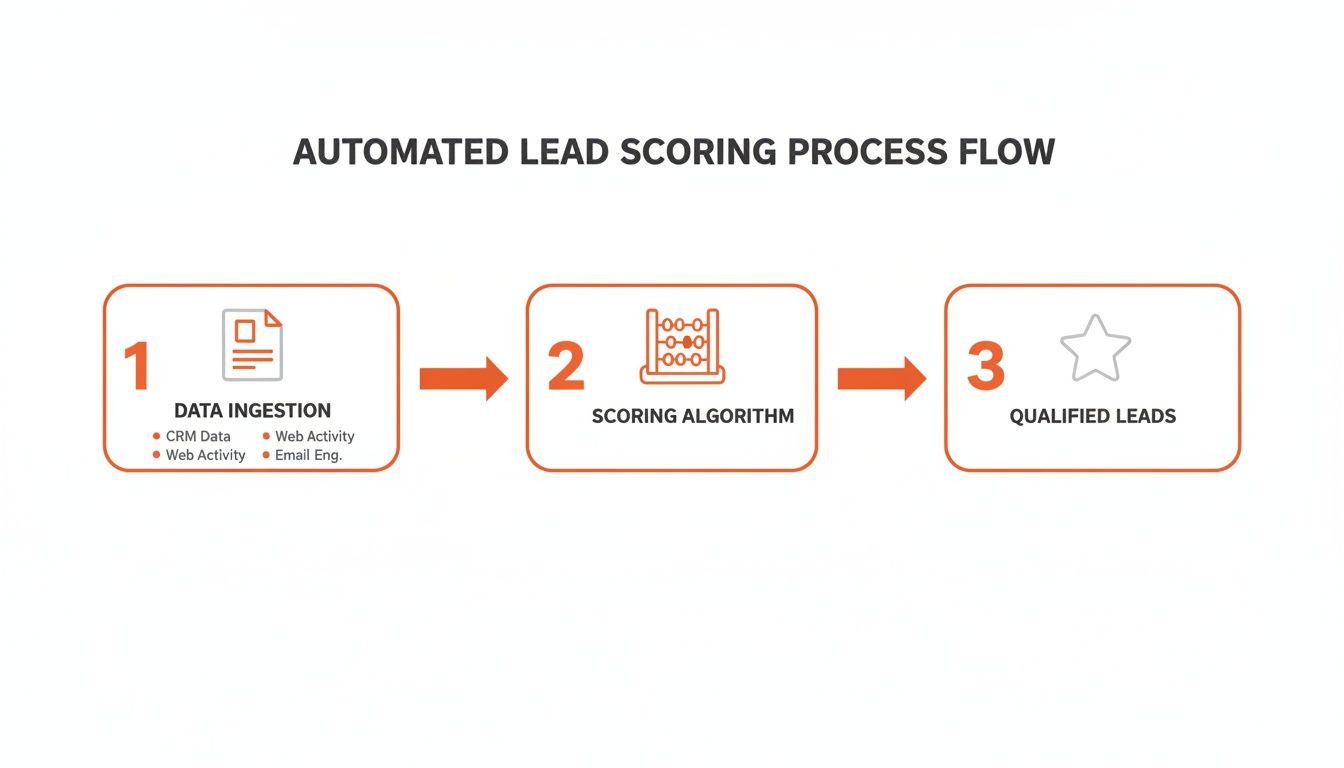
With a system like this, every lead gets scored consistently and objectively against your criteria before a rep ever sees it.
Track the KPIs That Actually Move the Needle
You can't improve what you don't measure. As soon as your new process is live, you need to become obsessed with a few key performance indicators (KPIs). These numbers will tell you if your qualification engine is working.
Here are the essentials to keep on your dashboard:
Lead-to-Opportunity Rate: What percentage of leads from marketing convert into real sales opportunities? If this number is climbing, your criteria are hitting the mark.
Sales Cycle Length: Better leads should move faster. By weeding out tire-kickers early, your reps can pour their energy into deals with real momentum.
Win Rate for Qualified Deals: Are you closing more of the deals you qualify? An increasing win rate proves your team is spending time with the right buyers.
Average Deal Size: A tighter qualification process often leads to bigger deals. When you focus on your ICP, you naturally find customers who get the most value from your solution.
Put these metrics on a shared dashboard for both sales and marketing to see. Transparency creates a sense of shared ownership and keeps everyone’s eyes on the prize.
Build a Feedback Loop for Constant Improvement
Your qualification process is not a "set it and forget it" project. Markets change, products evolve, and customer needs shift. Your criteria need to be a living, breathing thing.
The key is to build a system for regular review.
Set up a bi-weekly or monthly huddle with key players from sales and marketing. This isn't a meeting for pointing fingers; it’s a workshop for making the process better, together.
The agenda should be simple but powerful:
Review the KPIs: Look at the data as a team. Where are you winning? Where are the bottlenecks?
Analyze Recent Deals: Dig into last month's wins and losses. Did the wins fit your ICP perfectly? What common threads did you find in the deals you lost?
Get Rep Feedback: Your frontline reps are a goldmine. What are they hearing on calls? Do the scoring criteria reflect a lead's real potential?
This constant feedback loop turns your process from a static document into an intelligent system that gets smarter over time.
Your Top Lead Qualification Questions, Answered
Let's dive into some of the questions that always come up when teams get serious about qualifying leads. Think of this as your practical, no-nonsense FAQ for building a sales process that works.
What's the Real Difference Between an MQL and an SQL?
This is a classic, and it's super important to get right.
An MQL (Marketing Qualified Lead) is someone who's shown interest. Maybe they downloaded an ebook or signed up for a webinar. They've raised their hand, but they're still doing their research. They're curious, not committed.
An SQL (Sales Qualified Lead) is where things get serious. This is an MQL that sales has vetted and confirmed is the real deal. They have a genuine need, the budget to solve it, and the authority to make a decision. The entire process we've been talking about is designed to turn those curious MQLs into ready-to-buy SQLs.
How Often Should We Revisit Our Qualification Criteria?
Your qualification criteria should not be a "set it and forget it" thing. The market moves way too fast for that.
Plan to review your criteria at least every six months. You should also do an immediate check-in whenever there's a big shift, like a major product launch or a new competitor shaking things up.
A sudden dip in your lead-to-opportunity conversion rate is a massive red flag. That's your cue to get the team together. The best insights will come from regular, candid conversations with your sales and customer success teams—they're the ones on the front lines.
The biggest mistake is treating qualification like an interrogation. Instead of just running down a checklist, the goal is to have a genuine conversation. The criteria should guide the conversation, not control it.
Can a Disqualified Lead Ever Become a Customer?
Absolutely! And you’d be surprised how often it happens. "Disqualified" rarely means "never." More often, it just means "not right now."
Maybe their budget got frozen, or a different project took priority. Whatever the reason, you should never just delete these leads.
The smart move is to place them into a long-term marketing nurture sequence. Keep sending them valuable content, check in occasionally, and stay on their radar. When their timing and priorities change, you’ll be the first person they call. It's a simple strategy that turns a past "no" into a future "yes."
What's the Single Biggest Mistake in Lead Qualification?
I see this one all the time: forgetting the human element. New reps can get so fixated on ticking off boxes on their BANT or MEDDIC checklist that they completely forget to listen.
Qualification isn't a robotic script; it’s a conversation.
A consultative approach is what builds trust and uncovers deep-seated needs that a checklist could never find. Your goal isn't just to qualify them for your business, but to help them figure out if you're the right solution for theirs. This simple shift in mindset changes the entire dynamic from a sales pitch to a collaborative problem-solving session—and that’s a game-changer.
Ready to stop the manual grind and start automatically enriching and scoring your best leads? With Clura, you can build powerful data extraction workflows in just one click—no code required.
