
Discover the best competitive price monitoring software. This guide compares top tools and strategies to help you master dynamic pricing and win your market.
In the fast-paced world of e-commerce, competitive price monitoring software is no longer a luxury—it's the engine that separates market leaders from the rest. This technology automates the tedious work of tracking your competitors' prices, promotions, and stock levels, turning raw data into a powerful strategic advantage. We're not just talking about matching a discount; we're talking about making smarter, faster, and more profitable pricing moves.
This guide will show you how these tools work, what features matter most, and even how you can build a custom price monitor yourself, no code required.
Why Price Monitoring Is Your E-Commerce Superpower
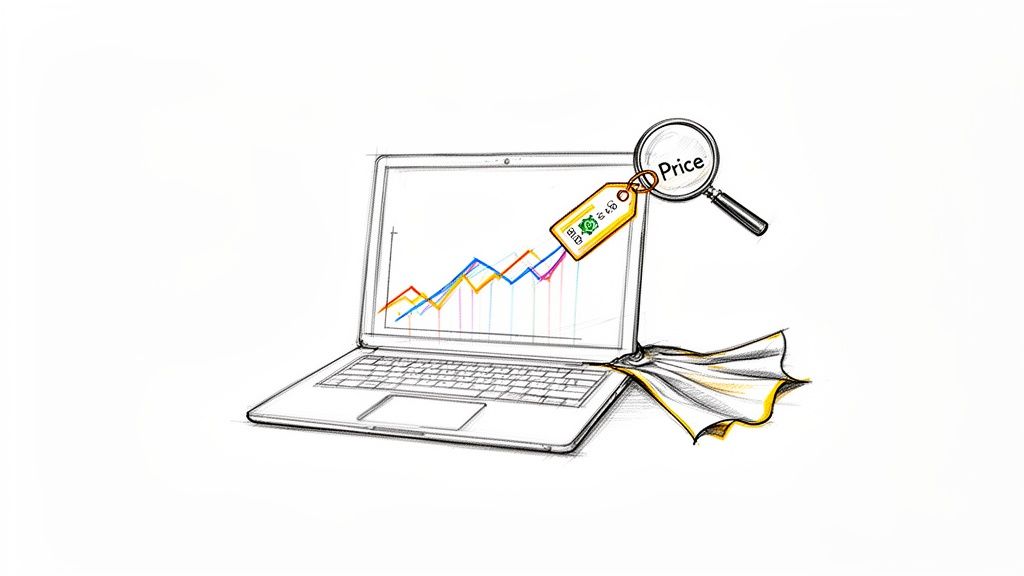
Let's be real: your customers can compare prices across a dozen different retailers in seconds. If you’re making pricing decisions in a bubble, you’re already behind. While you’re debating a price change, your savviest competitors have already adjusted theirs based on live market data, snagging sales that should have been yours.
This is where competitive price monitoring software becomes your secret weapon. It transforms your pricing strategy from guesswork into a precise, data-driven science, giving you the confidence to act decisively.
Go Beyond Simple Price Checks
Effective price monitoring is about much more than just peeking at a competitor's price tag. It’s about building a complete, 360-degree view of the market landscape. The right tools deliver intelligence that helps you answer the questions that really matter to your business:
Protect Your Profits: Dodge devastating price wars by knowing precisely when to hold firm on your price and when a small, strategic adjustment makes sense.
Strengthen Brand Value: Use hard data to justify premium pricing and stop your brand from being devalued by a race to the bottom.
Claim Market Share: Spot the perfect moments to attract price-sensitive shoppers without wrecking your margins.
The explosive growth of this technology tells the whole story. The global price monitoring software market hit $1,042.9 million in 2024 and is on track to soar to $2,500 million by 2035—a compound annual growth rate of 8.3%. This isn't just a trend; it's a fundamental shift in how modern e-commerce works.
The Problem with Manual Tracking
Trying to manually check competitor websites is a game you can’t win. It's painfully slow, full of errors, and impossible to scale as your product catalog or competitor list grows. By the time you’ve wrestled that spreadsheet into shape, the data is already out of date.
Automated price monitoring gives you the speed and accuracy to compete at the highest level. It frees your team from mind-numbing data gathering and empowers them to become strategic thinkers who analyze, decide, and act.
This is the cornerstone of any solid competitive strategy. Understanding pricing in its full context is a key piece of the bigger puzzle we explore in our guide on what is market intelligence. For more advanced tactics, check out these 5 ways to spy on competitors and dominate e-commerce.
Must-Have Features in a Modern Pricing Tool
Choosing the right competitive price monitoring software feels easier when you know exactly what to look for. Not all tools are created equal. The best platforms have evolved beyond simple price scraping to become the strategic command center for your entire pricing operation.
A basic tool might show you a competitor's price today. A game-changing tool shows you their entire pricing history, alerts you the second a price changes, and even suggests your next move. It’s all about shifting from just seeing data to acting on it with confidence.
Core Capabilities Every Business Needs
Before getting dazzled by bells and whistles, let's focus on the fundamentals. Any software you consider must nail these core features to give you a clear and accurate picture of the market.
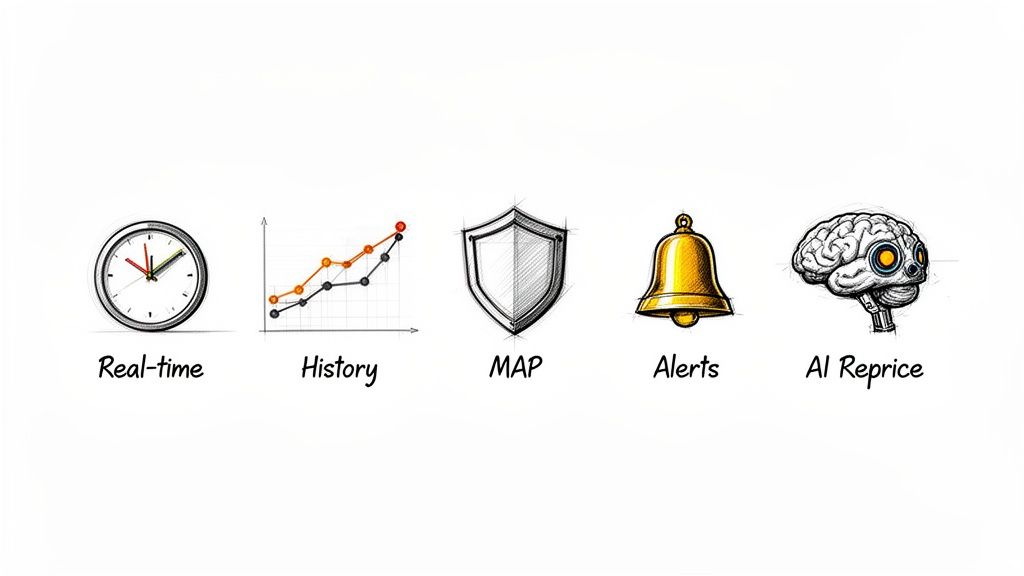
Real-Time Data Collection: The market moves fast, and your data needs to keep up. Real-time updates mean you're reacting to what’s happening now, not yesterday. This is how you jump on opportunities before they disappear.
Historical Price Analysis: A single price drop is interesting, but a pattern is a superpower. Historical data reveals seasonal trends, helps predict competitor promotions, and shows how they react to market shifts over time.
Accurate Product Matching: Your data is useless if the software can't tell your "Pro T-Shirt, Blue, Large" from a competitor's "Active Tee - L - Navy." The best tools use smart AI to accurately match products across websites, even when names or SKUs don't align.
These features are the bedrock of reliable pricing intelligence. For a deeper look at applying them, our guide on how to monitor competitor prices offers hands-on strategies.
Features That Give You a Decisive Edge
Once the basics are covered, it's time to find the features that separate good tools from great ones. These capabilities automate your workflow and hand you a serious competitive advantage.
The most powerful features are those that move you from passive observation to proactive strategy. They don't just give you data; they tell you what to do with it.
Keep an eye out for these game-changers:
MAP Monitoring Alerts: Minimum Advertised Price (MAP) violations can crush your brand's value. Automated MAP monitoring instantly flags any seller who lists your products below that price, allowing you to enforce your policies immediately.
Customizable Dashboards and Reporting: No one wants to drown in raw data. A great tool visualizes the most critical information in a clean, intuitive dashboard and lets you build custom reports focused on the competitors and metrics that matter to your business.
Dynamic Repricing Engines: This is where the magic happens. AI-driven repricing engines use your data and rules to automatically adjust prices in real time. You can set rules to always be 1% cheaper than a key competitor, maintain a specific margin, or react to inventory levels—putting your pricing strategy on autopilot.
The market for these tools is booming for a reason. Global price monitoring software is projected to hit $1.92 billion in 2025 and reach nearly $5.09 billion by 2034, growing at a remarkable CAGR of around 13%. To see a modern feature list in action, it's worth exploring copycat247's feature set.
Essential vs. Advanced Software Features
Not sure what to prioritize? This table breaks down essential features from advanced ones to help you decide what you need now versus what you might grow into later.
Feature Category | Essential for All Businesses | Advanced for Scaling Businesses |
|---|---|---|
Data & Intelligence | Real-Time Data Collection, Historical Price Tracking, Accurate Product Matching | Predictive Analytics, Stock Level Monitoring, Competitor Promotion Tracking |
Automation & Action | Basic Email Alerts, Scheduled Reports | Dynamic Repricing Engines, MAP Violation Enforcement, Automated Workflows |
Usability & Reporting | Standard Dashboard, Basic Product Comparison | Customizable Dashboards, API Access, Advanced Visualizations & Analytics |
Whether you're just starting out or dominating your market, choose a tool that meets your current needs and supports your future growth.
Finding the Right Pricing Software for Your Business Size
Choosing the right competitive price monitoring software isn’t about finding the "best" tool—it’s about finding the best tool for you. A platform built for a global brand would be overkill for a startup, and a simple tool would leave a growing business flying blind.
It all comes down to matching the software’s power, complexity, and price to your specific needs and catalog size. Let's break it down into three clear categories based on the number of products (SKUs) you manage.
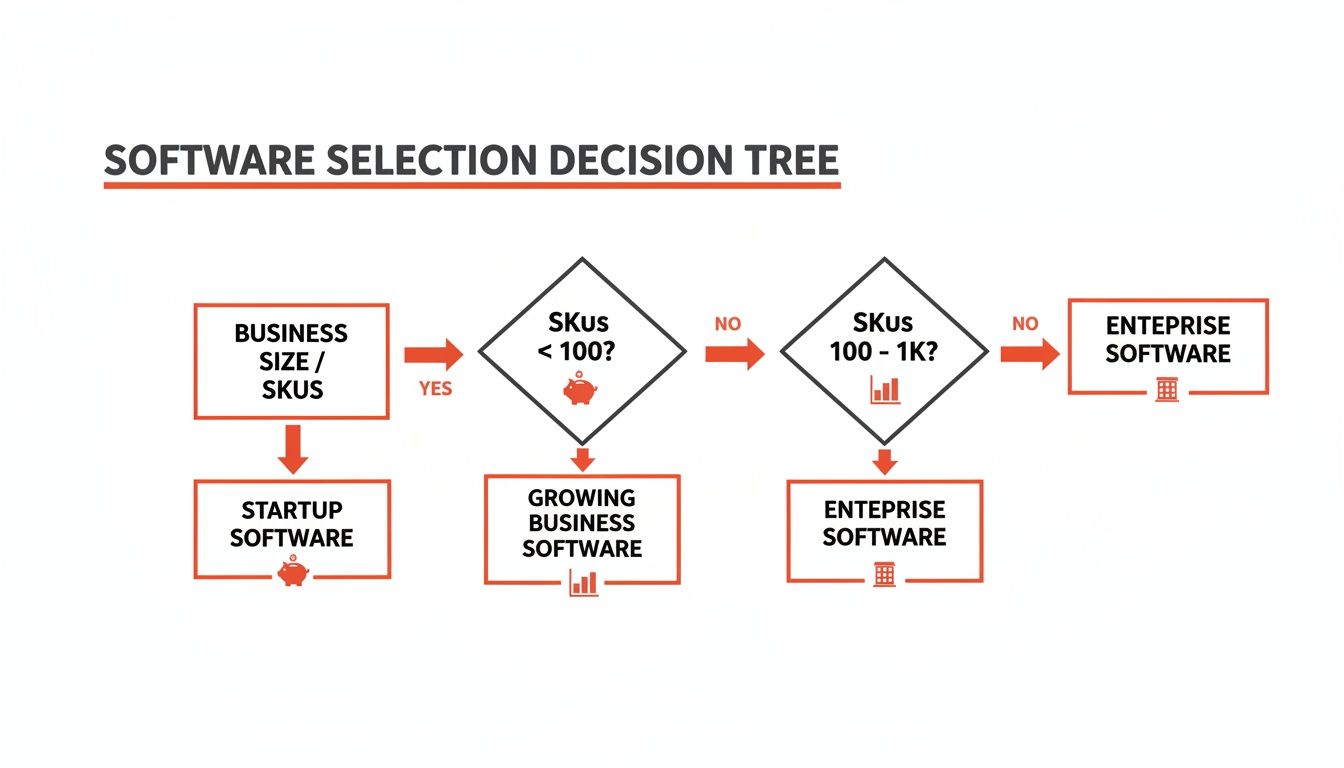
Small Sellers & Startups (Under 100 SKUs)
If you have a focused product line, you need accurate, actionable data without a huge budget. Your mission is to get the insights you need without hiring someone just to run the software.
It’s all about simplicity and efficiency.
Pricing Models: Look for affordable monthly plans, a solid free tier, or pay-as-you-go models.
Data Refresh Speed: Daily or twice-daily updates are usually enough. You need to know when big price shifts happen, but you’re likely not in a market that changes by the minute.
Key Features: Stick to the essentials: reliable product matching, historical price charts, and simple email alerts when a competitor makes a move.
The goal is to automate the manual work of checking websites so you can focus on growing your business.
Growing Businesses (100–1,000 SKUs)
Once your catalog grows, manual tracking is a recipe for disaster. At this stage, you’re not just watching prices—you're managing a pricing strategy. That demands more automation, power, and deeper insights.
You need a dedicated platform that can handle complexity without being complicated.
Your focus shifts from simply seeing price changes to understanding the why behind them. This means you need software that provides context, like competitor stock levels or active promotions.
Look for these key capabilities:
Powerful Automation: Your software should do more than send an email. It needs to offer rule-based repricing suggestions or integrate with your e-commerce platform (like Shopify or BigCommerce).
Flexible Integrations: The ability to connect to your other systems is huge. API access lets you pull pricing data into your own dashboards for a complete picture of performance.
Advanced Analytics: Look for customizable dashboards that let you slice and dice data by brand, category, or competitor.
Software in this bracket helps you transition from being reactive to proactive, making strategic decisions that directly impact your bottom line.
Large Enterprises (1,000+ SKUs)
For large businesses juggling thousands of SKUs, pricing is a core business function that demands a powerful, scalable, and intelligent solution. The complexity of modern e-commerce has driven the rise of specialized tools, and as you can discover in more detail on datainsightsmarket.com, companies with massive catalogs require sophisticated platforms.
At this level, you’re investing in a central intelligence hub.
Data at Scale: The platform must handle enormous amounts of data with near-instant refresh rates. Hourly or even real-time monitoring becomes standard.
AI-Driven Insights: Elite enterprise tools use AI to provide predictive analytics. They don't just report what happened; they help you forecast market trends and recommend optimal pricing strategies.
Comprehensive Intelligence: Top-tier platforms track everything from competitor assortments and shipping costs to customer reviews, giving you a 360-degree view of the competitive landscape.
These platforms are a significant investment, but the ROI is undeniable. They enable precise, data-driven pricing decisions at a scale that would be humanly impossible. To explore more options, our guide on the best competitor analysis tools offers a broader perspective.
Putting Pricing Intelligence into Action: Practical Examples
Theory is great, but the real magic of competitive price monitoring software happens when you see it solve real-world problems. Let's look at how a Shopify store owner, a brand manager, and a market analyst can use this technology to get game-changing results.
Each scenario breaks down a common headache and shows how smart, automated monitoring is the solution.
Use Case 1: Boosting Sales for a Shopify Store
Imagine you run a Shopify store selling electronics, and Black Friday is just around the corner. Your competitors are about to unleash a storm of unpredictable flash sales. Trying to keep up manually is impossible.
Your goal is to stay competitive without destroying your profit margins. You need to react instantly when a rival drops their price on a hot-ticket item.
The Setup: Use pricing software to monitor the product pages of your top three competitors. Create automated alerts that notify you the second a key product's price drops by more than 5%.
The Result: On Thanksgiving Day, you get an alert: a major competitor just launched a 20% off sale on the best-selling headphones you carry. You immediately activate a pre-planned discount code to match them. That split-second reaction helps you capture a huge chunk of early-bird shoppers, supercharging your holiday revenue.
Use Case 2: Protecting Brand Value with MAP Monitoring
Now, think like a major brand that sells products through dozens of third-party online retailers, including a massive storefront on Amazon. You have a strict Minimum Advertised Price (MAP) policy to protect your brand’s premium reputation.
The problem? Unauthorized sellers constantly list your products below MAP, undercutting your partners and cheapening your brand.
MAP monitoring isn't just about enforcing rules; it's about defending your brand's value. Automated tools are the only realistic way to protect your pricing integrity at scale.
Here’s how a monitoring tool puts enforcement on autopilot:
Automated Scanning: The software scans Amazon and other key marketplaces 24/7 for all listings of your products.
Instant Violation Alerts: The moment a seller advertises a product below your MAP, the system flags it and sends an immediate alert to your team with all the proof you need: seller name, price, and a timestamped screenshot.
Streamlined Enforcement: Armed with this data, your team can issue cease-and-desist notices in minutes, creating a clear pattern of enforcement that deters violators.
Use Case 3: Identifying Market Gaps for a New Product Launch
Finally, imagine you're a market analyst for a home goods company that wants to launch a new line of kitchen appliances. You need solid data to find where the real opportunities are.
Your job is to analyze the entire product assortment of your would-be competitors, hunting for underserved niches.
The Setup: Use a data collection tool to scrape the complete kitchen appliance category from the websites of two industry leaders. The tool grabs product names, categories, prices, and key features.
The Result: After analyzing the data, you have a breakthrough. You see that while both competitors offer dozens of high-end, expensive blenders, there's a massive gap in the mid-range market—specifically, the $75-$125 price point. You take this data to the product team, giving them an evidence-backed case for launching a new product line aimed squarely at that profitable, wide-open segment.
How to Build Your Own Price Monitor in 3 Simple Steps
What if you didn't have to get locked into rigid, single-purpose competitive price monitoring software? Most traditional tools are powerful but force you into their workflow. You get their dashboard, their reports, their way of doing things.
You need the flexibility to build custom monitoring solutions that fit your products and strategy. This is where a smart, AI-powered browser automation tool like Clura changes the game. Instead of buying a pre-packaged solution, you can create your own lightweight, automated price monitor in minutes—no coding required.
Let's walk through just how easy it is to take control of your competitive intelligence.
The No-Code Workflow for Custom Price Monitoring
The beauty here is the simplicity. You’re using an intuitive tool to automate the same steps you’d take manually, but at lightning speed and perfect scale.
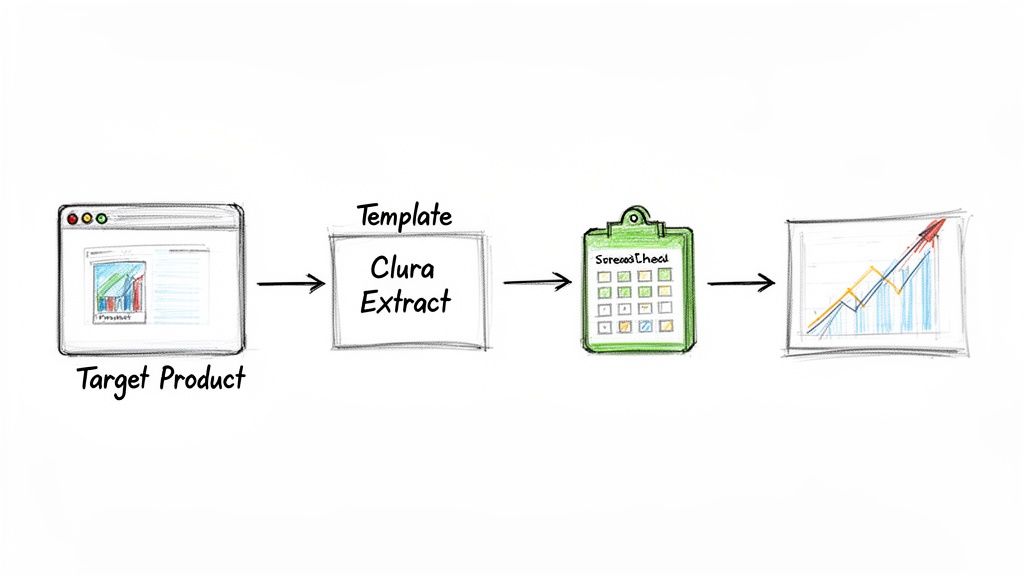
Say you want to track headphone prices on a competitor’s Shopify store. Doing this by hand is hours of copy-pasting. With an AI browser agent, it’s a simple, three-step process you can set up in minutes.
Here's the plan:
Target the Data Source: Go to your competitor’s product category page.
Activate a Template: Use a prebuilt template to instantly grab all the data.
Export and Analyze: Download the clean, structured data as a CSV.
This process gives you total freedom to monitor any website you need.
Step 1: Target Your Competitor's Product Page
First, navigate to the webpage where the data lives. For this example, we’ll aim for a competitor's main category page that lists multiple products at once.
Open your browser and go directly to the URL you want to monitor. This could be a search results page on Amazon or a "Headphones" category on a competitor's site. This page is your starting point.
Step 2: Use a Prebuilt Template to Extract Prices
This is where you get all your time back. Instead of manually copying every product name and price, you just let a smart template do the heavy lifting.
With the competitor’s page open, click the browser extension. It instantly suggests relevant prebuilt templates. Pick one like the "Product Listing Scraper," which is already configured to find and extract key details:
Product Name: Grabs the title of every item.
Current Price: Pulls the listed price for each product.
SKU or Product ID: Captures a unique identifier for accurate tracking.
Product URL: Saves a direct link to each product page.
With a single click, the tool zips through the page and organizes this information into a clean table right inside the extension. What would have taken an hour of tedious work is done in about 10 seconds.
Step 3: Export Your Data for Analysis
You’ve collected the raw data—now it's time to put it to work. The tool organizes everything into a perfect preview table. From there, exporting is just another click.
You can instantly download the dataset as a CSV file, which opens perfectly in Google Sheets, Microsoft Excel, or any other data tool.
This is the crucial handoff from data collection to real strategy. A clean, perfectly organized dataset is the foundation for spotting trends, finding opportunities, and making pricing decisions with total confidence.
Once your data is in a spreadsheet, the possibilities are endless:
Track Price Changes: Run the workflow daily or weekly and add the new data to your sheet to build a historical pricing log.
Compare Prices Side-by-Side: Grab data from several competitors and merge it into one dashboard for a complete market view.
Visualize the Data: Create charts to instantly see which competitors are aggressive on price or which of your products have the most volatile pricing.
This hands-on approach empowers anyone on your team to build a powerful, custom monitoring solution. Explore the prebuilt templates to see for yourself how fast you can get started.
Your Top Price Monitoring Questions, Answered
Jumping into competitive price monitoring software always brings up a few questions. That's a good thing! It means you're thinking strategically. Here are answers to the most common questions we hear.
How often should I check competitor prices?
It depends entirely on how fast your market moves. For hyper-competitive spaces like consumer electronics on Amazon, you need daily or even hourly updates. For more stable markets like B2B equipment, a weekly check-in is probably enough. The best tools let you set different schedules for different products, so you can increase frequency where it matters most.
Is it legal to monitor my competitors' prices?
Yes, it is 100% legal. When you monitor a competitor's website, you are collecting information that is publicly available to any shopper. It's a standard and accepted business practice. The key is to do it ethically with tools that respect website terms of service. Modern platforms like Clura are built to gather public data responsibly, so you get the intel you need without crossing any lines.
Can I monitor prices on any website?
Pretty much, yes. Today’s top tools can easily pull data from major platforms like Amazon, Shopify, and Walmart, as well as standalone brand websites. Some sites use aggressive anti-scraping technology, which can block simpler tools. This is where sophisticated, AI-powered browser automation platforms shine, as they are engineered to navigate modern web environments and reliably pull data from almost any public webpage.
What's the difference between price monitoring and dynamic pricing?
Great question! They are two sides of the same coin.
Price Monitoring is the input. It’s the process of gathering and analyzing competitor pricing data to build market intelligence.
Dynamic Pricing is the output. It's the action you take based on that intelligence—automatically adjusting your own prices in real time based on preset rules, demand, and competitor actions.
In short, monitoring provides the insights you need to build a strategy, and dynamic pricing is how you put that strategy into action automatically.
Ready to take control of your pricing strategy? With Clura, you can build a custom price monitoring workflow that fits your business perfectly. Automate data collection from any website in minutes—no coding needed.
Explore prebuilt templates and take control of your competitive intelligence today.
