
Discover what is sales intelligence and how it reveals valuable leads, accelerates deals, and boosts your sales outcomes.
Sales intelligence is your secret weapon for selling smarter, not just harder. Think of it as a powerful GPS for your sales team. It guides them directly to the right prospects with the perfect message, right when they're ready to buy.
Why Sales Intelligence Is Your New Must-Have
Let's be honest: the days of endless cold calls and generic email blasts are over. In a world drowning in noise, the best sales teams don't just hustle more; they operate with surgical precision. That’s the entire idea behind sales intelligence.
It’s about swapping guesswork for data-backed confidence. It completely changes how you find, understand, and connect with potential customers.
Imagine having a top-tier research assistant working for you 24/7. This assistant tirelessly scours the internet, sifting through millions of signals to pinpoint companies that are a perfect match for your product. Then, it dives deeper, serving up rich, contextual details about their current needs, pain points, and recent activities.
This means your team can finally stop chasing dead ends and focus all their energy on high-value leads who are already looking for what you sell.
The Three Pillars of Smarter Selling
When you boil it down, sales intelligence stands on three incredibly powerful pillars. Getting a grip on these is your first step toward building a sales machine that's both predictable and wildly efficient.
Finding High-Potential Leads: This is all about zeroing in on the best-fit companies and the key people inside them. It ensures your team's effort is always aimed at the right targets.
Understanding Their Unique Context: This is where you gather the good stuff—insights into a prospect's challenges, goals, and recent activities. This is what makes your outreach feel personal and relevant, not robotic.
Knowing Precisely When to Reach Out: This pillar is all about timing. It means tracking critical "buying signals"—like a company landing a new round of funding—that tell you now is the perfect moment to start a conversation.
This data-first strategy isn't just a "nice-to-have" anymore; it's quickly becoming essential for any modern sales organization. In fact, the global sales intelligence market is on track to hit an incredible $9.15 billion by 2031.
What’s driving this massive growth? It’s the sheer power to cut prospect research time from hours down to minutes by analyzing signals from over 100,000 different sources. You can dive deeper into these market trends and their impact on Mordor Intelligence. By adopting this approach, you give your team the tools to move faster, connect on a human level, and—most importantly—close more deals.
The Core Components of Sales Intelligence
So, what's really going on under the hood? Sales intelligence isn't a magic black box. It's a powerful process built on three core components working in perfect harmony.
When you get them right, they transform a chaotic mess of information into a crystal-clear roadmap for your sales team. They'll know exactly who to call, what to say, and when to reach out.
I like to think of it like a Michelin-star chef crafting a masterpiece.
First, you need the absolute best ingredients (Data Collection).
Then, you have to prep them—clean, chop, and season everything to unlock the flavors (Data Enrichment).
Finally, you serve the dish at the perfect moment, just as the diner's appetite peaks (Buying Signals).
Skip a step, and the whole thing falls flat. This simple map shows how it all comes together.
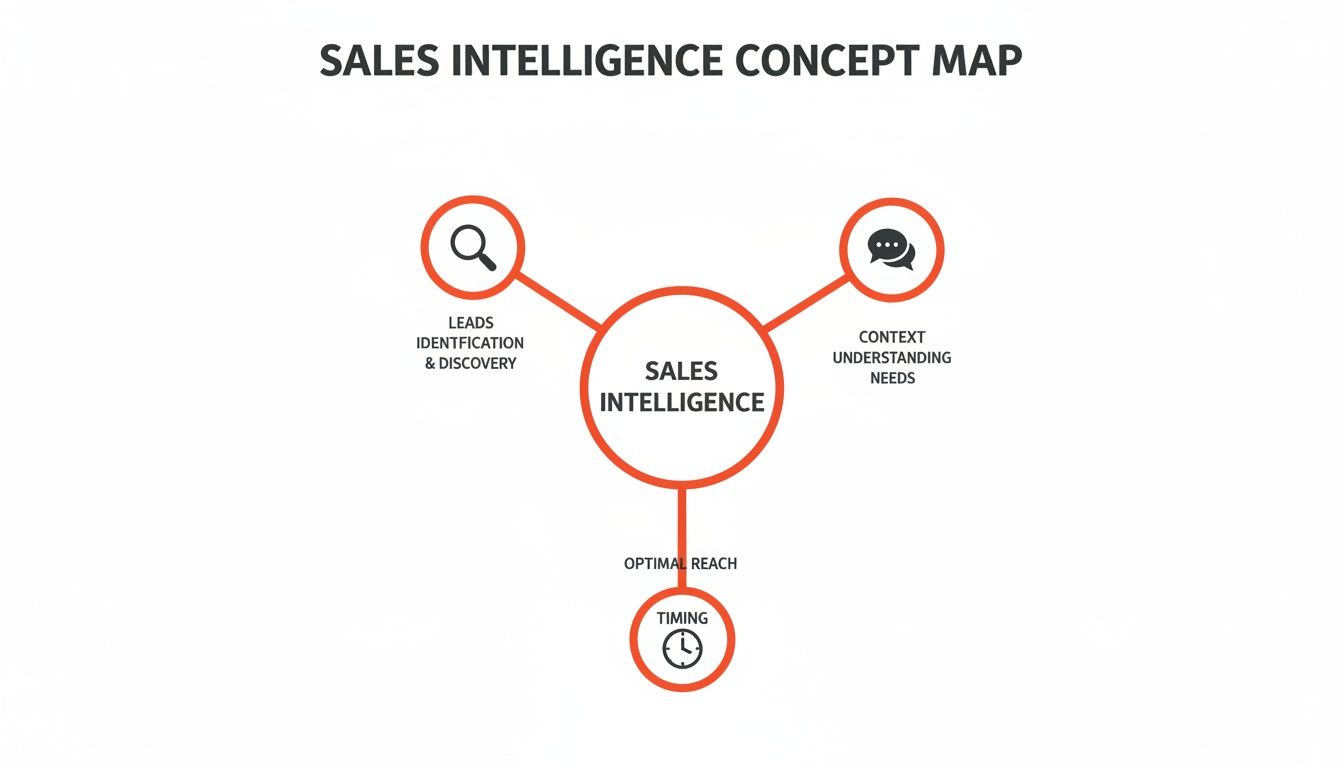
Ultimately, this three-part process turns random data points into a true strategic advantage, fueling smarter conversations and closing more deals.
Data Collection and Aggregation
It all starts with gathering public information. Modern sales intelligence tools are like digital detectives, constantly scouring millions of sources across the web. They pull details from company websites, press releases, social media profiles, job boards, and industry news sites.
This isn't just a simple copy-paste job. We're talking about sophisticated browser automation that can systematically pull structured data, like grabbing employee lists from LinkedIn, funding announcements from Crunchbase, or the tech stack listed on a company's career page.
The goal is to build a massive, ever-growing reservoir of raw information that holds the clues to your next big customer.
Data Enrichment
Let’s be real: raw data on its own is messy. A name and a company isn't enough to build a real connection. This is where data enrichment steps in, transforming that basic info into a rich, three-dimensional profile of your prospect.
Data enrichment is the engine that turns a lead from a simple name into a strategic opportunity. It fills in the blanks, providing the essential context your team needs to connect with prospects on a human level.
The enrichment process adds critical details to what you already have, turning a fragmented puzzle into a clear picture. The result is a complete profile that helps your reps truly understand who they’re talking to. If you want to go deeper, check out our full guide on what is data enrichment and how to master it.
Here’s what enrichment typically adds:
Accurate Contact Information: Verified emails and direct-dial phone numbers.
Detailed Firmographics: The nitty-gritty on industry, company size, and annual revenue.
Key Technographics: The specific software and tools a company uses, revealing integration opportunities or pain points.
Professional Background: A person's job title, responsibilities, and career history to help you tailor your pitch.
Buying Signals and Triggers
The final piece of the puzzle is all about timing. Buying signals, or trigger events, are flags that pop up indicating a prospect might be ready to make a move. Spotting these signals is the secret to reaching out at the perfect moment, right when your solution is most relevant.
Think of these triggers as green lights for your sales team, screaming, "Engage now!" Instead of shooting in the dark, reps can anchor their outreach to a specific, timely event. That instantly makes them more relevant and dramatically increases their chance of getting a reply.
Common buying signals include:
New Executive Hires: A new leader in the C-suite almost always means a new budget and a fresh desire to shake things up.
Recent Funding Rounds: A huge injection of cash is a clear sign a company is ready to invest in growth.
Company Expansion: Opening a new office or launching in a new country? They're going to need scalable systems.
Hiring Sprees: If a company is suddenly hiring a dozen new salespeople, you can bet they'll need technology to support that new team.
Negative Product Reviews: Spotting complaints about a competitor's product is the perfect opportunity to swoop in with a better alternative.
The Game-Changing Benefits for Your Sales Team
Now that we’ve pulled back the curtain on what sales intelligence is, let's get to the good stuff: what it actually does for your bottom line. We’re not talking about small tweaks here; this is about fundamentally reshaping how your team performs.
Think of it like giving your sales reps a set of superpowers. Suddenly, they can see exactly who to talk to, know precisely what to say, and engage at the perfect moment. All the guesswork is gone, replaced with focus, confidence, and incredible results.
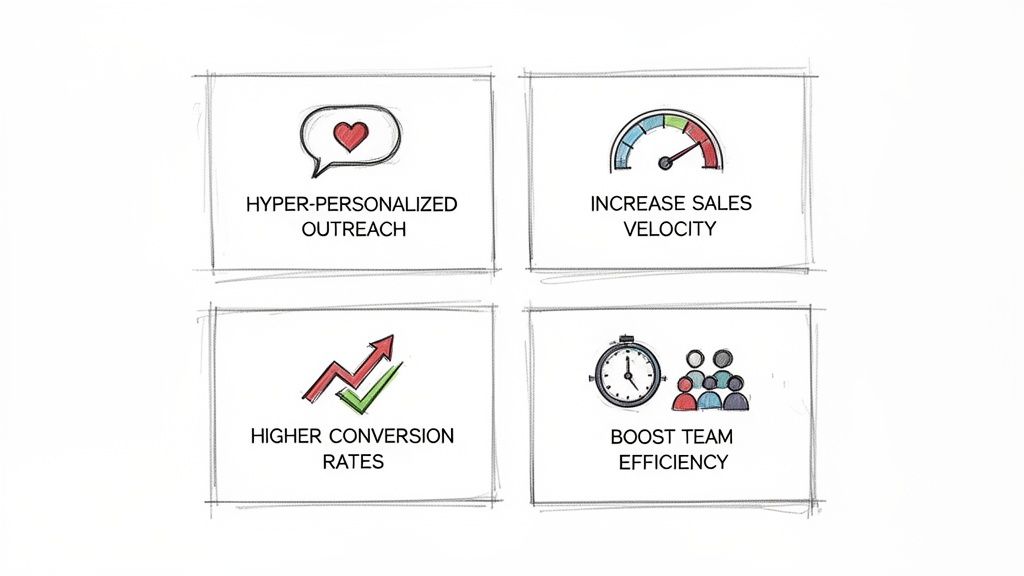
From crafting outreach that feels personal to dramatically speeding up your sales cycle, the impact is undeniable. Let's dive into the four game-changing benefits.
Hyper-Personalized Outreach
Generic email templates are dead. Buyers are bombarded with messages, and personalization is the only way to cut through the noise. Sales intelligence gives your reps the specific, contextual details they need to craft outreach that genuinely connects.
Instead of a tired, generic "I saw you're the VP of Marketing," your team can lead with something that shows they've actually done their homework.
Picture this:
"Hi [Prospect Name], I saw your company just secured Series B funding to expand into the APAC region—congratulations! As you scale your team, I imagine you'll be looking for a more efficient way to manage your new SDRs. We helped [Similar Company] cut their new hire onboarding time by 40% with our platform."
That level of detail instantly elevates the conversation from a cold pitch to a relevant, value-driven discussion. It builds trust from the very first interaction.
Increased Sales Velocity
Sales velocity is just a fancy term for how quickly deals move through your pipeline. The faster you close, the faster you grow. Sales intelligence acts as a powerful accelerator by ensuring your team is always focused on the right activities at the right time.
Here’s how it speeds everything up:
Focus on High-Intent Leads: By tracking buying signals, your reps can prioritize prospects who are actively looking for a solution right now.
Shorter Research Cycles: Reps no longer need to spend hours digging for information. The data they need is served up automatically, freeing them to spend more time actually selling.
Reduced Friction: When outreach is personalized and timely, prospects are way more receptive. This leads to quicker discovery calls and a smoother path to closing the deal.
By zeroing in on the most promising opportunities, you eliminate bottlenecks and can dramatically shorten your sales cycle.
Higher Conversion Rates
A well-informed sales approach naturally leads to more wins. It’s that simple. When your reps are armed with deep insights into a prospect's challenges and goals, they can position your solution as the perfect answer to their specific needs.
This is where AI and big data are really changing the game. The market for these tools is exploding, projected to grow from USD 2.95 billion in 2022 to USD 6.68 billion by 2030. That growth is fueled by the ability to process over 100,000 sources to slash research time and deliver actionable insights. You can discover more insights about these market dynamics from Grand View Research.
Armed with this kind of intel, your team can build stronger business cases and handle objections with confidence, leading directly to higher win rates.
Boosting Team Efficiency
Finally, sales intelligence is a massive productivity booster. It automates the tedious, time-consuming tasks that bog down your sales team, letting them focus on what they do best: building relationships and closing deals.
Think about all the hours your reps burn on manual research—hunting for contact info, looking up company details, and searching for a good conversation starter. Sales intelligence tools do all of this heavy lifting in seconds.
This newfound efficiency means each rep can manage a larger pipeline of high-quality leads without burning out. The result? A happier, more productive team that consistently smashes its targets.
Impact of Sales Intelligence on Key Performance Indicators
Metric | Without Sales Intelligence | With Sales Intelligence | Average Improvement |
|---|---|---|---|
Lead-to-Opportunity Rate | 10-15% | 25-30% | +100-150% |
Average Sales Cycle Length | 90-120 days | 60-75 days | -25-35% |
Quota Attainment | 40-50% of reps | 70-80% of reps | +60-75% |
Time Spent on Research | 6-8 hours/week | 1-2 hours/week | -75-80% |
These figures clearly illustrate that sales intelligence isn't just a "nice-to-have." It's a fundamental shift that directly impacts the most critical drivers of revenue and team performance.
Building Your First Sales Intelligence Workflow
Alright, let's move from theory to action. Building a sales intelligence workflow might sound complex, but it's not. It's about creating a smart, repeatable process that consistently delivers incredible leads to your sales team.
Think of it like building a high-performance engine. You start with the core components, assemble them piece by piece, and fine-tune everything until it runs on its own.
You don't need a Ph.D. in data science for this. It’s about being methodical and following four key steps. This playbook will turn a messy sea of information into a predictable revenue machine. Let's start with the most important step: knowing who you're selling to.
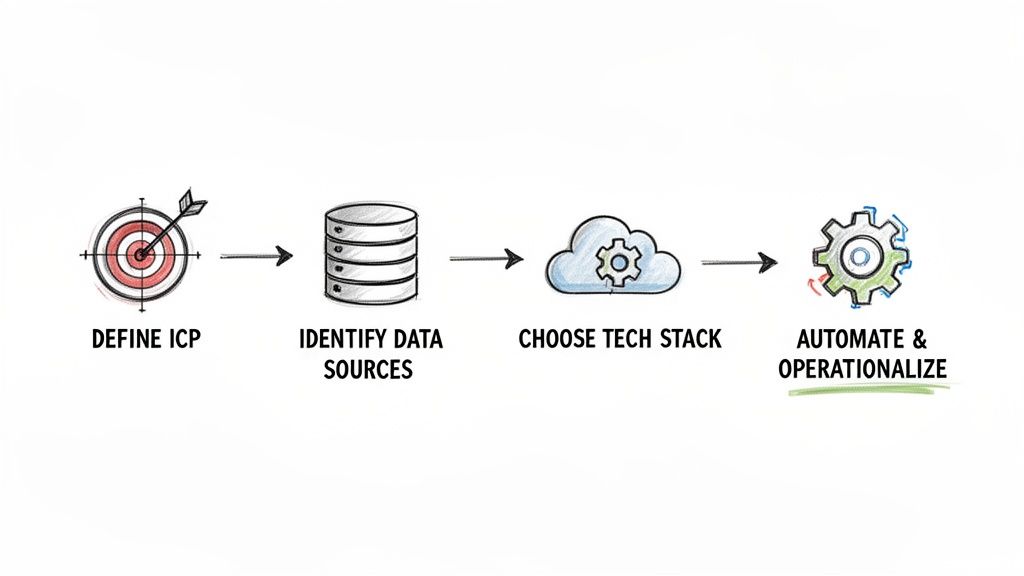
Step 1: Define Your Ideal Customer Profile
Before you even think about data, you need a crystal-clear picture of your perfect customer. This is your Ideal Customer Profile (ICP), and it’s the North Star for your entire sales strategy. Without a solid ICP, you're just throwing darts in the dark.
An ICP isn't just basic demographics. It's a rich story of the kind of company that gets game-changing value from your product.
The best way to build one? Look at your happiest current customers. Dig in and find the common threads:
Industry: Are they all in SaaS? Manufacturing? E-commerce?
Company Size: Do you see a sweet spot, like companies with 50-200 employees?
Revenue: What's their typical annual revenue?
Pain Points: What specific problems does your product solve for them?
Technology Stack: What other software are they already using?
Getting this right ensures your team stops wasting time on dead-end leads and focuses all their firepower on accounts they can win.
Step 2: Identify Your Key Data Sources
Now that your ICP is set, you know what information you're looking for. The next step is figuring out where to find it. The internet is a massive ocean of data, but you need to know where the best fishing spots are.
Put yourself in your customers' shoes. Where do they leave clues about their needs? Your best data sources will likely include:
Professional Networks: LinkedIn and Sales Navigator are goldmines for contact info, job titles, and career moves.
Company Websites: The "About Us" and "Careers" pages are packed with clues about company culture and growth plans.
Industry News: This is where you'll spot trigger events—like a funding round or a new executive hire.
Job Boards: A company suddenly hiring ten new sales reps? That's a massive buying signal that they need tools to support that new team.
Pinpointing these sources first lets you build a focused, efficient data collection plan.
Step 3: Choose Your Technology Stack
You can't build a modern sales intelligence engine by hand. You need the right tools to do the heavy lifting for you. Your tech stack doesn't have to be complicated, but it does need to cover a few critical jobs.
A killer sales intelligence stack usually has three core parts:
A Data Collection Tool: An AI-powered browser scraper is your best friend here. It automates pulling clean, structured data from all the sources you just identified.
A CRM (Customer Relationship Management) System: This is command central. It's where you manage every prospect, and your freshly gathered data needs to flow right into it.
An Engagement Platform: This helps your team run outreach campaigns across email and other channels, using all that rich data to make every message personal.
The real magic of your tech stack is creating a seamless, automated flow of information—from an online signal to a new lead in your CRM—so your reps can stop prospecting and start selling.
These data-driven insights will supercharge how you use your sales pipeline management tools, making your forecasts more accurate and helping you allocate resources more effectively.
Step 4: Automate and Operationalize
This is the final step. It's time to connect the pieces and turn your process into a well-oiled machine. Operationalizing your workflow means making it a repeatable, hands-off system that constantly feeds your sales team high-quality opportunities.
This is all about setting up simple "if-then" triggers. For instance:
If a target company posts a new "VP of Sales" job, then automatically add that company to a high-priority sequence in your CRM.
If a new company fitting your ICP appears in an industry database, then automatically scrape their executives' contact details and create new lead records.
Automation is what unleashes the true power of sales intelligence. It crushes human error, saves hundreds of hours of manual work, and guarantees your sales team is always armed with the freshest data to drive meaningful conversations.
How Sales Intelligence Supercharges Your Entire Revenue Team
Sales intelligence isn't just a tool for reps—it's the connective tissue that makes your entire revenue team smarter and more coordinated. When everyone is working from the same real-time data, it creates a unified engine for growth.
Think of it like a high-performance pit crew in a race. Every member knows exactly what the others are doing because they share the same data. Sales intelligence is that shared telemetry, allowing for seamless handoffs and accelerating your momentum.
Let's look at how this plays out for each key player.
Powering Up Your Sales Development Reps
Your Sales Development Reps (SDRs) live and die by the quality of their leads. This is where sales intelligence completely changes the game. Forget cold-calling from stale, generic lists. SDRs can now build hyper-focused prospect lists based on what's happening right now.
For instance, an SDR gets an alert that a target company just secured Series B funding. That's not just a lead; it's a conversation starter. They can craft an opening line that is perfectly timed and impossible to ignore.
This intel empowers SDRs to:
Pinpoint In-Market Accounts: They can laser-focus on companies that are actively signaling a need for your solution.
Personalize at Scale: Armed with real context, SDRs can ditch the generic templates and make every email and call feel personal.
Book More Meetings: When outreach is this relevant, response rates soar. That means more qualified meetings on the calendar.
Arming Your Account Executives for Success
Once a meeting is set, the baton passes to the Account Executive (AE). For an AE, sales intelligence is like having a cheat sheet for every deal. It helps them map out complex org charts, identify every key player, and understand the internal dynamics.
An AE can use these insights to find not just their initial contact, but the real economic buyer, the technical champion, and even potential blockers. As we break down in our guide on how to generate B2B leads, turning a single point of contact into a network of internal advocates is a game-changer.
With sales intelligence, AEs walk into every call feeling like an insider. They're not just pitching a product; they're presenting a thoughtful solution to a problem they already understand.
Equipping Sales Leaders with Strategic Insight
Sales leaders are steering the ship. They're focused on the big picture: hitting revenue targets, carving up territories, and coaching their team. Sales intelligence gives them the bird's-eye view they need to make brilliant strategic calls.
Instead of relying on a gut feeling, a sales leader can dig into market data to design perfectly balanced sales territories. They can spot market trends—like a competitor making moves in a specific vertical—and pivot their strategy before it's too late. Best of all, they can analyze the data behind both wins and losses to deliver sharp, data-driven coaching that helps people improve.
Fueling Marketing with Account-Based Precision
Finally, don't forget your marketing team. All this rich account and contact data is gold for them. It’s the fuel that powers a high-octane Account-Based Marketing (ABM) engine.
When marketing knows exactly which accounts sales is targeting—and why—they can work in perfect harmony. They can surround those high-value prospects with targeted ads, relevant content, and personalized event invites. This creates a seamless buyer journey where every touchpoint feels connected and designed just for them.
Common Mistakes and How to Avoid Them
Jumping into any new strategy can feel tricky, but knowing where the traps are is half the battle. When it comes to sales intelligence, a few common slip-ups can easily derail even the most well-intentioned teams.
The good news? You can sidestep them completely. Let's break down the three biggest pitfalls and how to steer clear of them.
Relying on Outdated Data
This is, without a doubt, the biggest mistake. Data isn't static—it changes constantly. People switch jobs, companies get acquired, and phone numbers go out of service. Working with old information is like using an old map; you’re going to get lost.
Stale data leads directly to bounced emails, embarrassing calls, and a mountain of wasted time. It torpedoes the very efficiency you’re trying to create.
The fix is simple but non-negotiable: Prioritize continuous data hygiene. Your tools need to be constantly refreshing and verifying information. The best platforms do this automatically, ensuring your team is always working with the freshest intel.
Ignoring Critical Buying Signals
The second major blunder? Collecting incredible data but failing to act on the most important parts—the buying signals. You can have the most detailed prospect profiles imaginable, but if you miss trigger events like new funding rounds or key executive hires, you're leaving money on the table.
Ignoring these signals means you’re always a step behind. You end up sending a generic pitch when you could have kicked off a perfectly timed conversation. It’s the difference between being proactive and just being another noisy salesperson.
Over-Automating Personalization
Finally, there's the trap of letting automation go too far. Sales intelligence tools are amazing for finding the "what," but they can't replace the human "why." Relying too heavily on automated templates makes your outreach feel cold and robotic.
Real personalization isn't just dropping a [Company Name] token into a template. It’s about using the rich context you've gathered to show you’ve done your homework and actually understand your prospect’s world. It’s about connecting the dots in a way only a human can.
Here’s how to find the perfect balance:
Automate the Research: Let your tools do the heavy lifting of finding data and spotting signals.
Humanize the Outreach: Use those insights to craft a short, authentic message that a robot could never write.
By dodging these common mistakes, you'll set your team up to get incredible value from sales intelligence from day one.
Got Questions About Sales Intelligence? We've Got Answers.
Let's tackle a few of the most common questions that come up when teams first explore sales intelligence.
Isn't This Just a Fancy Name for a CRM?
Not at all! Think of it this way: your CRM is your team's memory, and sales intelligence is its eyes and ears on the world.
A CRM is brilliant for managing the relationships you’ve already built. It’s the home for your customer history, notes, and deal stages.
Sales intelligence, on the other hand, is all about discovery. It’s your scout, actively searching the market for new opportunities and digging up deep insights on prospects you don't even know yet. They're a killer combo: sales intelligence finds the opportunities, and your CRM helps you manage them.
How Can I Start If I'm on a Tight Budget?
You don't need a huge budget to get going. The best thing you can do is get really good with a high-quality data collection tool.
For instance, a smart AI-powered web scraper can help you pull incredibly targeted lead lists from places like LinkedIn or niche industry websites. It gives you premium data for a fraction of what big enterprise platforms cost.
The key is to start small and focused. Nail down your ICP and hunt for just one or two powerful buying signals—like a company posting a specific job opening. Build a simple, repeatable process around that, and you'll see a real impact without a massive investment.
How Do I Actually Measure the ROI?
Great question. You absolutely need to prove the value. It comes down to tracking a few core metrics that directly impact revenue.
Here’s what to watch:
Lead Conversion Rate: Are more of the prospects you find turning into qualified opportunities?
Sales Cycle Length: Is your team closing deals faster?
Time Saved on Prospecting: Track the hours your reps get back each week by automating research. That time can now be spent selling.
By measuring these before and after you implement a new tool, you can draw a straight line from your investment to real gains in efficiency and closed deals.
Ready to build a smarter sales workflow? Clura helps you collect and organize web data in one click. Explore prebuilt templates.
