
Unlock competitive pricing with our ultimate guide to Amazon price scraping. Learn the tools and strategies to monitor prices and boost your e-commerce sales.
Welcome to the new frontier of e-commerce strategy! In a marketplace as massive and fast-paced as Amazon, manually tracking competitor prices is a losing battle. This is where Amazon price scraping stops being a technical chore and becomes your biggest competitive advantage.
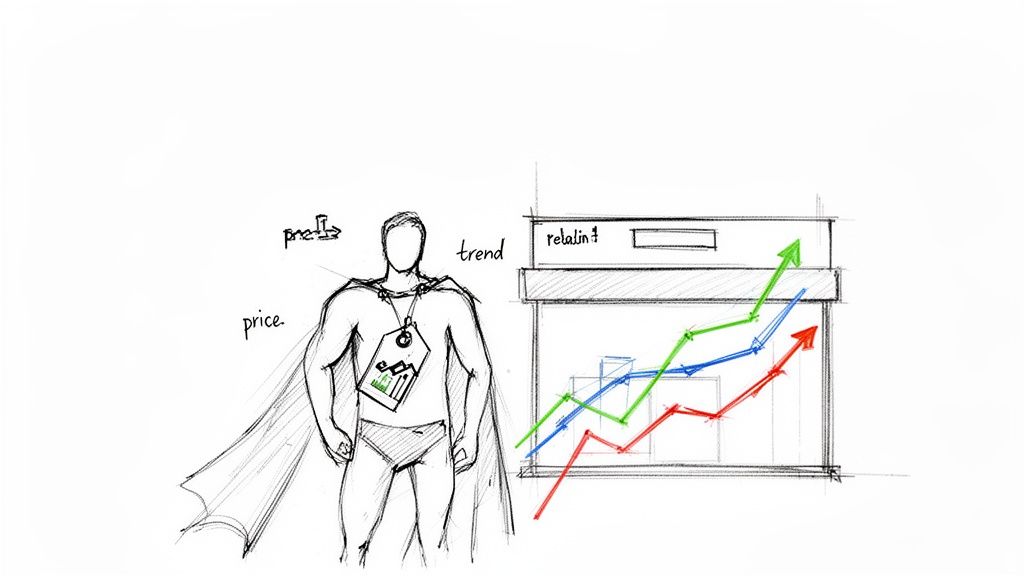
Why Amazon Price Scraping Is Your E-Commerce Superpower
Imagine the Amazon marketplace as a giant, ever-changing ocean of data. To succeed, you need more than a great product; you need to make smarter, faster decisions than everyone else. Clicking through a few competitor listings every day? That’s slow, wildly inefficient, and simply won't cut it.
Amazon price scraping automates this entire process, giving you a live, up-to-the-minute view of the market. It's your secret weapon for making data-backed moves that directly boost your bottom line. With this kind of automated intelligence, you suddenly have the power to:
Perfect Your Pricing Strategy: Adjust your prices on the fly to match market conditions, protecting your profit margins while keeping sales strong.
Outsmart Your Competition: Get an instant alert when a rival slashes their price, launches a sale, or runs out of stock. This lets you react in minutes, not days.
Spot Market Trends Early: Identify pricing patterns and popular new products before they take off, giving you a massive head start.
Understanding the Scale of Amazon
The need for automation becomes clear when you look at the numbers. In 2024, Amazon's net sales soared to $638 billion, and the platform now commands over 40% of all U.S. e-commerce sales. On a battlefield this huge, real-time price intelligence isn't just nice to have—it's essential.
This intense competition means prices can fluctuate multiple times a day. Without an automated system tracking these changes, you're flying blind and basing critical business decisions on outdated information.
From Complex Code to Simple Clicks
Not long ago, scraping was a job for developers. Today, AI-powered tools have made this technology accessible to everyone, turning a complex coding project into a simple, automated workflow. You can get started without writing a single line of code.
This shift gives sellers and brands of all sizes access to the same powerful data that was once reserved for large corporations. By collecting accurate price data, you can also get much better at understanding which products customers actually want to buy.
The goal isn't just to collect data—it's to turn that data into smart, actionable insights. Automated price scraping gives you the clarity to set the perfect price at the perfect time.
For a deeper dive into the technical details and broader strategies, check out this a comprehensive guide to Amazon price scraping.
Choosing Your Amazon Price Scraping Tool
Alright, let's get to the fun part—choosing your tool for scraping Amazon prices. You have a few different options, and the right choice depends on your goals, your timeline, and your comfort level with technology.
Think of it like this: you can build a race car from scratch, lease a high-performance engine, or jump into a ready-to-race go-kart. They all get you around the track, but the experience, cost, and effort are worlds apart.
The DIY Route: Building Your Own Python Scraper
For those who love to code, building a custom scraper in Python is the ultimate power move. Using libraries like Requests to download a webpage's HTML and Beautiful Soup to parse it, you can extract exactly what you need—the price, product title, and more.
Going DIY gives you total control. You decide what to collect and how to format it. But this power comes with responsibility. You're now in charge of everything.
Avoiding Blocks: Amazon has strong defenses. You'll need to rotate proxies and manage user agents to avoid being IP-blocked.
Constant Maintenance: Amazon frequently updates its website structure. A small change can break your scraper, forcing you back to the code for repairs.
Scaling Challenges: Scraping a dozen pages is one thing. Scraping 10,000 products daily requires serious infrastructure to manage without getting shut down.
Building your own scraper is a fantastic project if you have the development skills and time to maintain it. Just know it’s a significant commitment.
The Smart Shortcut: Using a Web Scraping API
What if you want the power of a custom script without the maintenance headaches? A web scraping API is your answer. This is the best approach for any serious, scalable project.
An API (Application Programming Interface) does the hard work for you. You just send it an Amazon product ASIN, and it returns clean, structured JSON data.
All the messy details—managing proxies, solving CAPTCHAs, and adapting to website changes—are handled by the API provider. It’s the perfect balance of control and convenience.
An API gives you the flexibility of a custom scraper without the endless maintenance. It’s a reliable, scalable way to feed real-time Amazon data directly into your applications.
If you're exploring different ways to get this information programmatically, it's worth learning how to get Amazon product data through various channels.
The "Get It Done Now" Method: No-Code Tools
If you need data right now and the idea of code makes you nervous, a no-code tool is your best bet. These are often browser extensions or simple apps designed for business users, not developers.
You just navigate to an Amazon page, click a button, and the tool extracts all the key data into a clean CSV file. It’s that simple.
This method is all about speed and simplicity. It's perfect for:
Sales professionals needing competitor prices for a presentation.
E-commerce owners doing a quick spot-check on key rivals.
Anyone who wants the data without the technical drama.
You trade deep customization for incredible speed. If you're curious about what's available, a guide on the best data extraction software can help you compare top options.
Comparing Amazon Price Scraping Methods
Here's a straightforward look at different price scraping techniques, highlighting their key pros and cons for business users.
Method | Technical Skill Needed | Ongoing Maintenance | Scalability Potential | Ideal for |
|---|---|---|---|---|
DIY Python Scraper | High (Python, HTML/CSS) | High & Constant | Moderate to High (with effort) | Developers & data scientists with time |
Web Scraping API | Low to Moderate (API basics) | None | Very High | Businesses needing reliable, scalable data |
No-Code Tool | None | None | Low to Moderate | Quick, one-off tasks & non-technical users |
Ultimately, the best tool is the one that fits your workflow and helps you get the insights you need with the least friction.
How to Beat Amazon's Anti-Scraping Defenses
Let's be real: Amazon is a fortress. It's incredibly good at spotting and blocking automated scrapers. If you've tried to pull data from more than a handful of pages, you’ve almost certainly hit a CAPTCHA wall or a 503 error page.
But don’t worry—these defenses aren't unbeatable. The trick is to mimic real human behavior, and modern tools have gotten very good at this.
Think of it as a cat-and-mouse game. Amazon’s bots look for robotic patterns, like hundreds of requests coming from the same IP address in a minute. Your mission is to look less like a single robot and more like a crowd of individual shoppers browsing the site.
The Art of Blending In
The secret to successfully scraping Amazon prices is to make your requests look like they came from a real person. Amazon’s anti-bot systems are smart, but they look for a few key giveaways.
Here's what a smart scraper does to stay under the radar:
Rotates IP Addresses: Instead of using the same server IP repeatedly, a professional system uses a pool of residential proxies. These are real IP addresses from actual internet service providers, making your scraper look like a regular person browsing from home.
Manages User Agents: A user agent is a string that tells a website what browser you're using. By cycling through a list of common user agents, you avoid looking like a single script hitting the site on repeat.
Respects Rate Limits: Bombarding the site with requests is the fastest way to get blocked. A well-behaved scraper adds random delays between requests to mimic natural human browsing patterns.
The best approach to scraping Amazon isn't about brute force; it's about finesse. By using rotating residential proxies and varying your digital fingerprint, you can gather data reliably without setting off alarms.
Deciding whether to build your own system or use a ready-made tool often comes down to your technical skills and how quickly you need to start. This decision tree can help you choose the best path.
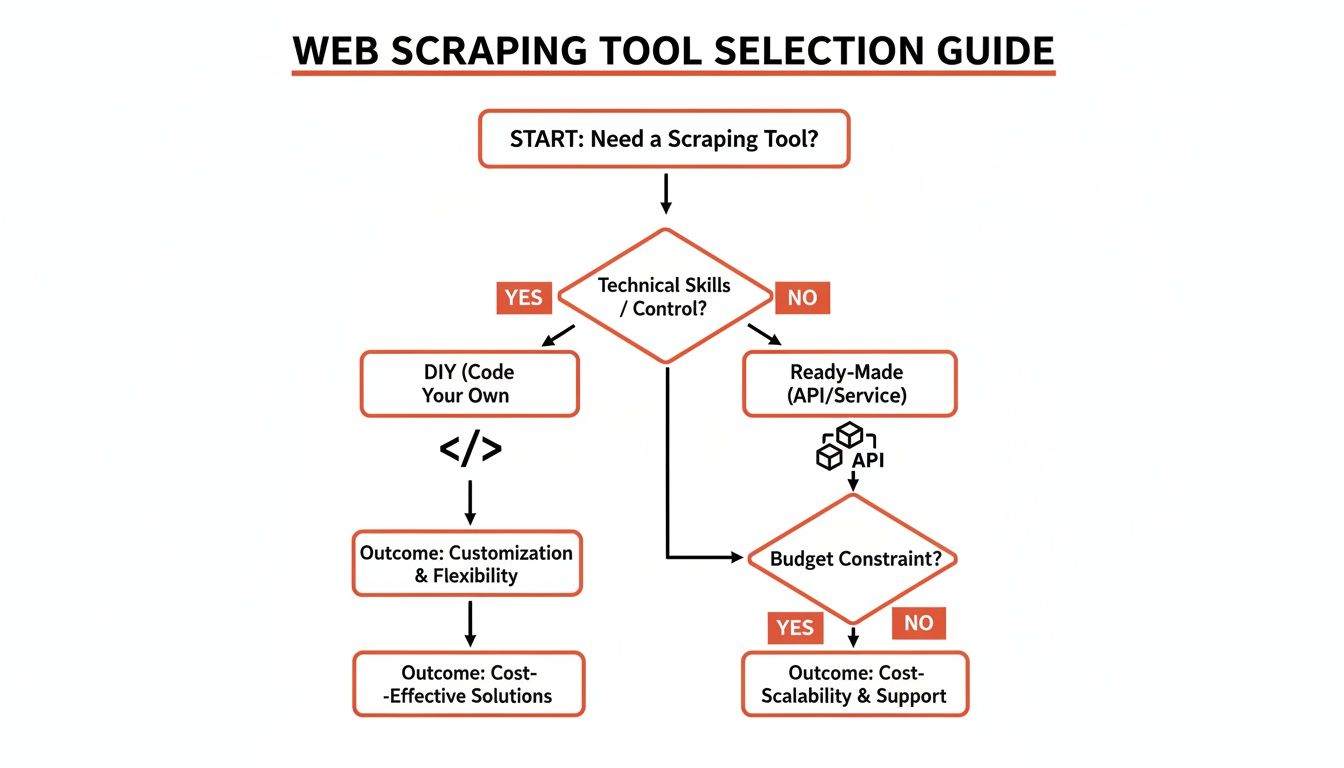
As you can see, while a DIY approach offers total control, solutions like scraping APIs or no-code tools deliver speed and reliability without the technical overhead.
Why Do These Defenses Even Exist?
It’s easy to get frustrated with Amazon’s anti-scraping measures, but they exist for good reasons. These systems are designed to protect the platform from malicious activity.
For instance, they stop:
Server Overload: Aggressive scraping can slow down the website for actual customers.
Content Theft: Bad actors use bots to duplicate product listings for fraudulent sites.
Price Manipulation: Bots can be used to unfairly game pricing algorithms.
By scraping responsibly—using proxies, respecting site limits, and only collecting public data—you operate both ethically and effectively.
Overcoming JavaScript and Dynamic Content
One of the trickiest challenges is content that loads dynamically. Sometimes, the price or stock information you need isn't in the initial HTML. Instead, it’s loaded a moment later by JavaScript. A simple scraper will miss this data completely.
This is where a headless browser comes in. A headless browser is like a real web browser (like Chrome) running invisibly on your server. It can execute JavaScript, wait for all content to load, and then scrape the fully rendered page.
The best part? You probably don't need to manage this yourself. Modern AI-powered scraping tools and APIs handle this automatically. They detect when a page needs to be fully rendered and use a headless browser behind the scenes, ensuring you always get complete, accurate data.
The Hidden Gold Beyond Just the Price Tag
Winning on Amazon isn't just about having the lowest price. If you only focus on that single number, you're missing the bigger picture. A single Amazon product page is a goldmine of competitive intelligence, but only if you know what to look for.
Truly effective Amazon price scraping is about building a complete view of the market. Think of each piece of data as a clue. The price is one clue, but other details reveal your competitor’s entire strategy.
Uncovering the Buy Box Winner
The Buy Box is where over 80% of sales happen, so knowing who owns it for your key products is critical. Scraping this tells you which competitor is in the prime position to get the next sale.
When you track this over time, you start seeing patterns. Maybe one seller always wins the Buy Box on weekends, or another drops their price by a specific amount to claim it. This intelligence helps you build a dynamic pricing strategy to compete for that coveted spot.
Decoding Seller and Shipping Information
Who are you really competing against? Scraping seller information reveals whether you're up against the official brand, a third-party reseller, or an unauthorized seller violating your MAP (Minimum Advertised Price) policy. This is a game-changer for brand protection.
Don't forget shipping. A competitor might have a slightly higher price but offer free two-day shipping, making their total offer more attractive. Scraping this info gives you a true apples-to-apples comparison of what the customer actually pays.
Monitoring Stock Levels and Sales Velocity
Here's a data point most people ignore: stock availability. That "Only 3 left in stock" message is a huge signal. It means a competitor is about to sell out, potentially sending their customers your way.
Then there's the Best Seller Rank (BSR). This number provides a direct look at a product's sales velocity. A product with a BSR of #50 in its category is selling far more than one ranked at #5,000.
Monitoring a competitor's BSR is like having a spy on their sales floor. A sudden drop in their rank (a lower number is better!) could mean they just launched a promotion you need to counter—fast.
Tracking these metrics helps you get ahead of market shifts. You can adjust your inventory and marketing based on your competitors' actions, turning their business signals into your strategic advantage.
The marketplace is also getting smarter. Dynamic pricing on Amazon is evolving, with prices customized by ZIP code, device, and browsing history. Missing a mobile-only deal or a regional discount could be costly.
This is where sophisticated scraping shines. By using Amazon scraping APIs, retailers can power algorithms that respond to minute-by-minute changes. The payoff can be huge, with some businesses seeing 15% profit margin increases just by optimizing their prices.
When you put all these pieces together, you stop being reactive. You're no longer just chasing prices; you're building a solid competitive strategy based on a deep, data-backed understanding of your market.
Your No-Code Workflow for Scraping Amazon Prices
Enough theory—let's walk through how quickly you can start pulling Amazon prices. Forget wrestling with Python scripts. We’re going to use a simple, no-code workflow with an AI-powered browser extension that does the heavy lifting for you.
This approach is for anyone who needs accurate data now, without a steep learning curve. The goal is speed and simplicity. We'll turn a technical task into just a few clicks.
Step 1: Set Up Your Scraping Agent in Seconds
First, you need the right tool. We'll be using Clura, a browser extension designed to make web scraping incredibly easy. Once you add it to your browser, you're ready to go. It understands webpage structures, letting you just point and click on the data you want.
The process is simple:
Go to Amazon: Open your browser and navigate to any Amazon search results or category page. Let's say you’re tracking prices for "Bose headphones."
Activate the extension: With the Amazon page loaded, click the Clura icon in your browser's toolbar. This opens the scraping panel.
Choose a template: The fastest way to start is with a pre-built template. These are designed to instantly recognize key data points on popular sites like Amazon.
Think of a template as a smart recipe. It already knows where to find the product title, price, and rating on an Amazon page, so you don't have to. It's the ultimate shortcut.
Using a template automates most of the setup, ensuring you don't miss anything important.
Step 2: Select Your Data with a Click
Once the Clura panel is open, you’ll see it has identified the products on the page. Now, you decide exactly what information to capture. This is where you can go beyond price to gather rich competitive intelligence.
You’ll see a list of data fields the AI has detected. Simply check the boxes for the info you want.
Common Data Points to Capture:
Product Title: The full name of the item.
Price: The current listed price.
ASIN: Amazon's unique product identifier.
Rating: The average star rating.
Number of Reviews: The total count of customer reviews.
Product URL: A direct link to the product page.
This point-and-click interface gives you full control without ever looking at code. To explore a ready-to-use option, check out our pre-built Amazon Product Listings Scraper.
Step 3: Run the Scraper and Export Your Data
With your data fields selected, you're ready to run the scraper. You can tell the tool how many pages of search results to process—whether it's just the first page or the first ten.
Click "Run," and the AI agent gets to work. It will automatically navigate through each page, pulling the information you specified for every product. You can watch its progress as your data table fills up.
Once it's done, you'll have a structured table right in the extension panel. No more messy copy-pasting.
Here’s an idea of what your final, clean dataset will look like.
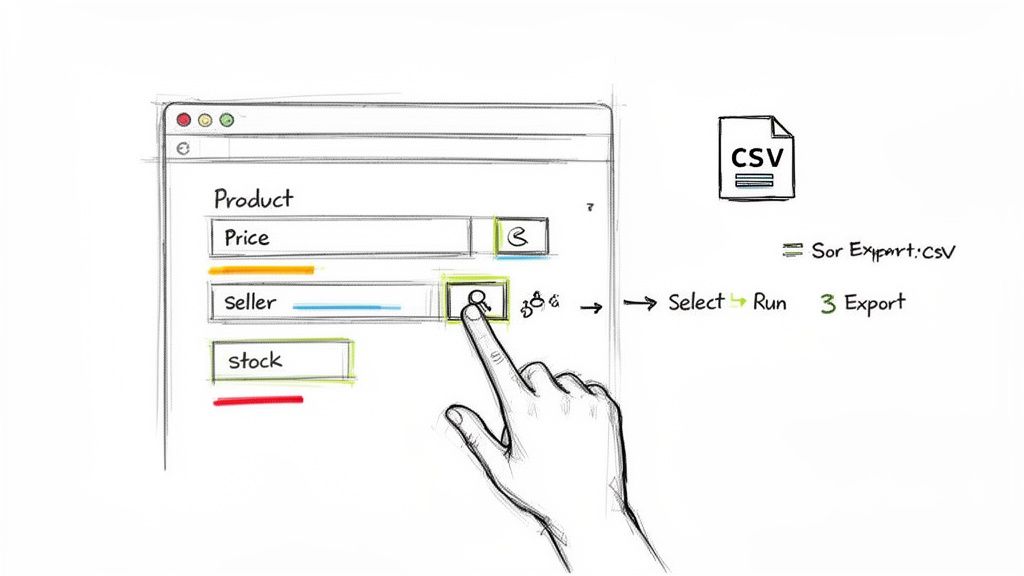
The image shows what you get: clean, organized output ready for analysis.
From here, exporting is just one more click. You can download the entire dataset as a CSV file, which opens in Google Sheets, Excel, or any analytics platform. The data is already clean and perfectly formatted.
This no-code workflow changes the game for Amazon price scraping. It proves you don't need to be a developer to access powerful web data.
Got Questions About Amazon Price Scraping? We've Got Answers
Diving into Amazon price scraping for the first time can bring up a few questions. Let's tackle the most common ones so you can get started with confidence.
Is It Legal to Scrape Prices from Amazon?
Yes, scraping publicly available data—like the prices you see on an Amazon product page—is generally legal. You are automating the process of collecting information that any website visitor can see.
However, you must do it responsibly and respect Amazon's Terms of Service.
Here's how to stay in the clear:
Don't overload their servers. A good scraper sends requests at a reasonable pace, like a human would.
Stick to public data. Price, stock levels, and seller names are fair game. Never scrape personal user data.
Use the data ethically. The goal is market research and competitive analysis, not malicious activity.
Modern scraping tools are designed to gather data responsibly.
The bottom line: Ethical scraping is about collecting public, non-personal data for legitimate business insights. It’s about working smarter, not breaking rules.
How Often Should I Scrape Amazon Prices?
The right frequency depends entirely on your market.
For fast-moving categories like consumer electronics, prices can change multiple times a day. In this case, you might need hourly scraping to catch flash sales or price drops. For more stable categories like books or home goods, a daily check-in is usually sufficient.
Start with a daily scrape. After a week, analyze the data. If prices change frequently, increase the frequency. If they are stable, a daily schedule is fine.
Can I Scrape Prices from Different Amazon Regions?
Absolutely! This is a powerful strategy for global sellers. You can pull pricing data from any of Amazon's regional sites, like Amazon.de for Germany or Amazon.co.jp for Japan.
The trick is to use a good proxy network. A quality scraping tool will let you route your requests through an IP address in the target country. This makes your scraper look like a local shopper, ensuring you see the correct currency, shipping details, and regional pricing.
What’s the Best Format for My Scraped Data?
For versatility and simplicity, CSV (Comma-Separated Values) is the best format. It’s a lightweight, universal file type that works with almost any software.
Once your data is in a CSV file, you can:
Open it in Google Sheets or Microsoft Excel for quick analysis.
Import it into a database for more complex queries.
Feed it into business intelligence tools like Tableau to create visual dashboards.
This flexibility allows you to plug your fresh Amazon data directly into your existing workflows without any hassle.
Ready to stop guessing and start making data-driven decisions? With Clura, you can automate your Amazon price scraping in minutes, no code required. Explore prebuilt templates and see how easy it is to get the competitive insights you need.
Try this workflow today at https://www.clura.ai.
