
Unlock your competitive edge with our guide to online price tracking. Learn to automate data collection, analyze pricing trends, and boost your profits.
Welcome to the wild world of e-commerce, where prices flip in the blink of an eye. If you're still manually checking competitor prices, you’re not just behind—you’re playing a different game. This guide is your ticket to setting up automated online price tracking, a non-negotiable strategy for any brand that wants to lead the pack.
Why Automated Price Tracking Is Your New Secret Weapon
Let's be real: manual price checks are a relic of the past. In a market where your customers can compare a dozen deals with a few taps, you need more than a spreadsheet updated once a week. You need a smart, automated system that feeds you actionable intelligence, not just a list of numbers. It’s all about protecting your margins, understanding your market position, and making decisions that move the needle.
Making the leap from reactive tweaks to proactive strategy has never been more vital. Consider this: nearly 90% of online shoppers compare prices before they hit "buy." Even a tiny price difference of 5% can send them straight to a competitor.
The proof is in the numbers. Retailers using real-time price tracking see revenue boosts between 3% and 8% and margin improvements of 1% to 4%. It's a game-changer.
Look Beyond the Price Tag
Effective online price tracking isn’t just about knowing who’s a dollar cheaper. It's about building a 360-degree view of the competitive landscape. A good automated system pulls in all the crucial data points that manual checks miss, giving you the full story behind every price.
You can gather intel on:
Historical Pricing: Spot seasonal trends and promotional patterns to predict your competitor's next move.
Stock Levels: Is a rival running low on a bestseller? That's your cue to capture their customers.
Shipping Costs & Times: The final cart price is what matters. Factor in the total cost to the consumer, which is a massive driver of purchase decisions.
Active Promotions: Keep an eye on BOGO offers, bundled deals, and flash sales to understand their discount strategy.
With this rich data, you're no longer playing a race-to-the-bottom pricing game. You can hold your price with confidence when you know a competitor’s shipping takes a week longer or strategically launch a promo the moment a rival's inventory runs dry.
The Power of Real-Time Data
The speed of e-commerce is relentless, and your data needs to keep up. A huge part of what makes automated price tracking so powerful is explained in a practical guide to real-time data streaming. On major marketplaces, prices can change multiple times a day. A price you noted yesterday is ancient history by this afternoon.
Automated tools work 24/7, catching every fluctuation as it happens. This gives you the incredible ability to respond to market shifts on the fly, adjust your own prices dynamically, and lock in your competitive advantage without lifting a finger.
Let's Build Your First Price Tracking Workflow
Alright, time to roll up your sleeves. With the right tools, you can create a price tracking engine that delivers incredible insights without writing a single line of code. It all starts with a crystal-clear mission.
Before you collect any data, you need to know exactly what you're trying to achieve. A focused goal is your best defense against drowning in irrelevant numbers and ensures every piece of information you gather serves a purpose.
So, what’s the most pressing need for your business? Are you trying to watch a handful of key competitors or get a bird's-eye view of the entire market?
Step 1: Nail Down Your Primary Goal
Your main objective is the North Star for your entire project. It dictates everything that follows, from the websites you target to the specific data you extract. Getting this right ties your efforts directly to business outcomes.
Here are a few common goals to get you started:
Competitive Intelligence: Monitor the prices of your top 3-5 direct competitors for your most important products.
MAP Compliance: Ensure your third-party retailers are sticking to your Minimum Advertised Price (MAP) policy to protect your brand's value.
Market Trend Analysis: Look for bigger-picture pricing patterns across a whole product category to spot opportunities or threats.
Dynamic Pricing: Feed real-time price data into your own pricing engine to adjust your prices automatically based on market activity.
Once you’ve locked in your primary goal, the next part becomes much easier.
Step 2: Pinpoint Your Targets and Key Data Points
With your mission defined, it’s time to get specific. Who and what are you tracking? Make a concrete list of the websites—and even the exact product pages—you want to monitor. For example, if you're tracking a competitor's new running shoe, you'll want the URLs for that shoe on their main site, Amazon, and any other major retailer they use.
Next, decide exactly what information you need from each page. The price is a given, but other details provide the context needed to make smart moves.
Your data shopping list should include:
Product Price: The current listed price.
Stock Availability: Is the item in stock, running low, or sold out?
Shipping Costs: What’s the standard shipping fee? Is there a free shipping option?
Customer Rating: The average star rating gives you a quick pulse on customer sentiment.
Number of Reviews: A high number of reviews often signals a bestseller.
Creating this curated list keeps your workflow lean, efficient, and focused only on the information that helps you hit your goal.
Step 3: Unleash Your AI-Powered Scraping Agent
Now for the fun part: automating the data collection. This is where AI-powered browser automation tools shine. Think of them as a brilliant assistant that can visit any website, find the exact data you need, and pull it out with perfect accuracy, every time. And no, you don't need to be a developer—you just have to show the tool what you want.
Setting up your first agent is surprisingly simple. You just go to one of your target product pages and use a point-and-click interface to "teach" the agent where the price is, where the stock status is, and so on. The AI is smart enough to learn the page's structure and identify those elements on its own. If this is all new to you, our guide on how to scrape a website is a fantastic place to start.
From there, the agent can repeat this process across thousands of similar pages, even if their layouts aren't identical. That’s the magic of modern web scraping—it's intelligent, resilient, and built for everyone.
Choosing the Right Tools for the Job
You’ve mapped out your price tracking mission. Now comes the fun part: picking your tools. The market is flooded with options, from simple browser plugins to full-blown custom scripts. Making the wrong call here can mean hours of frustration and a project that’s dead on arrival.
You need something that gracefully handles today’s dynamic websites and won't buckle as you track more products. This is where AI-powered browser automation tools have become game-changers, offering a fantastic blend of simplicity and serious horsepower.
Let's walk through the main options.
A Quick Tour of Price Tracking Methods
Not all tools are built the same. Some are perfect for a quick spot-check, while others are designed for massive, enterprise-level surveillance. Knowing the difference is key.
Browser Extensions: These are lightweight, easy to install, and great for personal shopping. For business, they lack the automation or scheduling features you need.
No-Code Web Scrapers: This is where the magic is happening. Tools like Clura use AI to let you build powerful data collectors with a simple point-and-click interface. No coding, no fuss. They’re built to scale and can handle tricky websites.
Custom Scripts (Python/Node.js): Building your own scraper gives you ultimate control but requires a dev team and constant maintenance to fight anti-scraping tech.
Pricing APIs: Some companies sell pricing data through an API. This can be a hassle-free option if they cover your exact market, but you’re limited to what they offer.
If you want to go deeper, we've put together a guide on the best data extraction software available today.
No matter which path you take, the core process is always the same.
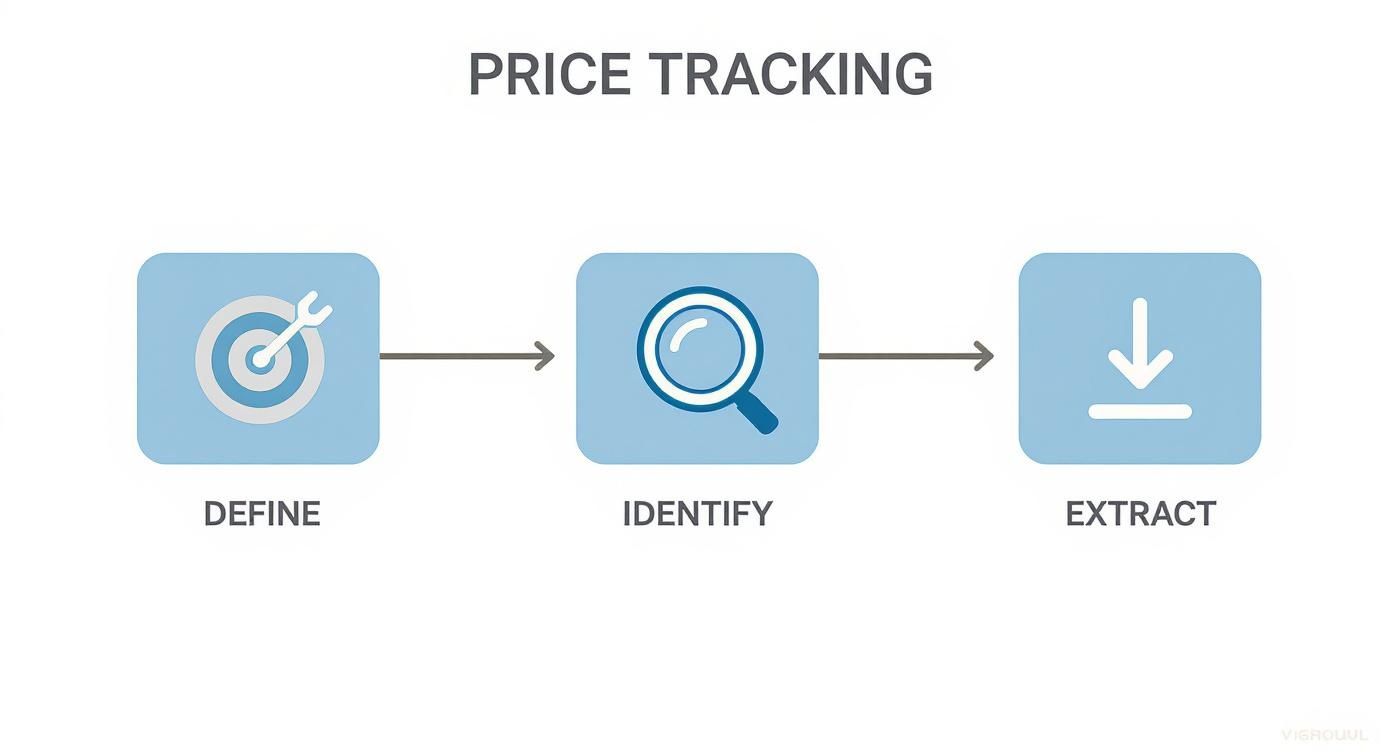
It boils down to three simple steps: Define your target, Identify the data, and Extract the goods. This is the foundation of any solid strategy.
Making the Right Choice for Your Business
So, how do you decide? The best tool fits your goals, your team's tech skills, and your budget.
For 90% of businesses, a no-code, AI-powered browser automation tool is the smartest bet. It removes the coding barrier, which means your marketing manager, a sales analyst, or anyone on the team can build and manage their own price tracking workflows. You get all the power of a custom solution without the overhead.
As you compare platforms, look for those that do more than just scrape prices. Many now include AI-powered competitor analysis tools, which can turn raw pricing data into a real strategic advantage.
Ultimately, you need something that delivers clean, reliable data, on time, every time. Choose a solution that empowers you to act on insights quickly and confidently—that's the real goal.
Putting Your Price Monitoring on Autopilot
You've collected your first batch of pricing data. That's a fantastic start, but a single snapshot only tells part of the story. The real magic happens when you turn that snapshot into a live, continuous feed of market intelligence. This is where we build a fully automated system that works for you 24/7.
Let's put your price tracking on autopilot.

Manual data pulls are slow and prone to human error. An automated workflow runs on a schedule that matches the speed of your market. This is the difference between looking at old photos and watching a live video of your competitive landscape.
Set a Schedule That Matches Market Speed
First, decide how often your scraping agent should run. The right frequency depends entirely on your industry and your goals.
Think about how fast prices change in your market.
Hourly: Essential for hyper-competitive niches like consumer electronics, especially during sales events like Prime Day. This lets you react to competitor price cuts almost instantly.
Daily: This is the sweet spot for most e-commerce businesses. A daily check-in is perfect for monitoring main rivals, tracking promotions, and checking stock levels.
Weekly: A great option for industries with slower pricing cycles, like B2B equipment or high-ticket goods. It helps you spot broader trends without getting lost in daily noise.
Modern browser automation tools make scheduling a breeze. You can set your agent to run at a specific time every day, once a week, or even every 15 minutes with just a few clicks. If you're new to the concept, our guide on how to automate data extraction is a great place to start.
Create Smart Alerts for Instant Notifications
Scheduled data collection is powerful, but automated alerts are a game-changer. This turns your static spreadsheet into a proactive intelligence engine. Instead of you checking a report, the system tells you the moment something important happens.
Imagine getting an instant email or Slack notification when:
A competitor's price for your top-selling product drops by more than 5%.
A key rival's flagship item goes out of stock.
A reseller violates your MAP policy.
A new product appears in a competitor's "new arrivals" section.
These alerts give you a massive leg up. You can react to market shifts in minutes, not days, making strategic moves while your competitors are still sifting through old data.
The global market for price comparison websites—a huge driver of this trend—was valued at around USD 30.34 billion in 2025 and is projected to hit USD 61.4 billion by 2035. This growth shows how much shoppers and businesses rely on timely pricing data. You can discover more about this market growth on businessresearchinsights.com.
Building Your Automated Notification System
Setting up alerts is usually straightforward inside a no-code tool. You'll create simple "if-then" rules based on the data your agent collects. It's like programming without writing code.
For example, a rule might look like this:
Trigger: IF the
pricefield for "Product A" onCompetitorX.comCondition: IS LESS THAN
your_priceby 10%Action: THEN send an email to
your-team@yourcompany.comwith the subject "Urgent Price Drop Alert!"
This level of automation means you're no longer hunting for insights—the insights are coming to you. You get peace of mind knowing your system is constantly watching your back, ready to flag anything critical the second it happens.
Turning Raw Numbers Into Winning Strategies
You’ve got data collection running on autopilot. That's a huge win! But right now, all you have is a pile of numbers. The magic happens when you transform that raw information into a competitive edge that drives business decisions.

The journey from a spreadsheet full of data to a winning game plan starts with one step you can't skip: cleaning your data. If you gloss over this, every chart you build will be built on a house of cards.
First, Tidy Up Your Data (Normalization is Key)
Scraped web data is almost always messy. It’s littered with currency symbols ($, €), commas, and weird formatting that will derail your analysis.
This is where normalization comes in. Think of it as creating a universal language for your data, translating everything into a single, consistent format that your analytics tools can understand.
It boils down to a few critical actions:
Ditch the Symbols: Turn
$199.99into a clean number like199.99.Standardize Formats: Make sure every date looks the same (e.g.,
YYYY-MM-DD).Handle Blanks: Decide what to do with missing values. Mark them
N/A, or fill them with a0? Be consistent.Unify Text: Ensure terms like "Out of Stock" and "Sold Out" are treated as the same thing in your system.
Most modern data tools—even a trusty Google Sheets spreadsheet—have built-in functions to make this cleanup easy. A little time spent here will save you a world of headaches.
Bring Your Data to Life with Visuals
Once your data is clean, it’s time to make it tell a story. Staring at rows of numbers is a great way to miss the bigger picture. Data visualization turns those numbers into patterns and insights you can spot in a heartbeat.
Your new command center is a dynamic dashboard. Whether you build it in Google Sheets, a powerful tool like Tableau, or another BI platform, this is where you’ll spot trends, decode competitor strategies, and uncover opportunities.
Even a simple line chart can be incredibly revealing. Imagine plotting your product's price against your top competitor's over the last 30 days. Suddenly, you can see exactly how they react to your promotions or pinpoint when they launch their own sales.
From Insights to Action: Making Data-Driven Moves
With clean data and clear visualizations, you can finally make decisions that move the needle. You're no longer guessing what your competitors are up to—you're seeing their playbook and anticipating their next move.
Here are a few powerful strategies you can put into action right away:
Make Smarter Price Adjustments: Instead of blindly matching a competitor’s price drop, make a calculated move. If your data shows their stock is low, maybe you hold your price steady and scoop up customers who can't wait.
Optimize Your Promo Timing: Did you spot a pattern where a rival always runs a 15% off sale during the last week of the month? Launch your own targeted offer a few days earlier and capture those sales.
Get Creative with Bundles: If a competitor is consistently undercutting you on a product, don't get drawn into a price war. Instead, bundle that item with a high-margin accessory to create a unique offer they can't easily replicate.
Enforce MAP Compliance: Your dashboard can act as a watchdog, flagging any retailers violating your pricing policies. This lets you take swift action to protect your brand's value.
This is the end game of online price tracking. It’s not about hoarding data; it's about turning that data into a playbook that helps you outsmart the competition, protect your margins, and build a stronger business.
Getting Around Common Price Tracking Roadblocks
Let's be honest: even the best plans for automated price tracking can go sideways. The web is a wild place, and websites can throw serious curveballs. But don't sweat it. With a little foresight, you can build a system that’s not just powerful, but also tough as nails.
This is your playbook for building a price tracking engine that won't quit.
Dodging Anti-Scraping Defenses
The single biggest hurdle? Websites don't exactly roll out the red carpet for bots. They use everything from CAPTCHAs to sophisticated IP blocking that can shut down your agent completely. Trying to muscle your way through is a battle you'll lose.
The trick is to make your agent act more like a human and less like a bot.
Rotate Your Proxies: A proxy server acts as a middleman that masks your real IP address. By rotating through a pool of proxies, you make it incredibly difficult for a website to figure out that all the requests are coming from you.
Be Smart with Scheduling: Don't bombard a site with hundreds of requests in seconds—that’s a dead giveaway. Instead, set your agent to run at random, staggered intervals. This "low and slow" approach mimics human browsing and helps you fly under the radar.
Mastering these two tactics will solve 90% of your access problems and keep your data flowing.
Handling Websites That Constantly Change
Modern websites are anything but static. E-commerce platforms are always testing new layouts and shuffling elements around. This is a nightmare for a rigid, old-school scraper, which can break the second the price element it’s looking for moves.
This is where AI-powered tools change the game. An intelligent agent doesn't just hunt for a specific snippet of code. It understands the context of the page. It knows what a price looks like, so it can find it even if it moves or the formatting changes. That adaptability is what separates a short-term fix from a long-term solution.
Keeping Your Data Squeaky Clean and Accurate
Nothing is more frustrating than pulling in "dirty data." This happens when your agent grabs the wrong thing by mistake—like scraping a temporary sale price instead of the regular list price. Garbage in, garbage out.
The best defense is a good offense. Build resilience into your scraping logic from the start.
Set Specific Rules: You can tell your agent to look for the "list price" and to specifically ignore anything labeled "sale" or "clearance."
Add Validation Checkpoints: After the data comes in, run a quick sanity check. If a price for an item that’s always been around $500 suddenly shows up as $5, your system can automatically flag it for a human to review.
By thinking ahead, you can build a system that’s not only powerful but also incredibly reliable. Try this workflow today.
Explore our prebuilt templates.
